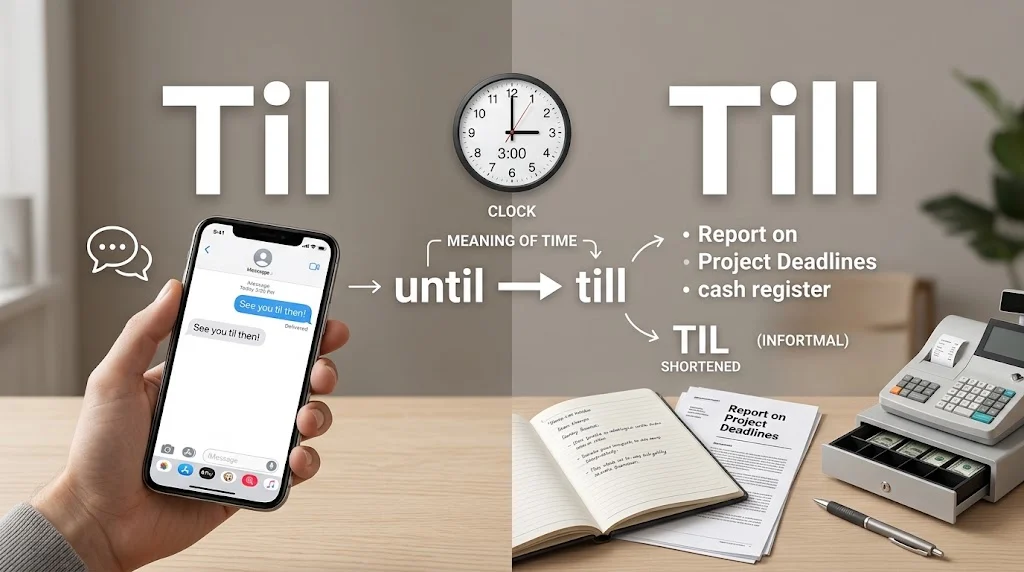
Till is the standard and widely accepted word meaning “up to the time when” or “until.” Til is also used, especially in informal writing, but it is generally considered a shortened form of “until” and is less appropriate in formal contexts. In most professional, academic, and edited writing, till or until is the safer choice.
The question til or till causes confusion because the two forms look almost identical but have different levels of acceptance in modern English. Till is a fully established word that can function as a conjunction, preposition, or noun, while til is commonly used as an informal shortening of “until.” This distinction matters when writing emails, essays, workplace documents, captions, and other content where spelling and register affect credibility. From a language perspective, the interesting fact is that till is not simply an incorrect version of until. In fact, till has a long history in English and predates the modern shortened form “until.” Understanding that history makes the usage difference much easier to remember.
Til vs Till: What’s the Difference?
At first glance, til and till appear to be spelling variations of the same word. In everyday communication, they can perform essentially the same function when they mean “until.” However, their status in standard English is not identical.
Till is a standard English word. It can mean up to a particular time or point.
For example:
We stayed there till midnight.
Til is commonly encountered as an informal abbreviation or shortened spelling of “until.”
For example:
I’ll wait til you arrive.
Although many readers understand this immediately, edited writing generally favors until or till.
| Feature | Til | Till |
| Part of speech | Usually conjunction or preposition when used as a shortened form of until | Conjunction or preposition |
| Meaning | Until | Until, or a cash register depending on context |
| Standard usage | Informal | Standard |
| Formal writing | Usually avoided | Acceptable |
| Academic writing | Usually avoided | Acceptable |
| Pronunciation | Usually pronounced like till | Usually pronounced like till |
| Other meaning | No common separate meaning | A cash register or money drawer |
There is one especially important point: till has another completely unrelated meaning.
In British English and other varieties, a till can mean a cash register or the drawer where money is kept.
The cashier opened the till.
So context determines which meaning is intended.
Mini Recap
Till is a standard English word meaning “until.”
Til is commonly used as an informal shortening of “until.”
For formal writing, choose till or until rather than til.
Till can also mean a cash register or money drawer.
Til or Till: Is This a Grammar, Vocabulary, or Usage Issue?
The distinction between til and till is primarily a spelling and usage issue rather than a complicated grammar rule.
Both forms can appear in positions where “until” would normally occur. The main difference is the level of formality and standard acceptance.
Consider these examples:
I’ll stay till Friday.
I’ll stay until Friday.
Both are standard.
Now compare:
I’ll stay til Friday.
This sentence is easily understood, but til gives the sentence a more informal appearance.
Are Til and Till Interchangeable?
In casual communication, they can be functionally interchangeable when the intended meaning is “until.”
However, that doesn’t mean they are equally suitable in every context.
If you’re writing a university assignment, business report, formal email, application, or professional article, till or until is preferable.
If you’re writing a text message, social media caption, casual note, or conversational dialogue, til may be acceptable depending on your audience and style.
Formal vs Informal Usage
Until is the safest option when you want a completely neutral and formal tone.
Till is also standard and can be used in formal writing, although some writers prefer “until” because it sounds slightly more formal.
Til has a distinctly informal appearance and is best reserved for contexts where conversational language is appropriate.
Academic vs Casual Usage
Academic writing normally favors until or till.
Casual writing allows more flexibility, so til may appear naturally.
For example:
The experiment continued until the temperature stabilized.
This is appropriate for academic writing.
A casual message might say:
Wait til I get home.
The second sentence sounds conversational rather than academic.
How to Use Til Correctly
Although til is not the preferred form in formal edited English, it appears frequently in informal communication.
Its main function is to represent a shortened form of until.
Workplace Example
Imagine a coworker sending a quick message:
I’ll be in the office til 6.
The meaning is perfectly clear. However, if this sentence appears in a formal company announcement, a better version would be:
I’ll be in the office until 6.
Academic Example
In an academic paper, you would normally avoid:
The participants waited til the test began.
Instead, write:
The participants waited until the test began.
The issue isn’t that the original sentence is impossible to understand. It simply uses a form that is less appropriate for formal academic prose.
Technology Example
Informal technology communication might contain:
The system will remain offline til midnight.
A polished technical notice would more naturally say:
The system will remain offline until midnight.
Usage Recap
Use til mainly in informal contexts.
It works well when you intentionally want a conversational tone.
For professional, academic, and polished digital content, until is usually the stronger choice.
How to Use Till Correctly
Till is a standard English word and can replace until in many sentences.
We waited till the rain stopped.
The store is open till 9 p.m.
She worked till midnight.
There is no grammatical problem with these sentences.
Workplace Example
The office will remain open till 7 p.m.
This is grammatically correct. However, a formal company announcement might choose:
The office will remain open until 7 p.m.
Both are acceptable, but “until” can sound slightly more formal.
Academic Example
The researchers continued the observation till the end of the study.
This is grammatically possible, although until may be more natural in highly formal academic prose:
The researchers continued the observation until the end of the study.
Technology Example
Keep the application open till the update finishes.
This works naturally in instructions intended for general users.
Usage Recap
Till is a legitimate standard English word.
It can mean “until” when used with a time or event.
It can also mean a cash register, so context matters.
When You Should NOT Use Til or Till
Choosing between these forms becomes easier when you know which situations require extra care.
- Do not use til in formal academic assignments. Choose until or, where appropriate, till.
- Do not use til in professional documents when standard edited English is expected.
- Do not assume till is incorrect simply because until is more common in formal writing. Till is a legitimate English word.
- Do not use til when you are trying to create a polished or highly authoritative tone.
- Do not confuse till meaning “until” with till meaning “cash register.”
- Do not assume that adding an extra letter automatically makes a word more formal. Till and until have different histories and usage patterns.
- Do not replace every instance of till with until automatically. Till is perfectly acceptable in many contexts.
- Do not treat til as a completely separate grammatical concept. In most contexts, it is simply an informal shortened representation of until.
Common Mistakes and Decision Rules
| Correct sentence | Incorrect or less suitable sentence | Explanation |
| I’ll wait till noon. | I’ll wait til noon. | Til is understandable but informal. |
| We stayed until midnight. | We stayed til midnight. | Until is more suitable for formal writing. |
| The shop is open till 10. | The shop is open til 10. | Till is standard English. |
| The cashier opened the till. | The cashier opened the until. | Here till means a cash register, not until. |
| Please remain seated until the announcement ends. | Please remain seated til the announcement ends. | Until fits the formal instruction better. |
Decision Rule Box
If you mean “up to a particular time or event,” use until or till in standard writing.
If you are writing informally and intentionally using a shortened conversational form, til may be acceptable.
If you mean a cash register or money drawer, use till.
This simple rule eliminates most errors.
Til and Till in Modern Technology and AI Tools
Digital communication has made informal spelling more visible than ever.
Text messages, social media posts, chat applications, online comments, and instant messaging often favor shorter forms because users prioritize speed and conversational tone. As a result, til appears regularly in informal digital communication.
AI writing tools also encounter both forms. An AI system may recognize “til” from conversational language while recommending “until” when asked to make a sentence more formal.
For content creators, the important lesson is not to judge a word only by whether it appears in online communication. Search engines and language models encounter enormous amounts of informal writing. A word can therefore be common online without being the best choice for formal editorial content.
For professional SEO content, until is usually the safest option when there is no reason to use the more conversational til or till.
Etymology: Why Till Is Not Simply a Misspelling
One of the most interesting facts about this topic is that till is historically older than until.
The word till has been used in English for centuries to express the idea of “up to the time of.” The word until developed with the addition of the prefix associated with the concept of “up to” or “as far as.”
This historical relationship explains why the idea that “till is wrong and until is right” is misleading.
Till is an established English word in its own right.
A useful expert style observation is:
“Till is a standard word, while til is chiefly an informal shortening.”
That distinction captures the practical difference without suggesting that till is an error.
Two Practical Case Studies
Case Study 1: Professional Communication
Suppose a company posts this announcement:
The customer support system will be unavailable til 11 p.m.
Readers will understand the message immediately.
However, the communications team changes it to:
The customer support system will be unavailable until 11 p.m.
Result: The revised version sounds more polished and appropriate for an official announcement while preserving exactly the same meaning.
The improvement is stylistic rather than grammatical.
Case Study 2: Casual Social Communication
Now imagine a friend sending:
I’m not leaving til you get here.
Changing it to:
I’m not leaving until you get here.
is grammatically fine, but the original feels more conversational.
Result: The informal spelling supports the casual tone without creating a meaningful comprehension problem.
These examples show why context matters more than simply labeling one form right and the other wrong.
Authoritative Usage Guidance
The safest approach is to distinguish standard vocabulary from informal spelling.
Till belongs to standard English and can be used as a conjunction or preposition meaning “until.” It also has an independent noun meaning a cash register or money drawer.
Til, by contrast, is generally encountered as an informal shortening of until. Its widespread use does not necessarily make it the best choice for formal edited prose.
Professional writers should therefore consider the audience, publication standards, and intended tone before choosing between the forms.
Error Prevention Checklist
Always use Till when
- You mean “until” and want a standard English form.
- You are writing in a neutral or moderately formal style.
- You are using the word as a standard conjunction or preposition.
- You mean a cash register or money drawer.
Never use Til when
- You are writing a formal academic paper.
- You are preparing a professional report or official announcement.
- You want your wording to follow conservative editorial standards.
- You are unsure whether your audience accepts informal shortened forms.
- You can use “until” without changing the intended tone.
Related Grammar Confusions You Should Master
English contains many pairs and groups that look similar but differ in meaning, spelling, or usage. Once you understand til or till, these related topics are worth studying:
- Until or till: When each standard form is appropriate.
- Everyday or every day: Adjective versus time expression.
- Advice or advise: Noun versus verb.
- Affect or effect: Two frequently confused words with different functions.
- Then or than: Time sequence versus comparison.
- Your or you’re: Possessive determiner versus contraction.
- Its or it’s: Possessive form versus contraction.
- There, their, or they’re: Location, possession, and contraction.
- Who or whom: Pronoun choice in formal English.
- Further or farther: Figurative and physical distance.
Mastering these distinctions improves both grammatical accuracy and writing credibility.
FAQs
Is til or till correct?
Both can be encountered in English, but they do not have exactly the same status. Till is a standard English word meaning “until,” while til is generally an informal shortened form of “until.”
Is til a real word?
Til is widely used in informal writing as a shortened form of until. However, writers should generally choose until or till in formal and professionally edited content.
Is till grammatically correct?
Yes. Till is a grammatically correct and established English word. It can function as a conjunction or preposition meaning “until.”
Is till more correct than until?
Neither is inherently more grammatically correct. Both are standard. Until is often preferred in formal writing, while till is completely acceptable in many contexts.
Is til acceptable in formal writing?
Usually, it is better to avoid til in formal writing. Until is the safest choice, while till is also standard and acceptable depending on the style guide and context.
Should I use till or until in an essay?
Until is generally the safest choice for an academic essay because it has a neutral and formal tone. Till is also grammatically correct, but individual academic style guides may favor until.
Is till informal English?
Till is not merely an informal word. It is an established standard English word. However, until may sound slightly more formal in some contexts.
Conclusion
The answer to til or till becomes straightforward once you separate standard English from informal spelling. Till is a legitimate standard word meaning “until,” and it has been part of English for centuries. Til is commonly used as an informal shortened form of “until,” especially in casual digital communication.
For formal writing, academic work, professional communication until is generally the safest choice. If you want a shorter standard form, till is perfectly acceptable. Reserve til for informal contexts where conversational style is intentional.

Margaret Atwood is an American writer who contributes to LingRoya.com creating clear and engaging content about the English language and everyday communication. She enjoys helping readers build confidence in their writing through simple, practical guidance.