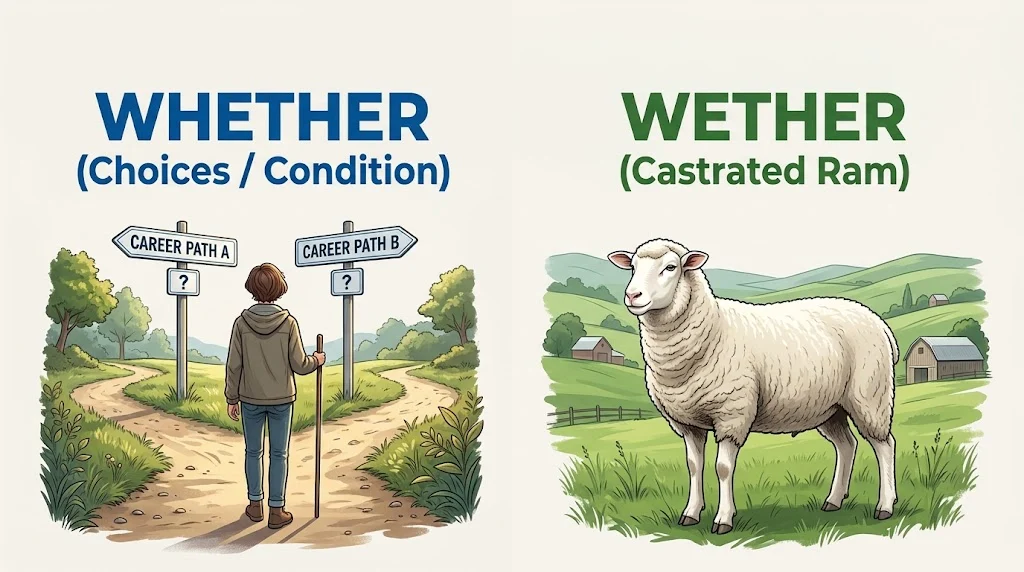
The correct word in almost every everyday sentence is whether. It is used to express alternatives, uncertainty, or a choice, as in “I don’t know whether she will come.” Wether is a specialized noun meaning a castrated male sheep.
Have you ever typed “wether” when you meant to ask “whether”? This tiny spelling mistake is surprisingly common because the two words are pronounced similarly, yet they belong to completely different parts of English vocabulary. Whether is used when discussing alternatives, uncertainty, or choices, while wether refers specifically to a castrated male sheep.
Understanding the difference matters because a single letter can change the meaning of a sentence completely. In professional emails, academic writing, search queries, and AI generated content, choosing the correct form helps your writing appear precise, polished, and trustworthy.
Wether vs Whether: What’s the Difference?
The simplest way to remember the distinction is to look at meaning rather than pronunciation.
Whether is primarily a conjunction. It introduces alternatives, uncertainty, or an indirect question.
Example:
I don’t know whether he will attend the meeting.
Here, whether introduces an uncertain possibility.
Wether is a noun. It refers to a male sheep that has been castrated. The word is mainly encountered in farming, agriculture, animal husbandry, historical writing, or specialized discussions about sheep.
Example:
The farmer moved the wether into a separate pen.
Here, wether refers to a specific type of sheep.
| Word | Part of Speech | Meaning | Common Use | Example |
| Whether | Conjunction, sometimes adverbial conjunction | Expresses alternatives, uncertainty, or a choice | Everyday and formal English | I wonder whether she agrees. |
| Wether | Noun | A castrated male sheep | Agriculture and animal terminology | The wether was moved to another field. |
Mini Recap
Whether is the normal word for choices and uncertainty.
Wether is a specialized noun referring to a castrated male sheep.
They should not be used interchangeably.
If your sentence involves “if,” “or not,” uncertainty, or alternatives, you almost certainly need whether.
Is Wether vs Whether a Grammar, Vocabulary, or Usage Issue?
The confusion between wether and whether is primarily a vocabulary and spelling issue, although grammar determines how whether functions in a sentence.
The two words are not interchangeable. Replacing whether with wether usually creates a spelling error and can make the sentence nonsensical.
Consider:
I don’t know wether he will arrive.
This is incorrect because the sentence expresses uncertainty. The correct version is:
I don’t know whether he will arrive.
By contrast:
The wether was grazing in the pasture.
This is grammatically correct because wether is being used as a noun referring to a sheep.
In formal and academic writing, whether is extremely common. Wether is perfectly correct when the subject genuinely involves sheep, but it is uncommon outside specialized contexts.
In casual communication, people may confuse the two because spelling errors are easy to miss, especially when writing quickly or relying on sound rather than visual recognition.
How to Use Whether Correctly
Whether is the word you need when you are talking about uncertainty, alternatives, or two possible outcomes.
Workplace Example
Please let me know whether you can attend the meeting tomorrow.
The writer is asking the recipient to confirm one of two possibilities: attending or not attending.
Another example is:
We need to decide whether the project should continue.
Here, whether introduces a decision.
Academic Example
Researchers examined whether sleep affects memory performance.
The sentence describes an investigation into a possible relationship. The researchers are essentially asking whether one thing is true.
Another example:
The study considered whether participants responded differently under stressful conditions.
Again, whether introduces an indirect question.
Technology Example
The software checks whether the user has entered a valid password.
The system is evaluating a condition. The meaning is closely related to “if.”
You may also see:
The application asks whether you want to save your changes.
This is a common construction in software interfaces.
Whether Usage Recap
Use whether for uncertainty, alternatives, decisions, and indirect questions.
It frequently appears before or not:
I don’t know whether he is coming or not.
It can also introduce alternatives:
We need to determine whether to upgrade the system or keep the current version.
How to Use Wether Correctly
Wether has a much narrower meaning. It is a noun used for a castrated male sheep.
Because most people do not regularly discuss sheep in technical terms, you are unlikely to need this word in ordinary conversation.
Workplace Example
In an agricultural workplace, you might read:
The farm manager inspected each wether before the animals were moved.
Here, the word is appropriate because the subject is livestock management.
Academic Example
A veterinary or agricultural paper might state:
The study compared the growth patterns of wethers raised under different feeding conditions.
In this context, wether is legitimate technical vocabulary.
Technology Example
Although rare, a livestock management application could use the term:
The database records the age and weight of each wether.
The technology itself does not change the meaning of the word. The term remains a noun referring to the animal.
Wether Usage Recap
Use wether only when you are specifically referring to a castrated male sheep.
It is not a variation of whether.
It should never replace whether in questions about choices or uncertainty.
When You Should NOT Use Wether or Whether
Knowing when not to use a word can be just as valuable as knowing when to use it.
1. Do not use wether for uncertainty
Incorrect:
I don’t know wether she is available.
Correct:
I don’t know whether she is available.
2. Do not use wether before “or not”
Incorrect:
We haven’t decided wether or not to proceed.
Correct:
We haven’t decided whether or not to proceed.
3. Do not use whether when discussing sheep
Incorrect:
The whether was grazing near the barn.
If you mean a castrated male sheep, the correct word is wether.
4. Do not choose the spelling based only on pronunciation
Because the words can sound similar, listening alone may not help you determine the spelling.
5. Do not assume wether is an alternative spelling of whether
It is not. The words have different meanings and different grammatical functions.
6. Do not replace whether with if in every formal sentence
“If” can sometimes replace whether, but the two words are not always interchangeable.
For example:
I don’t know whether he will attend or not.
The use of whether is particularly natural because the sentence explicitly presents an alternative.
7. Do not use whether for a simple yes or no statement when no uncertainty is involved
For example:
She is attending the meeting.
There is no need for whether unless the sentence is framed as a question or uncertainty.
8. Do not use wether outside its actual meaning
Using wether to sound formal or unusual does not make a sentence more sophisticated. It simply changes the meaning.
Common Mistakes and Decision Rules
| Correct Sentence | Incorrect Sentence | Explanation |
| I wonder whether he will come. | I wonder wether he will come. | The sentence expresses uncertainty, so whether is required. |
| We must decide whether to stay. | We must decide wether to stay. | Whether introduces a choice. |
| Tell me whether you agree. | Tell me wether you agree. | Whether introduces an indirect question. |
| The wether was healthy. | The whether was healthy. | The animal is a castrated male sheep, so wether is correct. |
| I don’t know whether it is true. | I don’t know wether it is true. | The sentence concerns uncertainty. |
| The farmer purchased several wethers. | The farmer purchased several whether. | Wethers are castrated male sheep. |
Decision Rule Box
If you mean uncertainty, alternatives, a choice, or an indirect question, use WHETHER.
If you mean a castrated male sheep, use WETHER.
A useful memory trick is simple: whether belongs to questions and choices, while wether belongs to sheep.
Wether and Whether in Modern Technology and AI Tools
Modern technology has made spelling accuracy more important, not less. Search engines, grammar checkers, word processors, and AI writing tools can often identify confusion between wether and whether, but they should not be treated as infallible.
Context matters.
An AI system or spell checker might encounter:
The farmer examined the wether.
That sentence is correct even though wether looks unusual to many users.
However:
I don’t know wether the report is finished.
clearly requires whether.
This distinction demonstrates why context aware language tools are more useful than simple spelling correction. A technically valid word can still be the wrong word for a particular sentence.
Etymology: Where Did Whether and Wether Come From?
The two words have separate historical origins despite their similar appearance and pronunciation.
Whether comes from Old English forms related to the idea of “which of two” or “which one.” Over time, it developed into the modern conjunction used to introduce alternatives and uncertainty.
Wether comes from an Old English word referring to a castrated ram or sheep. Its meaning remained closely connected to sheep husbandry over the centuries.
Their different histories explain why they should not be treated as spelling variants.
“Good word choice is not simply about correct spelling; it is about choosing the word whose meaning fits the sentence.”
This principle is especially important with homophones and near homophones, where pronunciation can hide significant differences in meaning.
Two Practical Case Studies
Case Study 1: Professional Communication
Imagine an employee writes:
Please confirm wether the client approved the proposal.
The intended meaning is obvious, but the spelling error can make the email appear rushed or poorly edited.
After correction:
Please confirm whether the client approved the proposal.
The meaning becomes grammatically and orthographically standard. In a professional environment, this small correction improves credibility without changing the underlying message.
Case Study 2: Academic Writing
Consider a research sentence:
The researchers investigated wether participants preferred the first method.
The intended meaning is clearly about an investigative question, not livestock.
Corrected:
The researchers investigated whether participants preferred the first method.
The correction removes an obvious vocabulary error and makes the sentence appropriate for academic writing.
These examples demonstrate an important practical point: the problem is rarely comprehension. Readers can often understand what the writer intended. The real issue is precision, credibility, and adherence to standard English.
Error Prevention Checklist
Always use WHETHER when:
When you are expressing uncertainty.
[ ] You are presenting two alternatives.
When you are discussing a choice.
[ ] You are introducing an indirect question.
When you can naturally replace it with “if” in the sentence.
[ ] You are using the construction “whether or not.”
Never use WETHER when:
You mean “if.”
When you are asking about two possibilities.
You are discussing uncertainty.
[ ]If you are describing a decision.
You are introducing an indirect question.
[ ] You are writing about ordinary choices or alternatives.
Use wether only when the subject is genuinely a castrated male sheep.
Related Grammar Confusions You Should Master
Once you understand wether vs whether, it is useful to learn other commonly confused English words. These distinctions can improve both everyday and professional writing.
- Weather vs whether
Weather concerns atmospheric conditions, while whether concerns alternatives or uncertainty.
- There vs their vs they’re
These words have different meanings despite similar pronunciation.
- Your vs you’re
Your shows possession, while you’re means “you are.”
- Its vs it’s
Its shows possession, while it’s is a contraction of “it is” or “it has.”
- Affect vs effect
Affect is commonly used as a verb, while effect is commonly used as a noun, although both words have additional uses.
- Then vs than
Then usually relates to time or sequence, while than is used for comparisons.
- Farther vs further
Farther commonly relates to physical distance, while further often concerns degree, development, or figurative distance.
- Who vs whom
Who commonly functions as a subject, while whom is traditionally used as an object.
- Advice vs advise
Advice is a noun, while advise is a verb.
- Practice vs practise
Practice is the standard noun and verb spelling in American English, while British English generally uses practise as the verb.
FAQs
What is the difference between wether and whether?
Wether is a noun meaning a castrated male sheep, while whether is used to express uncertainty, alternatives, or choices. They have different meanings and should not be used interchangeably.
Is wether a correct English word?
Yes, wether is a correct English word, but it is mainly used in farming, livestock, and veterinary contexts to describe a castrated male sheep.
Is whether a conjunction?
Yes, whether commonly functions as a conjunction to introduce alternatives, uncertainty, or an indirect question.
Can whether mean if?
Yes, whether can often mean if when introducing an indirect question, although whether is preferred when presenting alternatives or using “or not.”
Is it correct to say whether or not?
Yes, “whether or not” is a standard English expression used to show that an outcome applies regardless of a particular condition.
Why do people confuse wether and whether?
People often confuse them because they sound similar in speech, even though they have completely different meanings and uses.
What does wether mean in farming?
In farming, a wether is a castrated male sheep, and the term is commonly used in livestock and sheep production contexts.
Which is correct: “I wonder wether” or “I wonder whether”?
The correct phrase is “I wonder whether” because whether is used to introduce uncertainty or an indirect question.
Can whether be used in formal writing?
Yes, whether is appropriate for formal, academic, professional, and everyday writing when expressing uncertainty, alternatives, or choices.
Conclusion
For nearly all ordinary questions, choices, alternatives, and expressions of uncertainty, whether is the correct word. Wether is also a real English word, but its meaning is highly specific: a castrated male sheep. The easiest way to remember the difference is to connect whether with questions and choices and wether with sheep.
If you are writing an email, essay, report, article, or academic paper and want to say “if” or introduce two possibilities, choose whether. If your sentence is about livestock and specifically identifies a castrated male sheep, wether is the appropriate term

Neil Gaiman is an American writer who contributes educational content to LingRoya.com. His work focuses on helping readers improve their English with clear, practical and easy to follow guidance.