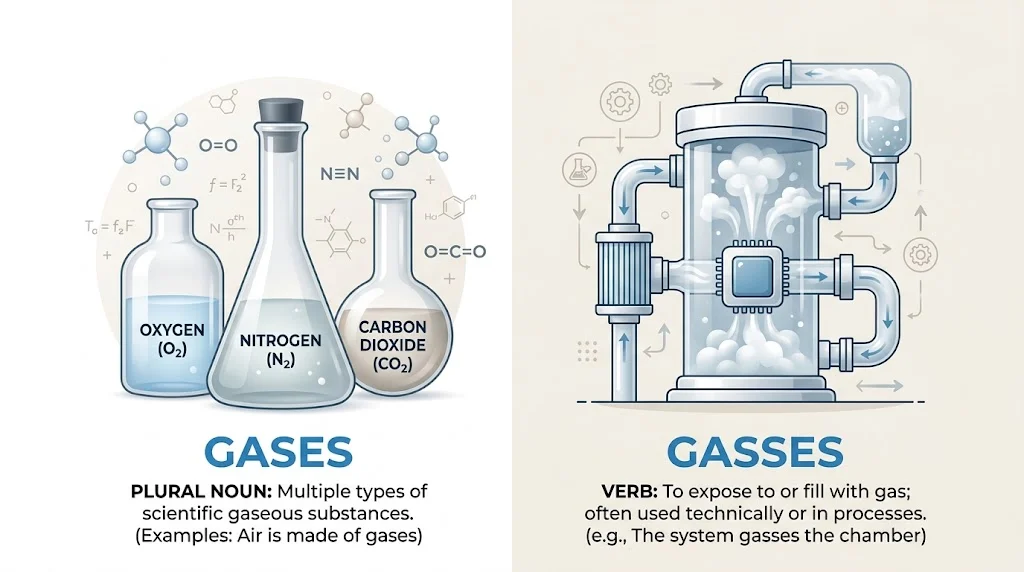
Gasses or gases are both correct English spellings, but they have different meanings and grammatical functions. Gases is the plural of gas, while gasses is the third person singular form of the verb gass, meaning to attack or expose someone to gas.
The correct choice depends on what you mean. Use gases when you are talking about more than one gas, such as oxygen and nitrogen. Use gasses when gass is being used as a verb, usually meaning to expose someone to gas. In scientific writing, gases is overwhelmingly the form you need.
Gasses or Gases: What Do These Words Mean?
The confusion between gasses and gases comes from English spelling rules and the fact that both forms are legitimate words. They simply belong to different grammatical categories.
Gases is the plural noun form of gas. It refers to two or more gases or to gas as a substance considered in different types or quantities.
For example:
The atmosphere contains several different gases.
Here, gases refers to multiple substances in gaseous form.
Gasses, on the other hand, is the third person singular present form of the verb gass. The verb is uncommon and usually means to attack, poison, or expose someone to gas.
For example:
The weapon gasses the target.
Because this verb is relatively rare, most writers who are deciding between these spellings actually need gases.
Comparison of Gasses and Gases
| Word | Part of speech | Meaning | Common context | Example |
| gases | Noun | More than one gas | Science, chemistry, atmosphere | Several gases are present in the mixture. |
| gasses | Verb | Exposes or attacks with gas | Specialized or uncommon usage | The device gasses the material. |
Mini Recap
Gases is the plural noun of gas.
Gasses is a verb form of gass.
Scientific and everyday writing normally requires gases.
If you mean different types or quantities of gas, choose gases.
Is Gasses or Gases a Grammar, Vocabulary, or Usage Issue?
The distinction is primarily a vocabulary and usage issue, although grammar determines which form belongs in a sentence.
The words are not interchangeable. Replacing one with the other can alter the grammatical role and meaning of a sentence.
In formal writing, gases is extremely common because scientific, environmental, medical, industrial, and academic discussions frequently refer to multiple gases.
Gasses is much less common. It appears when gass functions as a verb. Since that verb is specialized, readers may rarely encounter it outside particular contexts.
In casual conversation, the distinction can be overlooked because pronunciation may not make the difference obvious. In academic writing, however, spelling matters because terminology must communicate precisely.
A chemistry student writing about oxygen, hydrogen, carbon dioxide, and nitrogen should write gases, not gasses.
How to Use Gases Correctly
Gases is the plural noun of gas. Use it whenever you are referring to more than one gas, several kinds of gas, or multiple gaseous substances.
Workplace Example
The laboratory stores several compressed gases for industrial testing.
Here, gases identifies multiple substances used in the workplace.
Another example is:
Employees must handle industrial gases according to safety procedures.
The word clearly functions as a plural noun.
Academic Example
Scientists studied how different gases react under high pressure.
This is a typical academic use. The sentence discusses several gaseous substances, so gases is the appropriate spelling.
You will frequently see the word in chemistry, physics, biology, environmental science, astronomy, and atmospheric studies.
Technology Example
The sensor detects harmful gases in indoor environments.
Technology writing commonly uses gases when describing sensors, engines, air quality systems, industrial equipment, and environmental monitoring devices.
Usage Recap for Gases
Use gases when you mean:
More than one gas
Different types of gas
Multiple gaseous substances
Gas related scientific or environmental measurements
How to Use Gasses Correctly
Gasses is a legitimate word, but it is much less common. It is the third person singular present form of the verb gass.
The verb gass can mean to expose someone or something to gas, particularly in a harmful or attacking context. It may also occur in specialized descriptions involving treatment or exposure.
For example:
The chemical agent gasses the surrounding area.
Here, gasses describes an action performed by the subject.
Workplace Example
The equipment gasses the chamber during the treatment process.
This sentence uses gasses as a verb because it describes an action.
Academic Example
The study examines how the compound gasses exposed organisms.
This is a specialized construction. The word describes an action rather than naming several gaseous substances.
Technology Example
The automated system gasses the chamber before the next stage begins.
Again, gasses is a verb. It tells the reader what the system does.
Usage Recap for Gasses
Use gasses only when it functions as a verb.
It describes an action rather than a substance.
It is uncommon in ordinary English.
If you are discussing oxygen, carbon dioxide, nitrogen, or other substances, you almost certainly need gases.
When You Should NOT Use Gasses or Gases
Understanding when not to use each spelling can prevent some of the most common errors.
- Do not use gasses when you mean several types of gas.
Incorrect:
The atmosphere contains several gasses.
Correct:
The atmosphere contains several gases.
- Do not use gases when the sentence clearly requires a verb.
Incorrect:
The machine gases the chamber.
If the intended meaning is that the machine exposes the chamber to gas, gasses may be appropriate.
- Do not choose gasses simply because it looks like a regular plural.
The plural of gas is conventionally gases in standard English.
- Do not assume pronunciation will tell you which spelling is correct.
The context and grammatical role matter more than pronunciation.
- Do not use gasses in scientific writing when you are referring to multiple gases.
This can make an otherwise accurate report appear careless.
- Do not use gases as an action word when the sentence requires the verb gass.
Check what the subject is doing before choosing the spelling.
- Do not treat the two spellings as stylistic alternatives.
They have different functions and meanings.
Common Mistakes: Correct Sentence, Incorrect Sentence, and Explanation
| Correct sentence | Incorrect sentence | Explanation |
| Several gases were detected. | Several gasses were detected. | Multiple substances require the noun gases. |
| The atmosphere contains gases. | The atmosphere contains gasses. | Gases is the plural noun. |
| The system gasses the chamber. | The system gases the chamber. | The sentence needs a verb describing an action. |
| Scientists analyzed different gases. | Scientists analyzed different gasses. | The sentence refers to multiple substances. |
| The process releases gases. | The process releases gasses. | The word after releases is a plural noun. |
Decision Rule Box
If you mean multiple substances or types of gas, use GASES.
If you mean the action performed by something that exposes or attacks with gas, use GASSES.
A useful shortcut is to ask whether the word names things or describes an action.
Gasses or Gases in Modern Technology and AI Tools
Modern technology frequently uses the word gases because digital systems monitor, identify, measure, and analyze different gaseous substances.
For example, air quality sensors can detect gases in the atmosphere. Industrial monitoring platforms can analyze gases released during manufacturing. Space technology can also study gases present in planetary atmospheres.
AI tools may encounter both spellings because language models process enormous amounts of written material. However, frequency alone should not determine the correct choice. An AI system must consider the grammatical context.
For example:
The sensor measures several gases.
Here, gases is correct because the word refers to multiple substances.
By contrast:
The device gasses the chamber.
Here, gasses functions as a verb.
Context remains the decisive factor.
Etymology: Why Does Gas Become Gases?
The noun gas has an interesting history. It entered English from the seventeenth century Dutch word gas, associated with the idea of a vapor or spirit.
English spelling developed over time, and the plural form became gases. This follows a familiar pattern in which nouns ending in certain sounds take an additional syllable in the plural.
The verb gass is a separate grammatical development based on gas. Its doubled consonant helps distinguish the verb spelling from the plural noun in written English.
That distinction is useful because the two words can otherwise look confusingly similar.
Expert Style Explanation
“The simplest way to distinguish them is to identify the grammatical job of the word: gases names multiple gaseous substances, while gasses describes an action.”
This rule is especially useful for students, editors, technical writers, and anyone working with scientific terminology.
Two Practical Case Studies
Case Study One: Scientific Report
Imagine a chemistry student writing:
The experiment produced three gasses.
The intended meaning is that the experiment produced three different gaseous substances. The correct sentence is:
The experiment produced three gases.
The correction changes only one letter, but it restores the correct grammatical category and scientific meaning.
Case Study Two: Technical Documentation
Consider a manual that says:
The system gases the sealed chamber.
If the intended meaning is that the system performs an action involving gas, this wording may be appropriate depending on the technical process.
However, if the manual says:
The system detects several gases.
The plural noun is clearly required.
These examples demonstrate why proofreading should focus on context rather than spelling alone.
Author expertise: Written by a language and SEO specialist focused on English usage, grammar, terminology, and search friendly educational content.
Error Prevention Checklist
Always use Gases when:
- You mean two or more gases.
- You are discussing different gaseous substances.
- You are writing about chemistry or physics.
- You are describing atmospheric gases.
- You are discussing air pollution or greenhouse gases.
- You are writing academic or technical content.
Never use Gasses when:
- You simply mean the plural of gas.
- You are naming multiple gaseous substances.
- You are writing a scientific report about different gases.
- You are describing gases detected by a sensor.
- You are discussing gases in the atmosphere.
- You are referring to several gas samples.
Related Grammar Confusions You Should Master
If you’re building stronger English vocabulary and usage skills, these commonly confused pairs are worth learning:
- Affect or effect
- Advice or advise
- Practice or practise
- Licence or license
- Then or than
- Further or farther
- Whether or wether
- Its or it’s
- Their, there, or they’re
- Your or you’re
These distinctions are similar because the words often look or sound alike while performing different grammatical or semantic roles.
FAQs
Is gases the plural of gas?
Yes. Gases is the standard plural form of the noun gas. Use it when referring to multiple gases or different types of gaseous substances.
Is gasses a real English word?
Yes. Gasses is a legitimate English word. It is the third person singular present form of the verb gass, although that verb is relatively uncommon.
Should I write gases or gasses in a scientific paper?
You should normally write gases when referring to multiple gaseous substances. Scientific writing commonly uses the noun gases when discussing chemical substances, atmospheric composition, or physical properties.
What is the plural of gas?
The standard plural is gases. For example, “Different gases have different physical properties.”
What does gasses mean?
Gasses is a verb form meaning that someone or something exposes another person, object, or area to gas. Its exact meaning depends on context.
Why is gases spelled with one s while gasses has two?
The spellings represent different grammatical uses. Gases is the plural noun, while gasses is a verb form derived from gass. The doubled consonant helps preserve the distinction in writing.
Is gasses grammatically correct?
Yes, but only in contexts where gasses is functioning as the appropriate verb form. It should not replace gases when you mean more than one gas.
Is gases or gasses more common?
Gases is considerably more common because discussions of multiple gases occur frequently in science, technology, environmental studies, medicine, and everyday descriptions.
Can gases and gasses be used interchangeably?
No. They have different grammatical roles and meanings. Gases is normally a plural noun, while gasses is a verb.
Conclusion
The difference between gasses or gases becomes easy once you identify the grammatical role of the word. Choose gases when you mean multiple gaseous substances, such as oxygen, nitrogen, or carbon dioxide. Choose gasses only when you need the uncommon verb form of gass. For scientific, academic, workplace, and everyday writing, gases will usually be the correct choice.
The simplest rule to remember is this: gases names multiple gases, while gasses describes an action involving gas. When in doubt, look at what the word is doing in the sentence rather than relying on how it sounds.

Margaret Atwood is an American writer who contributes to LingRoya.com creating clear and engaging content about the English language and everyday communication. She enjoys helping readers build confidence in their writing through simple, practical guidance.