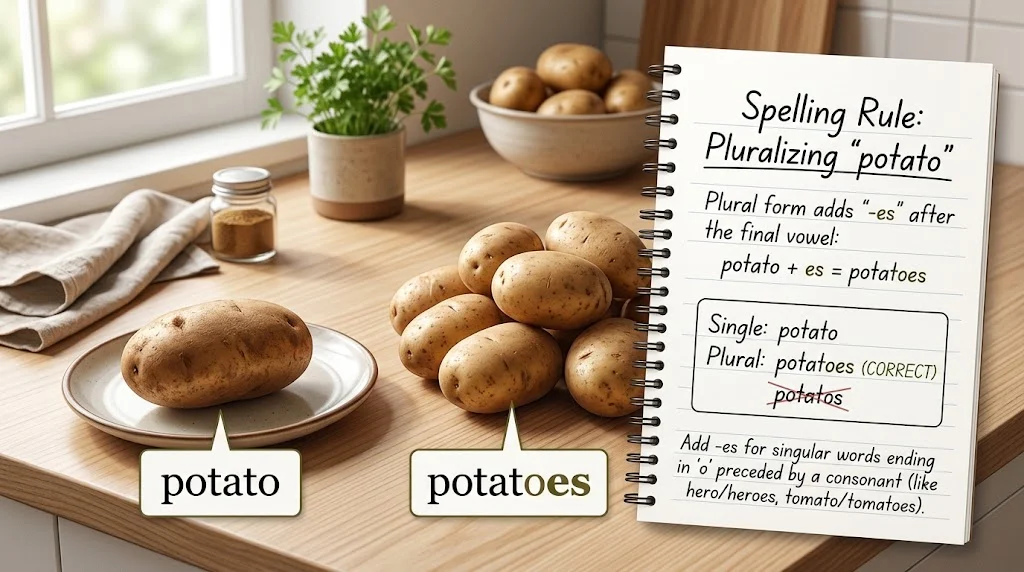
The correct plural of potato is potatoes, not potatos. Potato is a countable noun ending in the letter o, and its standard plural is formed by adding es. Dictionaries including Merriam Webster, Cambridge, and Oxford all list potatoes as the correct plural form. Potatos is considered an incorrect spelling in standard English.
Potato is a noun. It can refer to one edible tuber or, depending on context, the plant that produces those tubers. Cambridge classifies it as both countable and uncountable. For example, “I bought a potato” refers to one item, while “We had mashed potato” can refer to the food as a substance.
Potatoes is the plural noun. It refers to more than one potato. “The farmer harvested potatoes” means the farmer harvested multiple tubers.
Potatos is not the standard plural spelling. The mistake usually happens because English has many nouns ending in o that form plurals simply by adding s. However, English plural spelling is not completely predictable, and potato is one of the words that takes es. Cambridge specifically lists potato as a noun whose plural is potatoes.
| Feature | Potato | Potatoes |
| Part of speech | Noun | Noun |
| Number | Singular | Plural |
| Meaning | One potato or the plant | More than one potato |
| Correct spelling | Potato | Potatoes |
| Incorrect form | Not applicable | Potatos |
| Example | I baked a potato. | I baked three potatoes. |
Mini Recap
Potato is singular.
Potatoes is plural.
Potatos is not the standard English spelling.
The plural is formed by adding es rather than simply adding s.
Is Potatos vs Potatoes a Grammar, Vocabulary, or Usage Issue?
This is primarily a spelling and grammar issue involving plural nouns.
The word itself is familiar vocabulary. The difficulty comes from knowing how to form its plural correctly.
English has several ways of creating plural nouns. The most common pattern is adding s, as in book and books. Another common pattern is adding es after certain endings. Cambridge explains that nouns ending in sounds or letters such as ch, s, sh, x, and z commonly take es. It also identifies potato, tomato, and several other nouns ending in o that form their plurals with es.
This is why learners sometimes write potatos. The spelling looks logical if someone has learned examples such as radio and radios, photo and photos, or piano and pianos.
However, English contains many historical spelling patterns. There is no universal rule saying every noun ending in o must take either s or es.
Formal and Informal Usage
In formal writing, academic work, business documents, recipes, reports, and professional communication, use potatoes.
In casual conversation, people may make spelling mistakes without affecting comprehension. A listener will understand what someone means when they say “potatos,” because pronunciation usually makes the intended word obvious.
Writing is different. Standard spelling matters because readers cannot rely on pronunciation to interpret an unfamiliar form.
Academic Usage
Academic writing should always use the standard spelling. A biology report might say:
The experiment examined the growth of potato plants under controlled conditions.
A food science paper might say:
The samples were prepared using several varieties of potatoes.
Practical Usage
For everyday English, remember one simple distinction:
One potato.
Two potatoes.
Many potatoes.
Never use potatos as the standard plural spelling.
How to Use Potato Correctly
The singular form potato is used when referring to one tuber or when discussing the food or plant in a general or uncountable sense.
For example:
I bought a potato for dinner.
Here, the speaker means one individual potato.
Another example is:
Potato is an important crop in many parts of the world.
In this sentence, potato refers to the food or crop generally rather than one specific tuber.
Workplace Example
A restaurant purchasing manager might write:
We need to order 200 kilograms of potato for next week.
The singular form can be used when referring to the food as a general commodity.
However, the same workplace might say:
The kitchen received 500 potatoes this morning.
Here, the writer is counting individual items, so the plural is required.
Academic Example
A research paper could state:
The potato is cultivated in many regions with suitable climates.
The singular noun works because the sentence discusses the crop as a general category.
Technology Example
A grocery inventory system might contain a product category called “potato” while tracking individual units or varieties as “potatoes.” Software developers must distinguish between a product category and multiple physical items.
Usage Recap
Use potato for one item or for the food or crop in a general sense.
Use potatoes when referring to multiple individual items.
Do not use potatos in standard English.
How to Use Potatoes Correctly
Potatoes is the standard plural of potato. Merriam Webster explicitly gives potatoes as the plural, and Cambridge and Oxford do the same.
Consider these examples:
We bought five potatoes.
The potatoes are ready to harvest.
She peeled the potatoes before cooking them.
Each sentence refers to more than one potato.
Workplace Example
The restaurant ordered fresh potatoes from a local supplier.
Because the sentence refers to multiple items, potatoes is appropriate.
Academic Example
The researchers compared the nutritional composition of different potatoes.
The plural is needed because several individual samples or varieties are being compared.
Technology Example
An online grocery store might display:
Organic potatoes, two kilogram bag.
The product contains multiple potatoes, so the plural form is natural.
Usage Recap
Use potatoes whenever you mean more than one potato.
The spelling requires es.
The form potatos should not be used in standard English.
When You Should NOT Use Potatos or Potatoes
There are several situations in which writers make this mistake or apply the wrong plural rule.
- Do not write potatos when you mean more than one potato.
- Do not assume every noun ending in o forms its plural in exactly the same way.
- Do not write potatoes when you mean one individual potato.
- Do not change the spelling to potatoies. The plural is potatoes.
- Do not treat potatoes as a different word from potato. It is simply the plural form.
- Do not use the plural after a singular determiner such as “a” or “one.” Write “a potato,” not “a potatoes.”
- Do not rely exclusively on the rule that words ending in o take s. English has exceptions and groups that follow different patterns.
- Do not assume that a spelling mistake becomes correct simply because readers understand it.
Common Mistakes and Decision Rules
| Correct sentence | Incorrect sentence | Explanation |
| I bought one potato. | I bought one potatoes. | One requires the singular noun. |
| We bought several potatoes. | We bought several potatos. | The standard plural is potatoes. |
| She peeled three potatoes. | She peeled three potato. | A plural quantity requires the plural noun. |
| The potato is growing well. | The potatoes is growing well. | A singular subject takes the singular form. |
| The potatoes are ready. | The potatoes is ready. | A plural subject normally takes a plural verb. |
| He planted a potato. | He planted a potatos. | A singular noun must follow a singular article. |
Decision Rule Box
When you mean one, use potato.
If you mean more than one, use potatoes.
If you are tempted to write potatos, stop and remember that the standard plural ends in es.
Potatos and Potatoes in Modern Technology and AI Tools
Spelling questions increasingly appear in search engines, grammar checkers, word processors, educational platforms, and AI writing tools.
An AI assistant may recognize “potatos” as a likely misspelling because the surrounding context identifies the intended word. Modern spell checkers can also automatically suggest potatoes.
However, automated correction should not replace understanding the underlying rule. Knowing why potatoes is correct helps writers recognize similar patterns in other words.
For example, tomato becomes tomatoes, hero becomes heroes, and echo becomes echoes. Yet photo becomes photos and piano becomes pianos. Cambridge explains that plural formation for nouns ending in o depends partly on the individual word rather than one universal spelling rule.
This is why memorizing common examples can be more reliable than trying to force every noun into a single pattern.
The Etymology of Potato
The history of the word explains why its spelling does not follow a perfectly simple English pattern.
Merriam Webster traces potato to Spanish batata, a word from Taíno, and records the first known English use in 1565. Oxford similarly traces the word to Spanish patata, a variant of Taíno batata, meaning sweet potato. Oxford notes that the English word originally referred to the sweet potato before acquiring its modern meaning.
The word therefore entered English through another language rather than developing entirely within the native Germanic vocabulary of English.
That history is useful because borrowed words often develop plural forms that must simply be learned through established English usage.
An Expert Style Takeaway
“When a plural spelling is uncertain, the safest approach is to check the established dictionary form rather than assume every word follows the same rule.”
That principle is especially valuable with nouns ending in o.
Two Practical Case Studies
Case Study One: A Student Essay
Imagine a student writing:
The farmers harvested hundreds of potatos after the rainy season.
A teacher or editor would correct the sentence to:
The farmers harvested hundreds of potatoes after the rainy season.
The concrete improvement is straightforward. The sentence changes from a nonstandard plural spelling to the dictionary recognized plural form. Cambridge and Oxford both identify potatoes as the plural of potato.
The lesson is broader than this one word. Academic writing requires attention to established plural forms, especially when a noun does not follow the most obvious spelling pattern.
Case Study Two: A Grocery Database
Consider an online grocery platform that labels its category “Potatos.”
The category is understandable, but it contains a spelling error that can affect the perceived professionalism of the website. Correcting it to “Potatoes” improves the visible language used in navigation, product descriptions, search results, and promotional material.
The concrete result is not a change in meaning. It is an improvement in spelling accuracy and editorial consistency.
This matters because small errors can become highly visible when repeated across thousands of product pages.
Error Prevention Checklist
Always use potato when
- You mean one individual tuber.
- A singular article such as “a” appears before the noun.
- You are discussing the crop or food generally in an appropriate uncountable construction.
- A singular subject requires the singular noun.
Never use potatos when
- You mean more than one potato.
- You are writing academic or professional English.
- You are preparing published content.
- You are completing an examination or language exercise.
- You are editing a website or database where standard spelling matters.
Related Grammar Confusions You Should Master
Learning the correct plural of potato can lead to a broader understanding of English spelling. These related topics are especially useful:
- Tomato and tomatoes
- Photo and photos
- Piano and pianos
- Hero and heroes
- Echo and echoes
- Radio and radios
- Potato and potato pronunciation
- Singular nouns and plural nouns
- Countable and uncountable nouns
- Irregular English plurals
The important lesson is that spelling patterns often have exceptions. Good writers learn the common rule while also learning the words that do not follow it.
FAQs
Is potatos or potatoes the correct spelling?
Potatoes is the correct standard plural spelling. Potatos is a spelling error. Merriam Webster, Cambridge, and Oxford all identify potatoes as the plural form of potato.
Why is the plural of potato potatoes?
Potato is one of the English nouns ending in o that forms its plural by adding es. Cambridge specifically lists potato and potatoes as an example of this plural spelling pattern.
Is potatos ever correct?
In standard modern English, potatos is not the accepted plural spelling of potato. The standard form is potatoes.
What is the singular of potatoes?
The singular is potato. For example, “I ate one potato” is singular, while “I ate two potatoes” is plural.
How do you spell the plural of potato?
Spell it potatoes. Add es to potato rather than simply adding s.
What is the plural of potato in academic writing?
The standard plural is potatoes. Academic writing should use the established dictionary spelling rather than the informal or incorrect form potatos.
Is potato singular or plural?
Potato is singular. Potatoes is plural. The distinction is the same basic number distinction found in many English nouns.
Conclusion
The answer to potatos or potatoes is clear: potatoes is the correct plural form of potato. The word potato refers to one tuber or, in some contexts, the food or crop generally. When referring to more than one individual item, use potatoes. Major dictionaries consistently support this spelling.
The reason this word causes confusion is understandable. English contains many nouns ending in o, and some form their plurals with s while others take es. Potato belongs to the second group. Once you remember the simple pattern of potato becoming potatoes, the spelling becomes much easier to use correctly.

Margaret Atwood is an American writer who contributes to LingRoya.com creating clear and engaging content about the English language and everyday communication. She enjoys helping readers build confidence in their writing through simple, practical guidance.