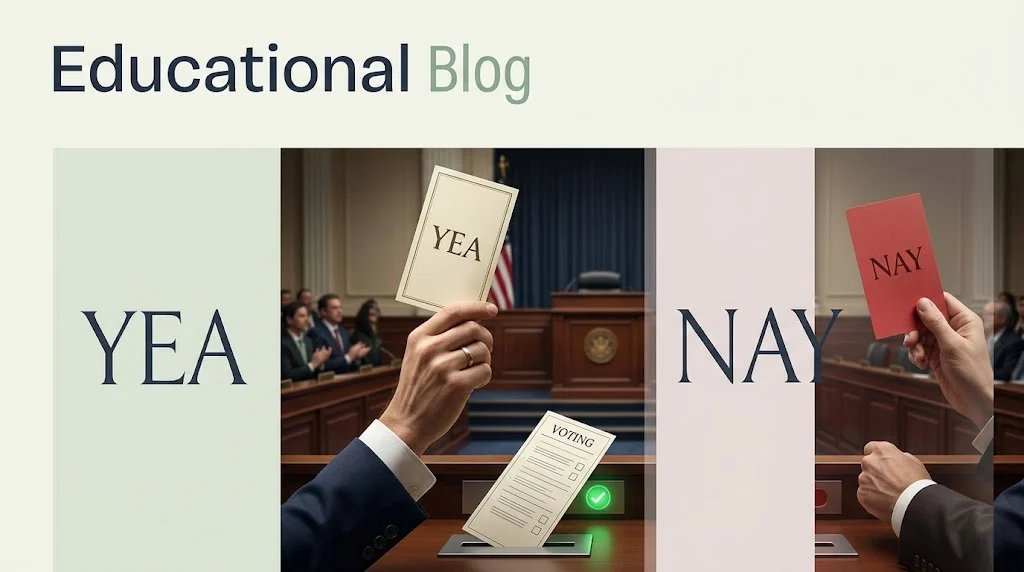
Yea or nay is an informal expression meaning “yes or no,” especially when asking someone to approve or reject a proposal, idea, or decision. Yea means yes or approval, while nay means no or opposition. The phrase is often associated with voting, meetings, and playful or rhetorical questions.
Yea or Nay: What’s the Difference?
The expressions yea and nay are both traditional words used to express agreement or disagreement, particularly in voting.
Yea is an adverb or noun used to mean yes, approval, or an affirmative vote.
Nay is an adverb or noun used to mean no, refusal, or a negative vote.
Together, yea or nay creates a simple contrast between approval and rejection.
| Feature | Yea | Nay |
| Part of speech | Adverb or noun | Adverb or noun |
| Basic meaning | Yes or approval | No or opposition |
| Typical context | Voting and formal decisions | Voting and formal decisions |
| Tone | Traditional, formal, playful, or humorous | Traditional, formal, playful, or humorous |
| Example | “The proposal received a yea.” | “The proposal received a nay.” |
Mini Recap
Yea means yes or approval.
Nay means no or rejection.
Yea or nay means yes or no.
The expression is especially common when discussing votes, decisions, proposals, and opinions.
Is Yea or Nay a Grammar, Vocabulary, or Usage Issue?
The difference between yea and nay is primarily a vocabulary and usage issue, rather than a grammar problem.
The two words are opposites, so they aren’t interchangeable.
If someone asks:
“Yea or nay?”
they’re essentially asking:
“Yes or no?”
However, the expression has a distinctive tone. In everyday conversation, most people simply say yes or no. Yea or nay can sound traditional, formal, theatrical, humorous, or deliberately old fashioned depending on context.
Are Yea and Nay Interchangeable?
No. They have opposite meanings.
You use yea to express agreement and nay to express disagreement.
“My vote is yea.”
means:
“I approve.”
But:
“My vote is nay.”
means:
“I oppose it.”
Formal vs Informal Usage
Historically, yea and nay have strong associations with formal voting. Today, however, using the phrase in ordinary conversation can sound somewhat playful.
For example:
“Yea or nay on this new restaurant?”
sounds more humorous than:
“Do you want to try this new restaurant?”
Academic vs Casual Usage
In academic or historical writing, yea and nay may appear when discussing parliamentary procedure, historical voting practices, religious texts, or older forms of English.
In casual writing, the phrase is often used for style.
How to Use Yea Correctly
Yea means yes, approval, or an affirmative vote.
It is particularly useful when discussing formal decisions or voting.
Workplace Example
The committee members voted yea on the proposed schedule.
This means the members approved the schedule.
A more contemporary workplace version would usually be:
The committee members voted in favor of the proposed schedule.
Academic Example
The final vote included 42 yeas and 18 nays.
This construction can work naturally in writing about voting procedures, especially when the writer wants to emphasize the formal voting terminology.
Technology Example
The proposal received a yea from every member of the online review panel.
This is grammatically possible, although yes or approval would usually sound more natural in modern technology writing.
Usage Recap
Use yea when you mean an affirmative vote or approval.
It often sounds formal, traditional, or deliberately playful.
For ordinary modern conversation, yes is usually the more natural choice.
How to Use Nay Correctly
Nay means no, refusal, disagreement, or opposition.
Like yea, it is strongly associated with voting and formal decisions.
Workplace Example
The board recorded three yeas and two nays.
Here, nays means votes against the proposal.
Academic Example
The historical record shows 65 yeas and 34 nays.
The terms are appropriate when describing a recorded vote.
Technology Example
The team gave a collective nay to the proposed software change.
This sentence is understandable, although modern technical communication would normally use rejected, opposed, or voted against.
Usage Recap
Use nay to express rejection or opposition.
It is most natural in voting contexts, historical discussions, and intentionally humorous language.
When You Should NOT Use Yea or Nay
There are several situations where yea or nay can sound unnatural.
1. Ordinary Everyday Questions
Instead of:
“Yea or nay, are you hungry?”
simply say:
“Are you hungry?”
2. Formal Scientific Writing
Scientific papers generally favor precise modern terminology. Yes or no or a specific description of the response is usually clearer.
3. Customer Service Communication
A customer service representative would rarely write:
“Yea or nay on your refund request?”
A professional alternative is:
“Would you like to proceed with the refund?”
4. Technical Instructions
Software documentation should prioritize clarity.
“Select yes to continue.”
is usually better than:
“Select yea to continue.”
5. When You Mean “Indeed”
Yea can have other historical uses, so don’t automatically substitute it for every occurrence of yes.
6. When You Mean “Not Only That”
In older or literary English, yea can introduce an additional or stronger point. This is a different usage from a simple affirmative vote.
7. When the Audience May Misunderstand
International readers or English learners may understand yes more quickly than yea.
8. When a Style Guide Requires Modern English
If your organization specifically prefers contemporary plain English, choose yes and no.
Common Mistakes With Yea or Nay
| Correct sentence | Incorrect sentence | Explanation |
| The vote resulted in 20 yeas and 5 nays. | The vote resulted in 20 yays and 5 nays. | Yeas is the standard plural of yea in voting contexts. |
| The senator voted yea. | The senator voted yes or yea interchangeably in a formal record. | Use the terminology required by the voting system or context. |
| The proposal received a nay from three members. | The proposal received a nayes from three members. | The normal plural is nays. |
| Yea or nay? | Yea or yea? | The expression contrasts approval with opposition. |
Decision Rule Box
If you mean approval or an affirmative vote, use yea.
When you mean rejection or a negative vote, use nay.
If you simply mean yes or no in everyday conversation, use yes or no.
Yea and Nay in Modern Technology and AI Tools
Modern AI systems and digital platforms occasionally encounter yea and nay in historical, political, literary, and voting related contexts.
For example, an AI system summarizing parliamentary records may preserve phrases such as yeas and nays because those terms describe actual voting categories.
However, if you’re writing a modern chatbot interface, survey question, or software instruction, yes and no are usually clearer.
Consider:
Do you agree? Yes or no.
This is more direct than:
Yea or nay?
The second version may still be appropriate when the interface deliberately uses a traditional or humorous tone.
Etymology of Yea and Nay
Both words have deep roots in the history of English.
Yea comes from Old English and was historically used to express affirmation or agreement. It survived in formal, religious, literary, and political language long after everyday English increasingly favored yes.
Nay also has Old English roots and has long been used to express denial or disagreement.
The pair became especially associated with formal voting. That’s why expressions such as yeas and nays still sound natural when discussing legislative decisions.
Interestingly, yea and yes are related historically but developed into distinct words with different modern uses.
An Expert Perspective on Yea or Nay
“Yea and nay are less about modern everyday vocabulary than they are about context, tone, and the tradition of formal voting.”
The most important lesson is simple: don’t treat yea as a fancy spelling of yes in every situation. Its strongest modern use is as a traditional affirmative vote.
Two Practical Case Studies
Case Study 1: A Committee Vote
Imagine a university committee deciding whether to approve a new academic program.
The recorded vote is:
12 yeas, 3 nays, and 1 abstention.
The terminology immediately communicates the voting outcome.
The concrete result is a concise record that distinguishes approval, opposition, and abstention without requiring a longer explanation.
Case Study 2: A Casual Social Poll
Now imagine a friend asking:
“Yea or nay on pizza tonight?”
Here, the phrase isn’t being used for an official vote. It’s deliberately playful.
The concrete result is a humorous tone that turns an ordinary yes or no question into something more dramatic.
This demonstrates why context matters. The same expression can sound formal in one situation and lighthearted in another.
Error Prevention Checklist
Always use yea when
You mean an affirmative vote.
You are describing formal voting terminology.
Discussing historical voting practices.
Intentionally want a traditional or humorous tone.
Never use nay when
You mean approval.
Describing an affirmative vote.
You simply want to say yes.
Writing a modern instruction that requires maximum clarity.
Remember
Use yea for approval.
Nay for opposition.
Use yes or no when modern, direct language is more appropriate.
Related Grammar Confusions You Should Master
Understanding yea or nay can also help you explore other commonly confused words and expressions:
- Yes or no
- Aye or eye
- Yea or yeah
- Nay or neigh
- Accept or except
- Agree or assent
- Approval or consent
- Advice or advise
- Effect or affect
- Everyday or every day
These pairs demonstrate how pronunciation, history, meaning, and context can create confusion even when words appear similar.
FAQs
What does yea or nay mean?
Yea or nay means yes or no, especially when asking for someone’s approval, opinion, or vote on a proposal or decision.
Is yea the same as yes?
Not always. Yea can mean yes or approval, particularly in formal voting. In modern everyday English, yes is much more common.
What does nay mean?
Nay means no, disagreement, refusal, or opposition. It is especially associated with formal voting and traditional English.
Is yea or nay formal or informal?
It can be either, depending on context. In voting, it can sound formal and traditional. In everyday conversation, it may sound playful, humorous, or deliberately old fashioned.
What is the plural of yea?
The plural of yea in voting contexts is usually yeas.
“The measure passed with 30 yeas and 10 nays.”
What is the plural of nay?
The standard plural is nays.
“There were only two nays.”
Is yea or nay still used today?
Yes. It remains especially common in discussions of formal voting, legislative procedures, historical records, and humorous modern expressions.
Should I say yea or yes?
Use yes in most everyday situations. Use yea when discussing voting or when you deliberately want a traditional, formal, or playful tone.
Is yea the opposite of nay?
Yes. In voting terminology, yea represents an affirmative vote, while nay represents a negative vote.
Conclusion
The answer to the yea or nay question depends on what you’re trying to communicate. Yea means approval or an affirmative vote, while nay means opposition or a negative vote. Together, the expression means yes or no.
In formal voting contexts, yea and nay remain useful and precise. In everyday conversation, however, yes and no are usually more natural. If you’re using yea or nay outside a voting context, consider whether its traditional or playful tone is actually appropriate for your audience.

Margaret Atwood is an American writer who contributes to LingRoya.com creating clear and engaging content about the English language and everyday communication. She enjoys helping readers build confidence in their writing through simple, practical guidance.