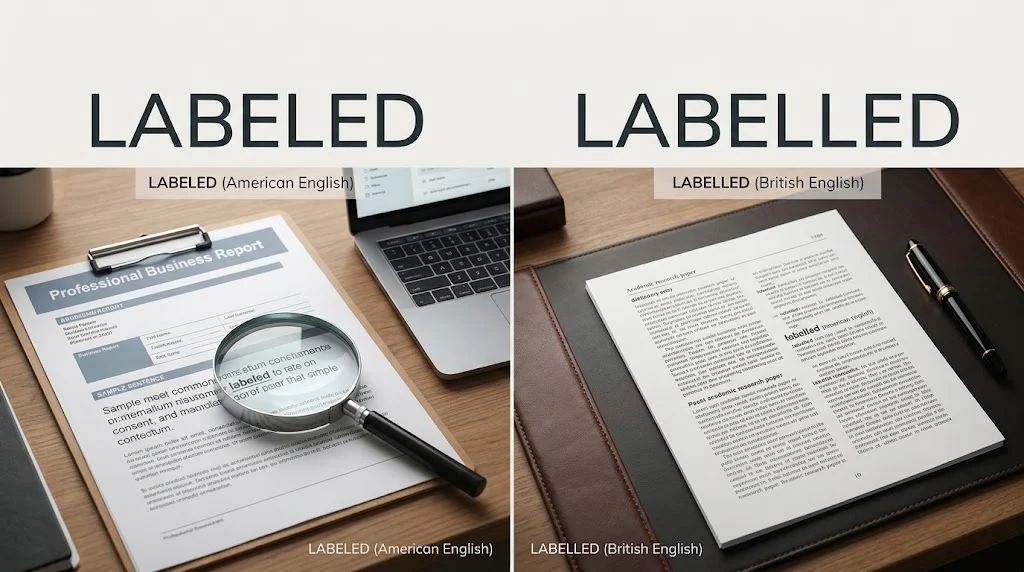
Labeled or labelled are both correct spellings of the past tense and past participle of the verb label. The difference is mainly regional: labeled is the standard spelling in American English, while labelled is preferred in British English and many other varieties that follow British spelling conventions.
If you’ve ever wondered whether to write labeled or labelled, you’re dealing with a spelling difference rather than a difference in meaning. Both forms mean “marked with a label” or “given a particular description.” American English generally uses labeled, while British English usually uses labelled. The key is consistency: professional writers, students, editors, and businesses should follow the spelling convention appropriate for their audience and keep it consistent throughout the same document.
Labeled or Labelled: What’s the Difference?
The words labeled and labelled are both forms of the verb label. They have exactly the same basic meaning and grammatical function.
The difference comes from regional spelling conventions.
In American English, the preferred spelling is labeled.
In British English, the preferred spelling is labelled.
The same pattern appears with other verbs ending in a consonant followed by an unstressed vowel sound. American English often uses a single final consonant before the suffix, while British English frequently doubles the consonant.
For example:
| Feature | Labeled | Labelled |
| Part of speech | Verb | Verb |
| Base verb | Label | Label |
| Meaning | Marked or identified with a label | Marked or identified with a label |
| Common spelling system | American English | British English |
| Past tense | Labeled | Labelled |
| Past participle | Labeled | Labelled |
| Meaning difference | None | None |
Mini Recap
Labeled is standard in American English.
Labelled is standard in British English.
Neither spelling is inherently more correct.
The important rule is to match the spelling to your chosen variety of English and remain consistent.
Is Labeled vs Labelled a Grammar, Vocabulary, or Usage Issue?
The difference between labeled and labelled is primarily a spelling and usage issue, not a difference in grammar or vocabulary.
Both words function as the past tense and past participle of label.
Consider these examples:
The boxes were labeled clearly.
The boxes were labelled clearly.
Both sentences communicate the same idea.
The distinction becomes important when you’re writing for a particular audience. An American publication will normally prefer labeled, while a British publication will generally prefer labelled.
This distinction also matters in academic writing, workplace communication, publishing, journalism, websites, and software documentation.
Formal vs Casual Usage
There is no major difference in formality between the two spellings. Labeled is not more casual, and labelled is not automatically more formal.
The difference is geographical rather than stylistic.
Academic vs Casual Usage
In academic writing, consistency matters more than choosing one spelling over the other. A British university paper can correctly use labelled, while an American academic paper can correctly use labeled.
The same principle applies to casual communication.
How to Use Labeled Correctly
Labeled is the standard American English spelling.
Use it when your audience follows American spelling conventions or when you’re writing according to an American style guide.
Workplace Example
The manager labeled each folder according to department.
Here, labeled describes the action of putting or assigning a label to each folder.
Another example is:
All confidential documents were labeled appropriately.
This spelling is natural in American workplace communication.
Academic Example
Researchers labeled the samples according to their chemical composition.
An American academic publication would normally use labeled.
Technology Example
The system automatically labeled incoming messages as spam.
Technology companies serving American English audiences commonly use labeled in interface text, help documentation, and technical explanations.
Usage Recap
Use labeled when writing in American English.
It works in formal, academic, professional, technical, and everyday writing.
It does not have a different meaning from labelled.
How to Use Labelled Correctly
Labelled is the preferred British English spelling.
It is also common in other English varieties influenced by British spelling conventions, including many contexts involving Commonwealth English.
Workplace Example
The administrator labelled each document with its reference number.
This spelling is appropriate when following British English conventions.
Academic Example
The researchers labelled the specimens before beginning the experiment.
A British academic publication would normally use labelled.
Technology Example
The application automatically labelled suspicious messages.
The spelling is equally correct in British English technology writing.
Usage Recap
Use labelled when following British English spelling.
It has exactly the same meaning as labeled.
The doubled l reflects the spelling convention rather than a different pronunciation or definition.
When You Should NOT Use Labeled or Labelled
There are several situations where writers commonly make mistakes with these forms.
1. Do Not Mix Regional Spellings Randomly
Avoid using labeled in one paragraph and labelled in another unless you have a specific reason.
Consistency makes writing look more professional.
2. Do Not Treat Them as Different Words
The two forms do not have different definitions.
You do not choose one based on meaning.
3. Do Not Assume Labelled Is More Correct
The extra l does not make the word more grammatically correct.
It simply reflects a different spelling convention.
4. Do Not Assume Labeled Is Always Correct
American spelling is not the universal standard.
If you are writing for a British audience, labelled is generally the better choice.
5. Do Not Change a Quotation Without Reason
If you are reproducing an exact quotation, preserve the original spelling unless your editorial policy specifically permits changes.
6. Do Not Ignore Your Style Guide
Professional organizations often establish a preferred variety of English.
Follow the relevant editorial standard rather than switching forms based on personal preference.
7. Do Not Change the Spelling in a Brand or Product Name
Some organizations, products, or systems use specific wording in their official names. Preserve those established names.
8. Do Not Confuse Spelling With Pronunciation
The extra l does not create a fundamentally different pronunciation.
Common Mistakes and Decision Rules
| Correct sentence | Incorrect sentence | Explanation |
| The files were labeled clearly. | The files were labelled clearly. | The first is preferred in American English when following American spelling. |
| The files were labelled clearly. | The files were labeled clearly. | The first is preferred in British English when following British spelling. |
| The researcher labeled the samples. | The researcher labeld the samples. | The past tense requires the correct spelling of label. |
| The researcher labelled the samples. | The researcher labled the samples. | The doubled consonant is part of the British spelling. |
Decision Rule Box
Writing in American English? Use labeled.
Writing in British English? Use labelled.
Writing for an international audience? Choose one spelling system and use it consistently.
Labeled and Labelled in Modern Technology and AI Tools
Modern technology has made this spelling distinction especially noticeable.
Software interfaces frequently contain words such as labeled data, labelled data, automatically labeled, and automatically labelled.
In artificial intelligence, labelled data is particularly common in British English and international technical writing influenced by British conventions. American technical documentation commonly uses labeled data.
For example:
The model was trained using labeled images.
The model was trained using labelled images.
Both sentences describe the same process. The choice depends on the spelling convention being followed.
This is important because AI systems, databases, documentation platforms, and content management systems may be configured for different regional varieties of English.
Why Does British English Double the L?
The spelling difference comes from different conventions for adding suffixes to words ending in a stressed or unstressed vowel and consonant pattern.
British English commonly doubles the final consonant in forms such as:
label → labelled
travel → travelled
cancel → cancelled
American English commonly uses:
label → labeled
travel → traveled
cancel → canceled
There are exceptions and variations, so the safest approach is to follow the established spelling convention of your intended audience.
Etymology of Label
The word label entered English through French and ultimately has roots associated with medieval forms referring to a strip, band, or narrow piece of material. Over time, its meaning developed toward a tag or attached marker used to identify something.
Today, label can refer to a physical tag, a descriptive category, a classification, or an action of assigning a name or category.
That explains why the verb appears so frequently in packaging, education, science, technology, psychology, and everyday communication.
Expert style quotation: “The best spelling is not the one that looks most familiar to you; it is the one that consistently matches your chosen variety of English.”
Two Practical Case Studies
Case Study 1: American Business Documentation
Imagine an American company creating a document management system. Its instructions say:
“Each file should be labeled with the employee’s department.”
Using labeled throughout the documentation creates consistency with American English.
If the same document repeatedly alternated between labeled and labelled, readers might interpret the difference as an editing inconsistency rather than a legitimate regional variation.
The concrete result is improved editorial consistency and a clearer professional presentation.
Case Study 2: British Academic Writing
Consider a British university research report containing this sentence:
“The specimens were labelled according to their origin.”
Using labelled aligns the report with British spelling conventions.
If the document otherwise follows British spelling, changing this single word to labeled would introduce an unnecessary American spelling into the text.
The practical result is greater consistency with the expected academic variety of English.
Error Prevention Checklist
Always use labeled when
You are writing in American English.
Your publication follows American spelling conventions.
Organization uses an American English style guide.
Your audience primarily uses American English.
Always use labelled when
You are writing in British English.
Your publication follows British spelling conventions.
Organization uses British English conventions.
Your audience primarily uses British or Commonwealth English.
Never use either form inconsistently when
The same article follows one established spelling system.
You are writing formal professional material.
Preparing academic or editorial content.
You are creating technical documentation that requires consistent terminology.
Related Grammar Confusions You Should Master
Once you understand labeled and labelled, several other regional spelling differences become easier to recognize.
- Canceled or cancelled
- Traveled or travelled
- Color or colour
- Realize or realise
- Theater or theatre
- Favorite or favourite
- Center or centre
- License or licence
- Organize or organise
- Practice or practise
These examples demonstrate an important principle: English has multiple established spelling standards. A spelling variation does not automatically mean that one form is wrong.
FAQs
Is labeled or labelled correct?
Both are correct. Labeled is the standard American English spelling, while labelled is the standard British English spelling.
Is labeled American or British English?
Labeled is primarily the American English spelling. It uses a single l before the past tense ending.
Is labelled American or British English?
Labelled is primarily the British English spelling. It doubles the final l before the past tense ending.
Should I use labeled or labelled in academic writing?
Use the spelling required by your institution, publisher, or style guide. American academic writing generally uses labeled, while British academic writing generally uses labelled.
Is labelled more formal than labeled?
No. Neither spelling is inherently more formal. The difference is mainly regional.
Do labeled and labelled have different meanings?
No. They have the same meaning and grammatical function.
Why does British English spell labelled with two Ls?
British spelling conventions commonly double the final consonant in words such as label when adding certain suffixes. American English generally retains one final l in this form.
Is it okay to use both labeled and labelled?
It is best not to mix them unnecessarily. Choose the spelling system appropriate for your audience and use it consistently.
Which spelling should I use for a US website?
Use labeled if the website is written in American English.
Which spelling should I use for a UK website?
Use labelled if the website follows British English conventions.
Conclusion
There is no real winner in the labeled or labelled debate because both spellings are correct. The choice depends on regional English.
Use labeled for American English and labelled for British English. Neither form changes the meaning of the sentence, and neither is grammatically superior. The most important rule is consistency. Once you choose a spelling convention, apply it throughout your article, document, website, or publication.
For most American audiences, choose labeled. For British audiences, choose labelled. When writing for an international audience, identify your preferred English variety and maintain that standard from beginning to end

Neil Gaiman is an American writer who contributes educational content to LingRoya.com. His work focuses on helping readers improve their English with clear, practical and easy to follow guidance.