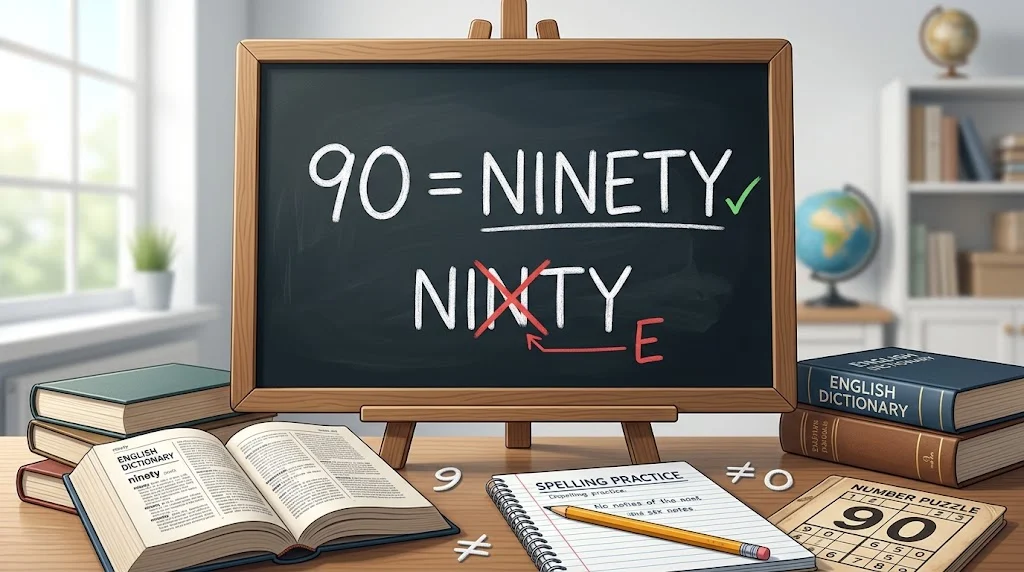
The correct form is ninety. It is the standard English spelling of the number 90. Ninty is an incorrect spelling and should not be used in formal, academic, workplace, or published writing.
If you’ve ever wondered whether to write ninety or ninty, you’re not alone. The correct spelling is ninety, meaning the number 90, while ninty is a misspelling that commonly appears in schoolwork, online searches, forms, and everyday writing. This small spelling error can create problems when numbers appear in important contexts such as invoices, contracts, examination answers, financial documents, addresses, or official records.
The confusion is understandable because English number words don’t always follow an obvious spelling pattern. However, once you remember that ninety is the established form, the choice becomes straightforward. This guide explains the spelling, pronunciation, grammar, history, common mistakes, and practical usage so you can confidently use the correct form.
Ninety or Ninty: What’s the Difference?
The difference is simple. Ninety is a correct English number word, whereas ninty is an incorrect spelling.
| Word | Part of Speech | Status | Meaning | Example |
| ninety | Number word, adjective, noun | Correct | The number 90 | She is ninety years old. |
| ninty | Number word | Incorrect | Intended to mean 90 | The ninty students attended. |
Ninety represents the quantity 90. It can function as a number word in expressions such as ninety people, ninety dollars, and ninety years.
Ninty has no standard meaning in modern English. When someone writes it, they almost always intend to write ninety.
Mini Recap
Ninety is the correct spelling of 90.
Ninty is a spelling mistake.
The word is pronounced approximately as “nine tee.”
The correct form should be used in both formal and casual writing.
The easiest memory aid is: nine changes to ninety, not ninty.
Is Ninety or Ninty a Grammar, Vocabulary, or Usage Issue?
This is primarily a spelling and vocabulary issue, although it also affects written usage.
The two forms aren’t interchangeable. Ninety is the recognized English number word, while ninty is simply a misspelling.
There is also no meaningful distinction between British and American English here. Both varieties use ninety.
In formal writing, the difference matters considerably. A misspelled number can make a document look careless, particularly when it appears in a legal agreement, financial statement, academic assignment, business report, or official application.
In casual conversation, the error may go unnoticed because people generally hear the word rather than see it. However, when the word is written, ninty should be corrected.
Academic writing also requires ninety. If you’re writing an essay, research paper, laboratory report, thesis, or examination response, use the standard spelling.
How to Use Ninety Correctly
Ninety is used whenever you need to express the number 90 in words.
Workplace Example
A business report might state:
The company received ninety applications for the position.
Another example is:
The project is expected to take ninety days.
In both sentences, ninety represents the quantity 90.
Academic Example
A research paper could say:
Ninety participants completed the questionnaire.
A teacher might write:
The student scored ninety percent on the examination.
The spelling remains ninety regardless of the academic subject.
Technology Example
Technology frequently displays numbers in both numerical and written forms.
For example:
The system processed ninety transactions during the test.
An artificial intelligence application might also generate:
The document contains ninety pages.
Whether the number appears in a user interface, database description, software documentation, or AI generated text, the standard spelling remains ninety.
Usage Recap
Use ninety whenever you write the number 90 in words. It works naturally in professional, academic, technical, and everyday contexts.
How Ninty Is Used
There is an important distinction here: ninty isn’t a standard form that you should intentionally use.
You may encounter ninty in internet searches, informal messages, social media posts, student assignments, handwritten notes, or user generated content. Its appearance does not make it an accepted spelling.
For example:
Incorrect: The building is ninty years old.
The corrected sentence is:
Correct: The building is ninety years old.
Workplace Example
Incorrect:
The invoice contains ninty items.
Correct:
The invoice contains ninety items.
A financial or administrative document should always use the standard spelling.
Academic Example
Incorrect:
Ninety students participated in the experiment.
Here, the first sentence is actually correct. A common mistake would be:
Ninty students participated in the experiment.
The second version should be corrected to ninety.
Technology Example
Incorrect:
The application stores ninty records.
Correct:
The application stores ninety records.
Usage Recap
Don’t use ninty as an alternative spelling. If you intend to write 90, the standard form is ninety.
Why Is It Ninety Instead of Ninty?
This is where the spelling can feel confusing.
The number 9 is spelled nine. When we form the word for 90, we don’t simply remove the e and add the ending. English has a conventional spelling pattern that produces ninety.
The sequence is:
nine → ninety
Not:
nine → ninty
The spelling ninety has been established in English for centuries, so it needs to be learned as the standard number word.
Compare it with other number forms:
- five becomes fifty
- four becomes forty
- twelve becomes twelve
- nine becomes ninety
Number names aren’t always formed through one perfectly predictable modern spelling rule. Some have developed through historical changes in English.
Ninety vs Nine: Understanding the Difference
Another source of confusion is the relationship between nine and ninety.
Nine means 9.
Ninety means 90.
The two words are related, but they aren’t interchangeable.
Consider these examples:
I have nine books.
This means there are 9 books.
I have ninety books.
This means there are 90 books.
A missing letter or incorrect spelling can therefore create more than a cosmetic problem. When the intended number isn’t clear, the reader may need to stop and interpret what the writer meant.
When You Should NOT Use Ninety or Ninty
There are several situations where writers commonly make mistakes.
- Do not write ninty when you mean 90.
The correct spelling is ninety. - Do not assume that spelling follows the pronunciation exactly.
English spelling often preserves conventional forms that aren’t obvious from pronunciation. - Do not use ninty in formal documents.
Use ninety in contracts, reports, applications, and official correspondence. - Do not treat ninty as an informal British or American alternative.
It isn’t a recognized regional spelling. - Do not confuse nine with ninety.
Nine means 9, while ninety means 90. - Do not copy a misspelling from online content.
Search results and user generated content can contain errors. - Do not assume spell check is unnecessary for number words.
Human proofreading remains useful, particularly for important documents. - Do not use ninty simply because it seems shorter.
Standard spelling takes priority over convenience.
Common Mistakes and Decision Rules
| Correct sentence | Incorrect sentence | Explanation |
| She is ninety years old. | She is ninty years old. | Ninety is the correct spelling of 90. |
| Ninety students attended. | Ninty students attended. | The number word must be spelled ninety. |
| The project will last ninety days. | The project will last ninty days. | Ninty is a misspelling. |
| He scored ninety percent. | He scored ninty percent. | Ninety is the standard written form. |
| The company sold ninety units. | The company sold ninty units. | Use ninety for the quantity 90. |
Decision Rule Box
If you mean the number 90, use X: ninety.
When you see Y: ninty, replace it with ninety.
If you mean 9, use nine, not ninety.
This rule works in virtually every standard English context.
Ninety and Ninty in Modern Technology and AI Tools
Modern technology has made spelling questions more visible than ever. People type queries into search engines, write prompts for AI systems, create software documentation, complete online forms, and communicate through messaging applications.
AI tools can usually understand ninty from context and infer that the writer means ninety. However, understanding an error isn’t the same as approving it.
For polished content, the standard spelling should always be preferred.
This is especially important for AI generated articles, automated reports, educational materials, product descriptions, and business documents. If an AI system produces ninty, the output should be corrected before publication.
Search engines may also show results for misspelled queries because users frequently make the same mistake. That doesn’t mean the misspelling is grammatically or orthographically correct.
The Etymology of Ninety
The history of ninety helps explain why its modern spelling shouldn’t be reconstructed from the spelling of nine.
The English number system developed from older Germanic forms. Historical forms of the word eventually evolved into the modern English ninety. Over time, spelling conventions changed, but the standard modern form became firmly established as ninety.
The word is therefore not a newly constructed combination of nine plus an independently applied suffix. Its modern spelling reflects historical development within English.
This is one reason memorizing the standard form is more useful than trying to invent a spelling based solely on pronunciation.
An Expert Rule to Remember
“When spelling number words, follow the established English form rather than reconstructing the word from its pronunciation.”
This principle is particularly helpful with words such as forty, fifty, and ninety. English number names contain several historical spellings that don’t always behave exactly as modern speakers might expect.
Two Practical Case Studies
Case Study 1: Academic Assessment
Imagine a student writes:
The survey included ninty participants.
The corrected version is:
The survey included ninety participants.
Concrete result: one spelling correction removes an obvious error from an academic sentence while leaving the meaning unchanged.
The lesson is important for students because number words frequently appear in research papers, statistics assignments, laboratory reports, and examination answers.
Case Study 2: Business Documentation
Consider a business document stating:
The company received ninty orders during the first quarter.
The professional version is:
The company received ninety orders during the first quarter.
Concrete result: replacing ninty with ninety makes the document conform to standard written English and prevents a visible spelling error from appearing in business communication.
The broader editorial lesson is simple: numerical information deserves careful proofreading because errors involving numbers can undermine confidence in the surrounding information.
Error Prevention Checklist
Always use X when
- You mean the number 90.
- You are writing ninety students.
- You are describing ninety days.
- You are writing a financial amount containing ninety.
- You are preparing academic work.
- You are creating professional documents.
- You are writing published content.
Never use Y when
- You mean the standard spelling of 90.
- You are submitting an examination answer.
- You are writing an academic paper.
- You are preparing a business report.
- You are completing an official form.
- You are publishing website content.
- You want standard English spelling.
Related Grammar Confusions You Should Master
If you’re interested in spelling and usage questions involving number words, these related topics are worth learning:
- Forty or fourty
- Fifty or fivety
- Ninety or ninty
- Eighty or eigthy
- Twelve or twelv
- Forty or fourty
- Lose or loose
- Definitely or definately
- Separate or seperate
- Receive or recieve
These examples demonstrate a larger principle: English spelling often requires familiarity with established forms rather than relying exclusively on pronunciation.
FAQs
Ninety is correct. Ninty is a misspelling and isn’t the standard English spelling of the number 90.
How do you spell 90 in English?
The number 90 is spelled ninety.
Why is ninety spelled without the e in nine?
The word ninety developed through historical changes in English. Its modern spelling is an established form and should be learned as ninety, rather than reconstructed from nine.
Is ninty an acceptable spelling?
No. Ninty is not the standard spelling. Use ninety in formal and informal writing.
How do you remember the spelling of ninety?
A useful memory aid is to remember the phrase nine becomes ninety. The correct form contains the sequence nine followed by ty, with the spelling established as ninety.
Is ninety spelled the same in British and American English?
Yes. Both British English and American English use ninety as the standard spelling.
Is ninety a noun or an adjective?
Ninety can function in different grammatical ways depending on context. It can identify a number or quantity and can appear before nouns, as in ninety students. It can also be used in expressions such as ninety is a large number.
What is the difference between nine and ninety?
Nine represents 9, while ninety represents 90. They are different numbers and should not be substituted for one another.
Why do people spell ninety as ninty?
The mistake likely comes from pronunciation and from assuming that the word should be formed by removing the final e from nine. However, the established English spelling is ninety.
Conclusion
When choosing between ninety or ninty, always choose ninety. It is the standard English spelling for the number 90, while ninty is a common spelling mistake. The confusion is understandable because English number words have developed through centuries of linguistic change, and their spellings aren’t always predictable from pronunciation.
Remember the essential distinction: nine means 9, while ninety means 90. When you need to write the larger number in words, use ninety.

Margaret Atwood is an American writer who contributes to LingRoya.com creating clear and engaging content about the English language and everyday communication. She enjoys helping readers build confidence in their writing through simple, practical guidance.