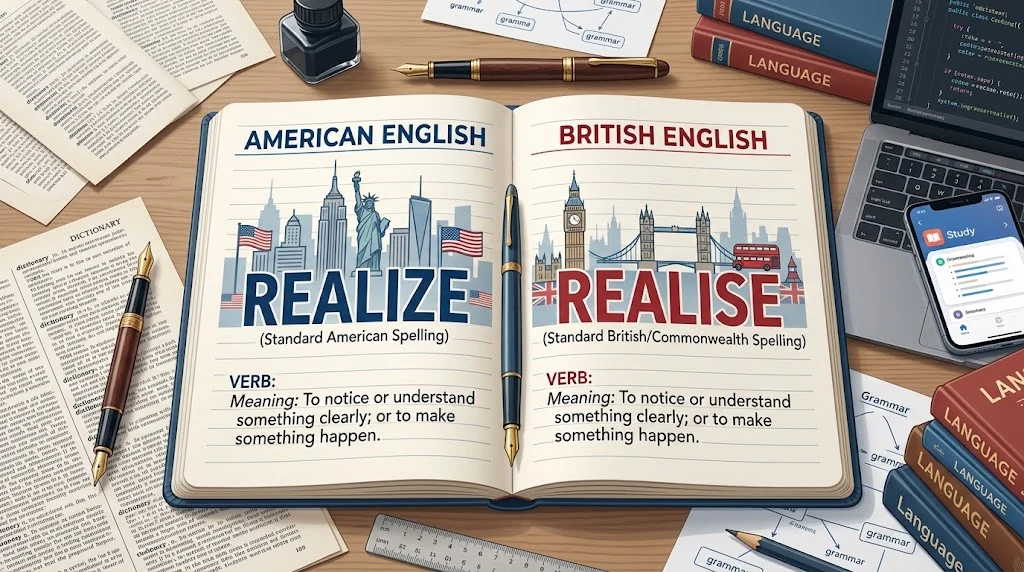
Both realize and realise are correct spellings of the same verb, meaning to become aware of something, understand something clearly, or make an idea become real. Realize is the preferred spelling in American English, while realise is standard in British English and commonly used in other varieties that follow British spelling.
Have you ever written an email, essay, or professional report and wondered whether realize or realise is the correct spelling? The confusion is understandable because both words have exactly the same meaning and pronunciation in standard English. The difference comes mainly from regional spelling conventions.
Realize is the spelling most strongly associated with American English, while realise is traditionally preferred in British English. Both can mean to become conscious of something, understand something suddenly, or successfully achieve an objective.
Realize vs Realise: What’s the Difference?
Realize and realise are both verbs. They have the same pronunciation, meaning, grammatical function, and word history. The primary distinction is geographical spelling preference.
| Feature | Realize | Realise |
| Part of speech | Verb | Verb |
| Meaning | Become aware, understand, or make real | Become aware, understand, or make real |
| American English | Preferred | Less common |
| British English | Accepted in some contexts | Preferred |
| Pronunciation | Same | Same |
| Past tense | Realized | Realised |
| Present participle | Realizing | Realising |
| Meaning difference | None | None |
Mini Recap
Realize and realise have the same meaning.
Realize is generally preferred in American English.
Realise is generally preferred in British English.
Neither spelling is inherently more correct than the other.
The key is consistency within the variety of English you are using.
Is Realize vs Realise a Grammar, Vocabulary, or Usage Issue?
The difference between realize and realise is primarily a spelling and regional usage issue, not a grammar issue.
Both words function as verbs and can appear in the same grammatical structures. You can say, “I realized my mistake” or “I realised my mistake,” depending on your preferred variety of English.
They aren’t interchangeable within a single consistent spelling system if your goal is formal consistency. In other words, you shouldn’t normally write an American English document using realize in one paragraph and realise in another without a deliberate reason.
Formal vs Informal Usage
Both spellings are suitable for formal writing. The choice depends on the English variety required by your audience.
An American university assignment will generally use realize. A British academic paper will generally use realise.
In casual communication, either spelling may appear depending on where the writer learned English.
Academic vs Casual Usage
Academic writing places particular importance on consistency. If your institution follows British English, use realise, realised, and realising consistently.
If your institution follows American English, use realize, realized, and realizing.
The same principle applies to professional writing, websites, reports, and published material.
How to Use Realize Correctly
Realize is the preferred spelling in American English. It can describe a moment when someone becomes aware of a fact.
For example:
I didn’t realize that the meeting had already started.
It can also describe understanding or recognizing something:
She realized that the figures were incorrect.
Another meaning is to make something become real or achieve something:
The company finally realized its long term expansion plan.
Workplace Example
An American employee might write:
“I just realized that the client sent the revised contract yesterday.”
Here, realized means became aware of or discovered.
Academic Example
An American student might write:
“The researchers realized that the original assumption was incorrect.”
The verb describes reaching an understanding.
Technology Example
A software developer might write:
“We realized that the application needed additional security testing.”
Again, the meaning is becoming aware of a fact.
Usage Recap
Use realize when following American spelling conventions. It works naturally in professional, academic, technical, and everyday writing.
How to Use Realise Correctly
Realise is the traditional preferred spelling in British English. It has exactly the same meanings as realize.
For example:
I didn’t realise how late it was.
It can also mean to understand:
She realised that she had misunderstood the instructions.
And it can describe achieving an idea or objective:
The team realised its ambition of opening a new office.
Workplace Example
A British employee might write:
“I realised that the customer had already approved the proposal.”
The meaning is identical to the American spelling realized.
Academic Example
A British academic might write:
“The researchers realised that further evidence was necessary.”
This is completely standard British English usage.
Technology Example
A British software engineer might write:
“We realised that the system required a more efficient database structure.”
The spelling follows British convention.
Usage Recap
Use realise when following British English spelling conventions. It is appropriate for formal and informal writing alike.
When You Should NOT Use Realize or Realise
There are several situations where choosing between the two forms can become confusing.
- Do not mix them in the same document without a reason. Pick one spelling system and maintain it.
- Do not assume realise is incorrect because American dictionaries prefer realize. British English has its own standard conventions.
- Do not assume realize is incorrect in every British context. The spelling with z has historical and dictionary support and is accepted in some British usage.
- Do not change the spelling based on pronunciation. Both forms are normally pronounced the same way.
- Do not treat the forms as different words. They have the same core meanings.
- Do not switch from realize to realise simply because your audience is international. Instead, establish a consistent style guide.
- Do not mix related spelling conventions carelessly. For example, choosing realise while using other American spellings throughout a document can create inconsistency.
- Do not change the spelling in a quotation unnecessarily. Preserve the original spelling when accurately quoting a source.
Common Mistakes and Decision Rules
| Correct sentence | Incorrect sentence | Explanation |
| I realized the error. | I realised the error. | The second is not grammatically wrong, but it may conflict with an American style guide. |
| I realised the problem. | I realized the problem. | The second may conflict with a British style guide. |
| She realized what happened. | She realised what happened. | Both are correct; choose according to regional convention. |
| They have realised their goal. | They have realized their goal. | Both work, but British style generally prefers realised. |
| He is realizing the importance of the change. | He is realising the importance of the change. | Both forms are possible; the preferred spelling depends on English variety. |
Decision Rule Box
If you are writing in American English, use realize.
When you are writing in British English, use realise.
If your organization, school, publisher, or client provides a style guide, follow that guide first.
Realize and Realise in Modern Technology and AI Tools
The distinction remains relevant in technology because software, AI tools, grammar checkers, and content platforms often serve international audiences.
An American AI generated document may naturally contain realize, while a British English document may use realise. Neither automatically indicates that the text was generated by AI or written by a native speaker.
For AI assisted writing, the best practice is to establish the desired language variety before generating or editing content. A prompt such as “Use British English spelling throughout” can help maintain consistency. The same principle applies to localization, software documentation, customer support articles, and international websites.
Realize or Realise: Etymology and Word History
Both forms ultimately trace back through French to Latin roots associated with making something real or actual. The English verb developed around the idea of making real and later acquired the important sense of becoming aware or understanding something.
The spelling difference developed as English spelling conventions evolved on different sides of the Atlantic. American English commonly developed preferences for z spellings in words such as realize, organize, and recognize, while British English traditionally uses s in realise, organise, and recognise.
This does not mean every British dictionary or writer rejects the z spelling. British usage can be more varied than the simple American versus British rule suggests.
An Expert Perspective on Realize vs Realise
“The best spelling is the one that matches your chosen variety of English and remains consistent throughout the document.”
From a professional editing perspective, consistency matters more than treating one spelling as universally correct. A document that consistently follows British or American conventions is clearer and more polished than one that switches unpredictably between them.
Two Practical Case Studies
Case Study 1: American Academic Writing
Imagine a university student in the United States writing a research paper. The student writes:
“The researchers realized that the initial results required further analysis.”
The spelling realized fits standard American English.
If the same student repeatedly uses British spellings elsewhere, such as organise and analyse, the document may appear stylistically inconsistent even though individual words are understandable.
Result: Choosing one spelling system improves editorial consistency and reduces avoidable corrections.
Case Study 2: British Business Communication
Consider a British company preparing a customer report:
“We realised that the original delivery estimate was inaccurate.”
The spelling realised fits conventional British English.
If the company uses realize, organize, and analyze throughout its American facing documentation, that may also be intentional if the target market is the United States.
Result: Localization should be based on the intended audience rather than treating one spelling as universally superior.
Error Prevention Checklist
Always use realize when
- You are following American English spelling.
- Your organization uses an American style guide.
- Your academic institution specifies American English.
- Your publication follows American spelling conventions.
- Your audience is primarily American and consistency matters.
Never use realise when
- Your style guide specifically requires American spelling.
- You are expected to maintain strict American English consistency.
- You are mixing it into a document that otherwise consistently uses American z spellings.
Always use realise when
- You are following conventional British English spelling.
- Your organization uses British spelling.
- Your publication follows British English.
- Your educational institution specifies British conventions.
Related Grammar Confusions You Should Master
If you’re improving your English writing, these spelling and usage distinctions are also worth mastering:
- Color vs colour
- Organize vs organise
- Analyze vs analyse
- Recognize vs recognise
- Center vs centre
- Favorite vs favourite
- Practice vs practise
- License vs licence
- Affect vs effect
- Fewer vs less
Learning these pairs helps you recognize a broader pattern: English can have different accepted conventions depending on region, audience, and style guide.
FAQs
Is realize or realise correct?
Both are correct. Realize is generally preferred in American English, while realise is traditionally preferred in British English.
Is realise British or American?
Realise is primarily associated with British English and other varieties that commonly follow British spelling conventions.
Is realize American English?
Yes. Realize is the standard and strongly preferred spelling in American English.
Do realize and realise have the same meaning?
Yes. They have the same meanings and function as the same verb. The main difference is spelling convention.
Is realize or realise more formal?
Neither is inherently more formal. Both are suitable for formal writing when used according to the appropriate regional spelling convention.
Can I use realize in British English?
Yes, realize can occur in British English, although realise is traditionally more common and is often preferred by British style guides.
Should I use realize or realise in an academic essay?
Follow your institution’s required style. Use realize for American English and realise for British English unless your academic style guide says otherwise.
Why does American English use realize while British English uses realise?
The difference reflects historical developments in English spelling and different regional preferences. American English generally favors z spellings in this group, while traditional British English commonly favors s spellings.
Is realized or realised correct?
Both are correct. Realized follows the American spelling pattern, while realised follows the traditional British spelling pattern.
Is realising or realizing correct?
Both are correct. Realizing is the American form, while realising is the traditional British form.
Conclusion
The choice between realize or realise is straightforward once you identify the English variety you’re using. Both forms are correct verbs with the same pronunciation and meanings. American English generally prefers realize, while British English traditionally prefers realise. The difference isn’t about grammar or meaning; it’s mainly about regional spelling and editorial style.
For academic, professional, and online writing, consistency is the most important rule. Choose the spelling required by your audience, institution, publisher, or style guide, and apply the same convention throughout your work. Once you understand this pattern, related pairs such as organize and organise or analyze and analyse become much easier to handle.

Neil Gaiman is an American writer who contributes educational content to LingRoya.com. His work focuses on helping readers improve their English with clear, practical and easy to follow guidance.