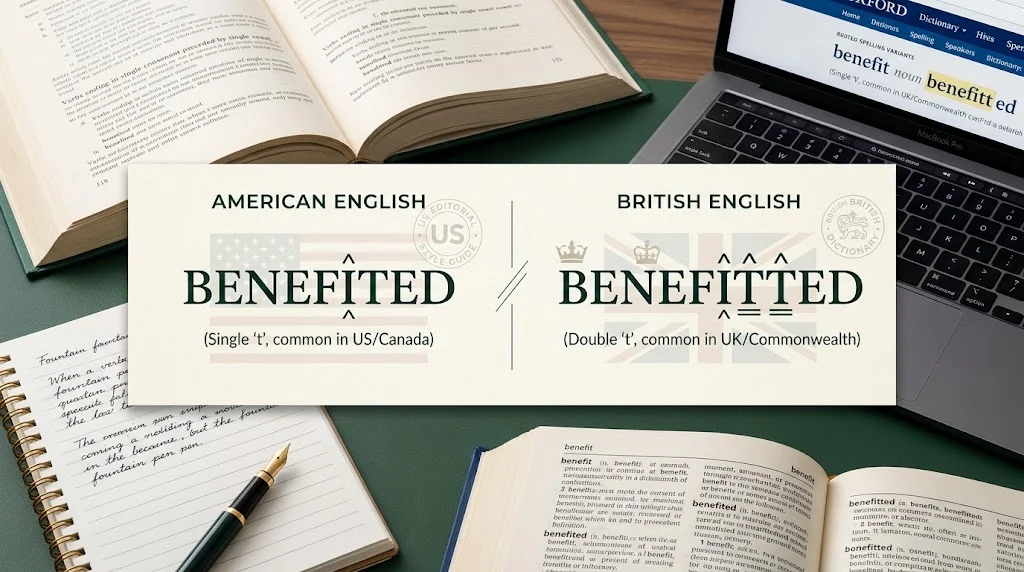
Benefited and benefitted are both correct forms of the verb benefit. The spelling with one “t” is preferred in American English, while the spelling with two “t”s is widely accepted in British English. The difference is mainly a matter of regional spelling convention, not a difference in meaning or grammar.
Have you ever typed “benefited” and wondered whether it should actually be “benefitted”? This is a common spelling question because English uses different conventions for forming past tense verbs ending in certain consonants. The confusion becomes especially noticeable when American and British English appear side by side in professional documents, academic papers, websites, and international communication. Both spellings are legitimate, but their frequency varies by regional writing standard.
Understanding when each form is preferred helps writers maintain consistency and avoid unnecessary corrections. For students, editors, teachers, bloggers, and professionals, knowing the difference also makes it easier to choose a spelling that matches the intended audience and style guide.
Benefited vs Benefitted: What’s the Difference?
Benefited and benefitted are both forms of the verb benefit.
The word benefit means to gain an advantage, receive help, or produce a positive result.
The form benefited uses one “t” before the ending.
Example:
“Thousands of students benefited from the program.”
The form benefitted uses two “t”s.
Example:
“Thousands of students benefitted from the program.”
The meaning remains exactly the same. The main difference is spelling preference based on regional English conventions.
Mini Recap
Both spellings are correct.
Benefited is more common in American English.
Benefitted is widely used in British English.
Neither spelling changes the meaning.
The most important rule is to follow one spelling convention consistently.
Is Benefited vs Benefitted a Grammar, Vocabulary, or Usage Issue?
The difference between benefited and benefitted is primarily a spelling and usage issue rather than a difference in grammar or meaning.
Both forms function as the past tense and past participle of benefit.
For example:
“The company benefited from the investment.”
“The company benefitted from the investment.”
Both sentences communicate the same idea.
The difference comes from regional spelling conventions and differences in how English varieties treat verbs ending in a consonant followed by a vowel sound.
American English
American English generally prefers benefited, with one “t.”
Examples include:
“The patient benefited from treatment.”
“The business benefited from the new policy.”
“The students have benefited from additional support.”
British English
British English commonly uses benefited, but benefitted is also an established and widely used spelling.
Examples include:
“The patient benefitted from treatment.”
“The business benefitted from the new policy.”
“The students have benefitted from additional support.”
This means it would be inaccurate to claim that “benefitted” is simply wrong in British English. It is an accepted spelling, although usage varies among writers, publishers, dictionaries, and style guides.
Formal vs Informal Usage
Both spellings can appear in formal writing.
The important consideration is consistency. A document using American English should generally follow American spelling conventions. A document intended for a British audience may use British conventions.
Neither form is inherently more formal.
Academic vs Casual Usage
Academic writers should choose the spelling that matches the required style guide or institutional convention.
For example, if an academic paper follows American English, benefited is usually the natural choice.
If it follows a British English style, benefitted may be appropriate.
In casual writing, readers generally understand both forms without difficulty.
How to Use Benefited Correctly
Benefited is the preferred spelling in American English and is also used in British English.
It is the past tense and past participle of benefit.
Workplace Example
“The company benefited from improved customer service.”
The sentence means that the company gained an advantage from improved service.
Academic Example
“Participants benefited from additional training.”
The sentence describes a positive result experienced by the participants.
Technology Example
“Users benefited from the latest software update.”
Here, benefited means users gained an advantage from the update.
Usage Recap for Benefited
Use benefited when following American English spelling conventions.
It is also acceptable in British English.
It works as both a simple past form and a past participle.
Its meaning does not differ from benefitted.
How to Use Benefitted Correctly
Benefitted is an accepted spelling that is particularly associated with British English usage.
It has the same meaning and grammatical function as benefited.
For example:
“The organization benefitted from increased funding.”
The sentence means that the organization gained an advantage from the funding.
Workplace Example
“The department benefitted from the introduction of flexible working.”
This is a natural construction in British English.
Academic Example
“The participants benefitted from access to additional resources.”
The sentence describes a positive effect experienced by the participants.
Technology Example
“The website benefitted from faster loading speeds.”
The sentence states that the website gained an advantage from improved performance.
Usage Recap for Benefitted
Use benefitted when it fits the spelling convention of your audience or publication.
It is especially familiar in British English.
It has the same meaning as benefited.
The double “t” does not indicate a different tense or meaning.
When You Should NOT Use Benefited or Benefitted
There are several situations in which writers make avoidable mistakes.
- Do not treat benefitted as a completely different word from benefited. They have the same meaning.
- Do not switch randomly between benefited and benefitted within the same document.
- Do not assume that one spelling is universally correct and the other is always wrong.
- Do not use the spelling preferred by one regional style while claiming that your document consistently follows another style.
- Do not write “benefittted” with three “t”s.
- Do not write “benefitted” merely because another verb doubles its final consonant. English spelling patterns are not completely uniform.
- Do not change the spelling simply because a grammar checker uses a different regional dictionary.
- Do not confuse benefited with the noun benefit. The grammatical role depends on how the word functions in the sentence.
Common Mistakes and Decision Rules
Decision Rule Box
If you are writing in American English, benefited is generally the safest choice.
If you are writing in British English, benefited and benefitted are both accepted, but follow the preference of your publication or style guide.
The most important rule is consistency.
Benefited and Benefitted in Modern Technology and AI Tools
The distinction appears frequently in digital content, software documentation, AI generated text, and international websites.
An American technology website may write:
“Millions of users benefited from the update.”
A British technology publication may write:
“Millions of users benefitted from the update.”
Neither sentence changes the underlying meaning.
AI writing systems and spelling checkers may also flag one version depending on the regional dictionary selected. This can make writers think that one form is incorrect when the real issue is regional preference.
When reviewing AI generated content, check the language variety of the entire document rather than correcting isolated words. A document intended for an American audience should generally maintain American spelling, while British oriented content should follow its chosen British convention.
Etymology and Spelling History
The word benefit ultimately comes from Latin roots associated with doing good or receiving a good result. English adopted the word through French and developed its modern noun and verb uses over time.
The spelling difference in benefited and benefitted reflects broader variation in English verb spelling.
Some English verbs ending in a consonant double that consonant before certain endings, while others do not. Regional spelling conventions also influence these patterns.
This is why writers should not assume that every verb follows exactly the same rule. Established dictionary usage and regional style are often more reliable than applying a single spelling formula mechanically.
An Expert Style Principle
“Correct spelling is not always about choosing one universal form; sometimes it is about choosing the form that fits your English variety and using it consistently.”
This principle is particularly useful when writing for international audiences.
Two Practical Case Studies
Case Study 1: American Business Report
Imagine an American company publishes an annual report containing the sentence:
“Employees benefitted from the new training program.”
The spelling is understandable, but the company’s editorial policy follows American English and uses single consonants in this construction.
The editor changes the sentence to:
“Employees benefited from the new training program.”
Result: The meaning remains unchanged, but the spelling now aligns with the company’s American English style.
Case Study 2: British Educational Article
A British educational website writes:
“Students benefited from the additional tutoring.”
An editor reviewing the article prefers the spelling “benefitted” because that form fits the publication’s established British style.
The sentence becomes:
“Students benefitted from the additional tutoring.”
Result: The content remains grammatically identical while the spelling matches the publication’s preferred regional convention.
These examples demonstrate an important point: the choice is primarily about spelling consistency, not correctness of meaning.
Error Prevention Checklist
Always use Benefited when
You are following American English conventions.
Your organization’s style guide specifies the one “t” spelling.
Your document consistently uses American spelling.
You want the most straightforward choice for American readers.
Never use Benefitted when
Your American English style guide specifically requires benefited.
You are switching between spelling conventions without a reason.
You are treating the two forms as different words.
Always use Benefitted when
Your publication specifically prefers this British spelling.
Your established editorial style uses the double “t” form.
Consistency with surrounding British English spelling is important.
Related Grammar Confusions You Should Master
Writers who are interested in benefited and benefitted should also understand other commonly confused forms:
- Learned vs learnt
- Burned vs burnt
- Spelled vs spelt
- Canceled vs cancelled
- Labeled vs labelled
- Traveling vs travelling
- Realize vs realise
- Color vs colour
- Toward vs towards
- Practice vs practise
These pairs often involve regional English differences, spelling conventions, or distinctions between noun and verb forms.
FAQs
Is benefited or benefitted correct?
Both are correct. Benefited is especially common in American English, while benefitted is widely used in British English.
Is benefited the American spelling?
Yes. Benefited is generally the preferred spelling in American English.
Is benefitted the British spelling?
Benefitted is widely used in British English, although benefited is also accepted and common in British usage.
Should I write benefited or benefitted in academic writing?
Follow your institution, publisher, or style guide. American English generally favors benefited, while British English may use either form depending on editorial preference.
Does benefited mean the same as benefitted?
Yes. Both forms have the same meaning and grammatical function.
Is benefitted grammatically correct?
Yes. Benefitted is an accepted past tense and past participle form of benefit.
Why does benefited sometimes have one t and sometimes two?
English spelling conventions vary by region and style. American English generally uses benefited, while benefitted is also established in British English.
Which is more common, benefited or benefitted?
Benefited is generally more common internationally and is strongly preferred in American English. Benefitted remains well established, particularly in British English.
Can I use benefited and benefitted in the same article?
You can, but it is better to choose one spelling convention and apply it consistently throughout the article.
Is “benefitted” wrong in American English?
It is less common in American English, where benefited is the standard preference. For American focused professional or academic writing, benefited is usually the better choice.
Conclusion
The choice between benefited or benefitted is mainly a matter of regional spelling and editorial preference. Both forms are legitimate past tense and past participle forms of benefit, and neither has a different meaning. American English generally prefers benefited, while benefitted is particularly familiar in British English, where both forms can be found.
If you’re writing for a specific audience, follow its established language convention and remain consistent throughout the document. For most American English content, choose benefited. For British English content, check the relevant style guide and use the preferred form consistently.

Neil Gaiman is an American writer who contributes educational content to LingRoya.com. His work focuses on helping readers improve their English with clear, practical and easy to follow guidance.