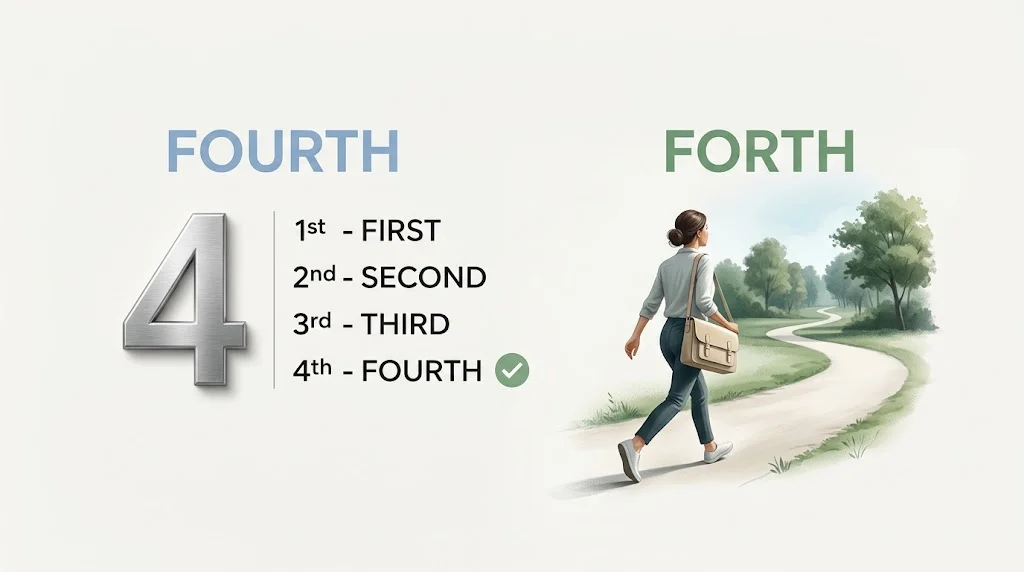
Fourth refers to the position of number four in a sequence, such as “She finished fourth.” Forth means forward or onward, as in “The soldiers marched forth.” The two words sound alike in many accents, but they have different meanings, spellings, grammatical roles, and uses.
The confusion between fourth or forth is common because the two words are pronounced almost identically. Their spellings differ by only one letter, yet their meanings are completely different. Fourth is an ordinal number used when something occupies position number four, while forth is an adverb that describes movement or progression forward.
This small spelling difference matters in real writing. A student might write “the forth chapter” instead of “the fourth chapter,” while a writer could mistakenly use “move fourth” when the intended meaning is “move forth.” Understanding the distinction helps you write accurately in essays, workplace documents, instructions, stories, and everyday messages.
Fourth vs Forth: What’s the Difference?
Although fourth and forth sound alike, they belong to different grammatical categories and perform different functions in a sentence.
Fourth is an ordinal number and adjective. It identifies something that comes after the third item and before the fifth. It can also function as a noun in expressions such as “the fourth was the best.”
Examples include:
“Today is the fourth day of the course.”
“She won fourth place in the competition.”
Forth is primarily an adverb. It means forward, onward, or outward from a particular point. It often appears in literary, formal, historical, or fixed expressions.
Examples include:
“The explorers moved forth into the unknown.”
“She stepped forth to accept the award.”
| Word | Part of speech | Main meaning | Example |
| Fourth | Ordinal number and adjective | Number four in a sequence | He lives on the fourth floor. |
| Forth | Adverb | Forward or onward | The travelers went forth at sunrise. |
Mini Recap
Fourth is connected with the number four and sequence.
Forth describes movement, progress, or continuation.
They sound similar but cannot normally replace one another.
Remembering the connection between four and fourth prevents most spelling mistakes.
Is Fourth vs Forth a Grammar, Vocabulary, or Usage Issue?
The difference between fourth and forth is mainly a vocabulary and usage issue, although grammar also helps determine which word belongs in a sentence.
These words are not interchangeable. The intended meaning determines the correct choice.
If you are talking about position in a sequence, use fourth. If you are describing movement forward or continuing onward, use forth.
For example:
“The fourth student entered the classroom.”
Here, fourth identifies the student’s position in a sequence.
“The student stepped forth.”
Here, forth describes movement forward.
In academic writing, fourth is much more common because writers frequently discuss chapters, stages, positions, results, and numbered items. Forth is less common and tends to appear in formal expressions, literary writing, historical language, or phrases such as “and so forth.”
In casual communication, forth may still appear in familiar expressions, but speakers rarely use it as an independent word when they simply mean forward. Modern English usually prefers “forward” in ordinary conversation.
How to Use Fourth Correctly
Fourth is used whenever you need to identify the position of something as number four in a sequence.
Workplace Example
“The fourth meeting will take place on Friday.”
The word fourth identifies the meeting’s position within a series.
Another example is:
“Please review the fourth section of the report.”
The writer is referring to section number four.
Academic Example
“The fourth chapter examines the causes of language change.”
Here, fourth identifies the position of the chapter.
You may also see it in academic discussions such as:
“She received the fourth highest score in the class.”
The word establishes an order or ranking.
Technology Example
“The fourth generation of the device introduced several improvements.”
Technology writing frequently uses fourth when discussing generations, versions, stages, or numbered releases.
For example:
“The fourth version includes improved security features.”
Usage Recap
Use fourth when you can connect the word directly to four.
If you are identifying position, ranking, sequence, chapter, stage, version, floor, or place, fourth is usually the correct choice.
How to Use Forth Correctly
Forth means forward, onward, or outward. It is often associated with movement, continuation, or progression.
Workplace Example
“The manager stepped forth to address the employees.”
Forth emphasizes movement forward or appearing before others.
Another example is:
“The team moved forth with its plan.”
This has a formal or somewhat literary tone. In everyday workplace English, “moved forward with its plan” would usually sound more natural.
Academic Example
“The researchers went forth to investigate the unexplained results.”
The word gives the sentence a formal or literary quality.
In ordinary academic prose, however, “continued to investigate” or “proceeded to investigate” may be more natural.
Technology Example
“The system sends the information forth to the central server.”
This use emphasizes movement from one point toward another. However, technical documentation usually favors clearer terms such as “forward,” “send,” or “transmit.”
Usage Recap
Use forth when the meaning involves moving forward, going onward, or coming outward.
It is especially common in expressions such as and so forth, go forth, set forth, and bring forth.
When You Should NOT Use Fourth or Forth
Knowing when not to use these words can prevent subtle mistakes.
- Do not use forth when you mean number four.
Incorrect: “This is the forth chapter.”
Correct: “This is the fourth chapter.”
- Do not use fourth when you mean forward.
Incorrect: “The soldiers marched fourth.”
Correct: “The soldiers marched forth.”
- Do not use forth for rankings.
Incorrect: “She finished forth in the race.”
Correct: “She finished fourth in the race.”
- Do not use fourth in the expression “and so forth.”
Correct: “Books, magazines, newspapers, and so forth.”
- Do not replace “forward” with forth automatically.
Although forth can mean forward, it often sounds more formal or literary.
- Do not confuse forth with fourth simply because they sound alike.
Pronunciation alone cannot determine spelling.
- Do not write “fourth” when describing onward movement.
The presence of the number four is a useful clue that fourth may be correct.
Common Mistakes and Decision Rules
| Correct sentence | Incorrect sentence | Explanation |
| This is the fourth lesson. | This is the forth lesson. | The lesson has position number four. |
| They marched forth. | They marched fourth. | The intended meaning is forward. |
| She finished fourth. | She finished forth. | The result is a ranking. |
| We discussed the fourth topic. | We discussed the forth topic. | The topic is number four. |
| The soldiers went forth. | The soldiers went fourth. | The soldiers moved onward. |
| And so forth. | And so fourth. | This is a fixed expression meaning and so on. |
Decision Rule Box
If you mean position number four, use FOURTH.
If you mean forward, onward, or outward, use FORTH.
A simple memory trick is this: fourth contains four. If the sentence relates to the number four, fourth is probably the correct spelling.
Fourth and Forth in Modern Technology and AI Tools
Modern technology creates plenty of opportunities for these words to appear in written instructions, documentation, software descriptions, and AI generated content.
For example, a technical writer might explain a product’s fourth version, fourth generation, or fourth stage. These uses clearly require fourth because they describe numerical order.
Forth may appear when describing information moving forward, but modern technical writing usually prefers precise verbs such as “send,” “forward,” “transmit,” or “transfer.”
AI writing tools can also produce mistakes when context is ambiguous because fourth and forth are homophones in many varieties of English. Human proofreading remains valuable when a sentence depends heavily on context.
The Etymology of Fourth and Forth
The words have different historical backgrounds.
Fourth developed from the Old English form associated with the number four and the ordinal relationship meaning fourth in order. Its spelling naturally preserves its connection with four.
Forth has much older roots connected with the idea of moving forward or onward. It has appeared in English for centuries and is related to expressions describing direction and progression.
Their similar pronunciation explains much of the modern confusion, but their meanings have remained distinct.
An Expert Perspective
A useful linguistic principle is:
“Context determines meaning, while spelling preserves the distinction.”
In practical English, this means that pronunciation may not tell you whether to write fourth or forth. The meaning of the sentence does.
Two Practical Case Studies
Case Study One: Academic Writing
Imagine a student writing a history essay:
“The forth chapter discusses the Industrial Revolution.”
The sentence contains a spelling error because the writer means chapter number four. Changing forth to fourth immediately makes the meaning accurate:
“The fourth chapter discusses the Industrial Revolution.”
This small correction matters because academic writing depends on precise references to chapters, sections, stages, and numbered arguments.
Case Study Two: Workplace Communication
Consider an employee writing:
“The forth step is to submit the completed form.”
The intended meaning is step number four. The correct sentence is:
“The fourth step is to submit the completed form.”
A manager reading the original sentence would probably understand the meaning from context, but the spelling error could reduce the professionalism of the document.
Error Prevention Checklist
Always use Fourth when
You mean number four.
You describe the fourth position.
You identify a fourth chapter or section.
You discuss a fourth stage or version.
You describe fourth place in a competition.
Never use Forth when
You mean number four.
You are describing a numbered sequence.
You are identifying a ranking.
You are referring to a fourth item.
Instead, use forth when the meaning is forward, onward, or outward.
Related Grammar Confusions You Should Master
Understanding fourth and forth can lead naturally to other commonly confused English words. These distinctions are useful for stronger spelling and vocabulary control.
- There vs their: location versus possession
- Where vs were: place versus past form of be
- Your vs you’re: possession versus you are
- Advice vs advise: noun versus verb
- Breathe vs breath: verb versus noun
- Then vs than: time or sequence versus comparison
- Weather vs whether: atmospheric conditions versus alternatives
- Lose vs loose: misplace versus not tight
- Principal vs principle: person or main item versus rule or belief
- Affect vs effect: influence versus result or outcome
Frequently Asked Questions About Fourth or Forth
What is the difference between fourth and forth?
Fourth means number four in a sequence, while forth means forward, onward, or outward. They may sound alike, but their meanings and grammatical functions are different.
Is fourth the same as forth?
No. Fourth is related to the number four and indicates position in a sequence. Forth generally describes movement or continuation in a forward direction.
Is forth a real English word?
Yes. Forth is a standard English word meaning forward, onward, or outward. It also appears in established expressions such as “and so forth.”
How do you spell fourth?
The correct spelling is fourth. It is formed from the number four and refers to the position immediately after third.
How do you spell forth?
The correct spelling is forth when you mean forward, onward, or outward. It is different from fourth, which refers to number four.
Is it fourth place or forth place?
The correct expression is fourth place because the person or team occupies position number four.
Is it go forth or go fourth?
The correct expression is go forth when the meaning is to go forward or onward.
Why do fourth and forth sound the same?
They are homophones in many English accents, meaning they have the same or nearly the same pronunciation but different meanings and spellings.
Is “and so forth” correct?
Yes. And so forth is a standard expression meaning and so on or continuing in the same way.
Conclusion
The difference between fourth or forth becomes easy once you connect each word with its meaning. Fourth is associated with the number four and identifies something that occupies position four in a sequence. Forth means forward, onward, or outward and is commonly found in expressions such as “go forth” and “and so forth.”
When proofreading, ask yourself one simple question: Am I talking about number four or movement forward? If the answer is number four, choose fourth. If the answer is forward or onward, choose forth. This quick distinction can eliminate one of the most common homophone spelling mistakes in English.

Philip Pullman is an American writer dedicated to creating clear and easy to follow English content. Through his work at LingRoya.com, he helps readers strengthen their language skills with practical and reliable guidance so that they can easily understand.