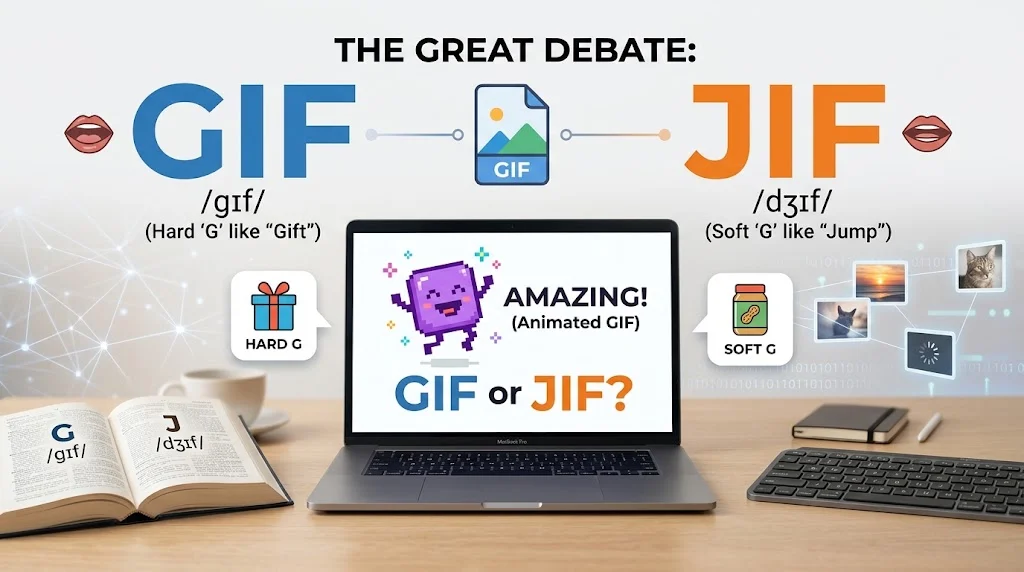
GIF or JIF refers to the same image file format, Graphics Interchange Format, but the pronunciation has caused a long running debate. “GIF” with a hard G is widely used, while “JIF” with a soft G also has strong historical support from the format’s creator.
If you say “GIF” with a hard G, you are using the pronunciation preferred by many English speakers, while “JIF” follows the soft G pronunciation associated with the format’s creator. Both pronunciations are widely recognized, and neither refers to a different file type.
The debate comes from English pronunciation patterns, the creator’s stated preference, and the unusual spelling of the acronym. For writers, students, designers, developers, and everyday internet users, the most important point is simple: GIF and JIF identify the same Graphics Interchange Format, not two different technologies.
GIF or JIF: What’s the Difference?
The biggest misconception is that GIF and JIF are two different digital formats. They are not. Both names refer to GIF, the acronym for Graphics Interchange Format, a bitmap image format developed by CompuServe and introduced in 1987.
The disagreement is about pronunciation, not meaning.
“GIF” is normally written with a capital G, I, and F because it is an acronym. When pronounced with a hard G, it sounds like “gift” without the final “t.” When pronounced with a soft G, it sounds like “jif.”
| Term | Meaning | Pronunciation | Usage |
| GIF | Graphics Interchange Format | Hard G | Extremely common |
| JIF | Pronunciation of GIF | Soft G | Historically supported |
| GIF file | An image using the GIF format | Usually hard G | Technical and everyday usage |
| Animated GIF | A GIF containing multiple frames | Both pronunciations | Common online |
Mini Recap
GIF is the actual name of the image format.
JIF is a pronunciation of the same term.
Neither pronunciation creates a separate file format.
The disagreement is linguistic rather than technological.
Is GIF or JIF a Grammar, Vocabulary, or Usage Issue?
The GIF or JIF debate is primarily a pronunciation and usage issue, although it also involves English phonetics and vocabulary.
It is not a grammar mistake to pronounce GIF either way. Grammar determines how words function in sentences, while pronunciation concerns how those words are spoken.
The situation becomes interesting because the letter G can represent different sounds in English. Consider “game” and “giant.” The G is hard in “game” but soft in “giant.” That means neither pronunciation is completely unreasonable from an English pronunciation perspective.
The creator of the format, Steve Wilhite, famously supported the soft G pronunciation. During his 2013 acceptance speech for a Webby Award, he reinforced the pronunciation “jif.” However, the hard G pronunciation had already become deeply established among English speakers.
Formal and Informal Usage
In professional writing, the safest approach is usually to write GIF rather than trying to represent its pronunciation as “JIF.”
For example:
The presentation includes an animated GIF.
In spoken conversation, either pronunciation is likely to be understood from context.
Academic Usage
Academic writing generally focuses on the format itself rather than the pronunciation controversy. If you are writing about digital communication, computer graphics, or internet culture, use the standard written form GIF.
Casual Usage
In everyday conversation, people commonly pronounce GIF with a hard G. Others deliberately use the soft G because they follow the creator’s preference or simply find that pronunciation more natural.
How to Use GIF in Everyday Communication
GIF is widely used as a noun when referring to an individual image file or the format itself.
Workplace Example
A marketing employee might say:
“I added a GIF to the company presentation to make the explanation more engaging.”
Here, GIF refers to an animated or visual image used for communication.
Academic Example
A student studying digital media might write:
“The GIF format became an important part of early online visual communication.”
In this context, GIF refers to the technology and its historical role.
Technology Example
A developer might explain:
“This website uses GIF files for short animated graphics.”
The term identifies the image format rather than a specific application.
Usage Recap
Use GIF when writing about the format.
In speech, either pronunciation can be understood.
The written form remains GIF regardless of how you pronounce it.
How to Understand JIF in Conversation
“JIF” is not normally a separate technical term for an image format. Instead, it represents the soft G pronunciation of GIF.
This distinction is important because writing “JIF” can make readers think you are referring to a different technology.
Workplace Example
A colleague might say:
“I usually pronounce GIF as JIF.”
The person is discussing pronunciation rather than identifying another file format.
Academic Example
A linguistics student could write:
“The pronunciation of GIF demonstrates how acronym pronunciation can generate language debates.”
Here, the subject is language usage.
Technology Example
A software engineer might say:
“The file is a GIF, although I pronounce the name JIF.”
This makes the distinction especially clear. The spelling identifies the format, while the pronunciation reflects the speaker’s preference.
Usage Recap
JIF is best understood as a pronunciation of GIF.
It does not describe a separate image format.
When writing technically, GIF remains the standard spelling.
When You Should NOT Use GIF or JIF
There are several situations where people can create unnecessary confusion.
- Do not treat GIF and JIF as different file formats. They refer to the same format.
- Do not write JIF when naming the official file extension. The standard extension is .gif.
- Do not claim that JIF is the official technical spelling. GIF is the established written form.
- Do not call GIF a video format. A GIF is an image format that can contain multiple frames and create animation.
- Do not assume that one pronunciation is automatically a grammar error. Pronunciation is different from grammar.
- Do not use JIF as a replacement for GIF in technical documentation. Readers expect the established spelling.
- Do not assume that everyone follows the creator’s preferred pronunciation. Language communities often develop their own conventions.
- Do not confuse the pronunciation debate with a software compatibility issue. The pronunciation does not change the underlying file.
Common Mistakes and Decision Rules
| Correct sentence | Incorrect sentence | Explanation |
| I sent you a GIF. | I sent you a JIF file. | GIF is the standard written name of the format. |
| I pronounce GIF as JIF. | JIF is a different image format. | JIF is commonly used to describe the pronunciation. |
| The website uses GIF images. | The website uses JIF images. | The standard technical spelling is GIF. |
| This GIF is animated. | This GIF is a video. | GIF is an image format, even when it contains animation. |
| How do you pronounce GIF? | Which file format is JIF? | The issue concerns pronunciation, not file type. |
Decision Rule Box
If you are writing about the file format, use GIF. If you are discussing pronunciation, you can explain that GIF may be pronounced with either a hard G or a soft G.
This rule avoids almost every common mistake surrounding the debate.
GIF or JIF in Modern Technology and AI Tools
GIF remains important in modern digital communication. Social media platforms, messaging applications, websites, online communities, and creative software frequently support animated GIFs.
AI tools have also made GIF creation easier. Modern systems can generate images, transform visual content, create short animations, and assist with multimedia workflows. Regardless of how a person pronounces the acronym, the underlying file format remains GIF.
The distinction is especially useful when discussing AI generated media. A generated animation may eventually be exported as a GIF, but calling it a JIF does not create a new technical category.
The Etymology of GIF and the Pronunciation Debate
GIF stands for Graphics Interchange Format. The format was developed by a team at CompuServe and introduced in 1987 as a way to exchange bitmap images efficiently across computer networks.
The pronunciation debate became famous because of the unusual relationship between the letter G and its possible sounds in English.
Steve Wilhite, one of the creators of the GIF format, supported the soft G pronunciation. His famous statement reinforced “JIF” as the preferred pronunciation from the creator’s perspective.
At the same time, millions of English speakers had already adopted the hard G pronunciation. As a result, both forms became firmly established in everyday language.
“The format has one spelling, but English speakers have developed two major pronunciations for it.”
This is a useful example of how real language usage can develop beyond a single authority’s preferred pronunciation.
Two Real World Case Studies
Case Study One: Digital Communication
Consider a workplace where employees exchange animated reactions through a messaging platform. One employee says “GIF” with a hard G, while another says “JIF.”
Nothing changes technically. Both employees are referring to the same type of image.
The practical result is that context resolves the disagreement without affecting communication.
Case Study Two: Technical Documentation
Imagine a software development team preparing documentation for users. The team writes “GIF” throughout the documentation and explains the pronunciation once if necessary.
This approach produces clearer technical communication because readers can immediately recognize the standard file extension and format name.
The concrete advantage is consistency. Users searching for information about .gif files can connect the written term in the documentation with the format used by their software.
Error Prevention Checklist
Always Use GIF When
You are writing the name of the image format.
Referring to a .gif file.
You are preparing technical documentation.
You are explaining web image formats.
Writing an academic or professional article.
Never Use JIF When
You mean a separate technical file format.
Naming the standard file extension.
You are trying to distinguish another image technology.
Replacing GIF in software documentation.
You want to suggest that JIF is a different format.
Related Grammar Confusions You Should Master
Understanding GIF and JIF also introduces a broader lesson about English pronunciation and usage. These related topics are worth studying:
- Acronyms and initialisms
- Hard G and soft G pronunciation
- Spelling versus pronunciation
- Homophones and near homophones
- Formal and informal language
- Technical vocabulary
- American and British pronunciation differences
- Abbreviations in English
- Internet slang and language change
- Pronunciation of brand names
Frequently Asked Questions About GIF or JIF
Is GIF pronounced GIF or JIF?
Both pronunciations are widely used. The hard G pronunciation is extremely common, while the soft G pronunciation was supported by GIF creator Steve Wilhite.
Is JIF a different file format from GIF?
No. JIF is not a separate standard image format in this context. It is commonly used to represent the soft G pronunciation of GIF.
Why do people pronounce GIF as JIF?
The soft G pronunciation is partly associated with the pronunciation of the G in words such as “giant.” Steve Wilhite also supported this pronunciation.
Why do people pronounce GIF with a hard G?
Many English speakers naturally interpret the G in GIF as a hard G, similar to the sound in “gift.” This pronunciation became extremely widespread.
What does GIF stand for?
GIF stands for Graphics Interchange Format. It is a bitmap image format that can also contain multiple frames for animation.
Is GIF a video or an image?
GIF is an image format. An animated GIF can contain multiple frames that create the appearance of motion, but the format itself is classified as an image format.
Should I write GIF or JIF?
Use GIF when writing the name of the format. JIF can be used informally when discussing or representing the soft G pronunciation.
Which pronunciation is officially correct?
There is no universally accepted pronunciation that makes the alternative a grammatical error. The creator preferred the soft G pronunciation, but the hard G pronunciation is firmly established in widespread usage.
Does pronunciation affect how a GIF file works?
No. Pronouncing GIF with a hard G or soft G has absolutely no effect on the file, its quality, animation, compatibility, or technical function.
Conclusion
The GIF or JIF debate is ultimately a fascinating example of how language develops around technology. GIF is the standard written name for Graphics Interchange Format, while JIF represents the soft G pronunciation used by many speakers and supported by the format’s creator. The hard G pronunciation is also deeply established in everyday English.
Therefore, there is no need to treat GIF and JIF as competing file formats. When writing professionally, technically, or academically, use GIF. When speaking, either pronunciation can be understood, making the debate more about English usage and pronunciation than about technology.

Neil Gaiman is an American writer who contributes educational content to LingRoya.com. His work focuses on helping readers improve their English with clear, practical and easy to follow guidance.