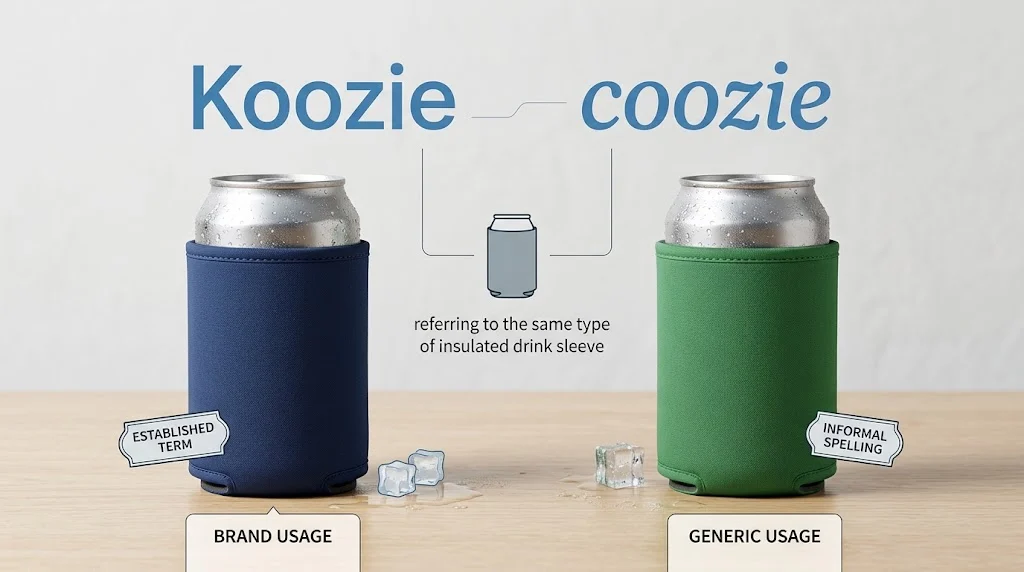
Quick Answer: Koozie and coozie usually refer to the same insulated sleeve used around a can or bottle to help keep a beverage cold and reduce condensation. Koozie is the established trademark spelling associated with the Koozie brand, while coozie is a commonly used alternative spelling. For a clearly generic term, use can cooler or drink sleeve.
Have you ever typed koozie or coozie and wondered whether one spelling is simply wrong? This small spelling question actually involves vocabulary, everyday usage, and trademark conventions. Both forms are commonly understood as an insulated drink holder, but they do not have exactly the same status.
Koozie has a documented brand history, while coozie appears as an informal alternative form. Understanding this distinction helps you choose the right wording for casual conversation, academic writing, workplace communication, and commercial content.
Koozie or Coozie: What’s the Difference?
The main difference between koozie and coozie is not their basic meaning. Both are generally used to describe an insulated sleeve that fits around a beverage can or bottle. The important distinction involves spelling, brand identity, capitalization, and context.
Koozie functions primarily as a noun when people use it informally to describe a drink holder. When referring to the actual trademarked brand, however, Koozie® is a trademark and should be treated according to the brand’s usage requirements.
Coozie is an alternative spelling used in everyday English. It is generally understood from context and often refers to the same type of beverage sleeve.
| Feature | Koozie | Coozie |
| Basic meaning | Insulated drink sleeve | Insulated drink sleeve |
| Part of speech | Noun | Noun |
| Common pronunciation | KOO zee | KOO zee |
| Brand status | Koozie® is a trademark | Not the trademark spelling |
| Everyday usage | Very common | Common alternative |
| Formal generic wording | Can cooler is clearer | Can cooler is clearer |
| Typical context | Casual speech and brand references | Casual speech and informal writing |
The two forms usually point to the same physical object.
The difference becomes important when branding or commercial writing is involved.
For a generic product, can cooler is clearer and safer.
For the specific brand, Koozie® is the appropriate branded form.
Is Koozie or Coozie a Grammar, Vocabulary, or Usage Issue?
This is primarily a vocabulary and usage issue, rather than a traditional grammar problem.
Neither spelling represents a different grammatical action or concept. Both are nouns when they describe an insulated beverage holder. The confusion comes from the fact that English speakers encounter multiple spellings for a word that sounds essentially the same.
In casual conversation, you may hear either form without anyone misunderstanding you. A person saying, “Put the bottle in the coozie,” will normally be understood immediately.
Formal writing requires more care. If you are writing an academic paper, professional product description, company policy, or ecommerce listing, can cooler, drink sleeve, or beverage insulator may communicate the meaning more precisely.
The brand distinction is especially important for businesses. Koozie Group’s published brand standards state that Koozie® should be used as a trademark with a generic product description rather than as the generic noun for every drink cooler.
How to Use Koozie Correctly
The spelling koozie is widely recognized in casual American English. It is often used as a noun for an insulated sleeve around a beverage container.
When referring specifically to the trademarked product, use Koozie® rather than treating the word as the generic name of every drink cooler. The official brand guidance recommends constructions such as Koozie® can coolers rather than using Koozie as the generic product category.
Workplace Example
The marketing team ordered branded Koozie® can coolers for the company event.
Here, the word identifies a branded product and appears with its generic product description.
Academic Example
The researchers examined how insulated drink sleeves influence beverage temperature during outdoor activities.
In academic writing, drink sleeve or beverage insulator is generally clearer than relying on a brand associated term.
Technology Example
The event website lets customers personalize their drink sleeves with names and company logos.
A generic expression such as drink sleeve works particularly well in technology, ecommerce, and interface content.
Usage recap: Use Koozie® when you mean the trademarked brand. Use can cooler or drink sleeve when you mean the product category generally.
How to Use Coozie Correctly
Coozie is commonly encountered as an alternative spelling for an insulated beverage sleeve. It is especially natural in casual conversation, social media, informal messages, and everyday writing.
For example, someone might say, “I brought a coozie for my soda,” and the meaning would be clear.
The spelling does not normally create a different meaning from koozie. Instead, it reflects the flexible nature of informal vocabulary.
Workplace Example
I packed a coozie for the outdoor staff picnic.
This is understandable in a casual workplace message, although can cooler may be preferable in formal company documentation.
Academic Example
The survey asked participants whether they regularly used a coozie to keep canned drinks cold.
The sentence is understandable, but a research paper could use insulated beverage sleeve for greater precision.
Technology Example
The shopping app recommends a coozie when customers select canned beverages for outdoor events.
For professional interface writing, can cooler would usually be more direct.
Usage recap: Coozie is recognizable as an alternative spelling, but formal and commercial writing often benefits from the clearer generic expression can cooler.
When You Should Not Use Koozie or Coozie
There are several situations where choosing a more precise expression is better.
- Do not use Koozie as though every drink cooler is automatically a Koozie branded product.
- Do not use Koozie as a generic noun in commercial writing when you are describing products from multiple manufacturers.
- Do not assume coozie is a completely separate object from koozie.
- Do not use either spelling in highly formal writing when beverage insulator communicates the meaning more precisely.
- Do not capitalize coozie simply because it refers to a drink holder.
- Do not treat coozie as a completely incorrect spelling in casual English.
- Do not use Koozie® for an unrelated product unless you are actually referring to the brand.
- Do not confuse these forms with cozy, which is an ordinary English adjective meaning comfortable or snug.
Common Mistakes and Decision Rules
| Correct sentence | Incorrect sentence | Explanation |
| I put my can in a coozie. | I put my can in a coozie because it is a different product from a koozie. | The two forms generally describe the same type of drink sleeve. |
| The company ordered Koozie® can coolers. | The company called every drink cooler a Koozie®. | The trademark refers to the branded product. |
| We need ten can coolers for the event. | We need ten Koozies from several unrelated brands. | The generic term avoids unnecessary brand confusion. |
| She bought an insulated drink sleeve. | She bought an insulated drink action. | A drink sleeve is a physical object, not an action. |
| He placed the bottle inside a coozie. | He placed the bottle inside a cozy. | Cozy has a different ordinary English meaning. |
Decision Rule Box
If you mean the trademarked brand, use Koozie®.
When you mean the product generally, use can cooler or drink sleeve.
If you are writing casually, coozie is understandable as an alternative spelling.
Do not treat koozie and coozie as two different products.
Koozie and Coozie in Modern Technology and AI Tools
Modern technology has made spelling variation more visible because users encounter product names across search engines, ecommerce websites, online marketplaces, social media, and AI generated text.
Search systems can usually understand that koozie, coozie, can cooler, and drink sleeve can refer to closely related concepts. However, semantic understanding does not eliminate the importance of accurate terminology.
For ecommerce businesses, the distinction is particularly useful. A seller describing a generic product can use can cooler or insulated drink sleeve to make the product category immediately clear. A seller discussing a genuine Koozie® product should preserve the brand’s trademark usage.
AI writing tools can also produce inconsistent capitalization because they learn from both branded and informal language. Human review remains valuable when trademark terminology appears in commercial content.
The Etymology and History Behind Koozie
The history of Koozie is closely connected with its trademark status. The Koozie brand became associated with insulated beverage coolers, and the term subsequently became widely used in everyday language to describe similar products.
That broad everyday usage helps explain why people now encounter spellings such as koozie and coozie outside official brand contexts. The trademark owner itself makes an important distinction between Koozie® branded products and generic can coolers.
The related word cozy, meanwhile, has a much older English history. Dictionary sources trace cozy to Scots and possibly Scandinavian origins, with the meaning connected to comfort and warmth.
This similarity in sound likely contributes to some of the spelling confusion surrounding drink sleeves.
An Expert Perspective on Koozie or Coozie
“The most useful distinction is not simply correct spelling versus incorrect spelling, but brand usage versus generic product terminology.”
That principle reflects a broader lesson in English vocabulary. Words can develop informal meanings that become much wider than their original commercial or historical use. Good writing recognizes both everyday language and precise terminology.
Two Practical Case Studies
Case Study One: A Workplace Promotion
Imagine a company preparing promotional products for a summer event. The marketing team wants to order several hundred insulated beverage sleeves from different suppliers.
Calling every item a Koozie could create unnecessary brand confusion. A more precise product specification would be custom can coolers or custom insulated drink sleeves.
The result is clearer communication between marketing, purchasing, and suppliers.
Case Study Two: An Online Store
Consider an online shop selling an insulated foam sleeve made by an independent manufacturer.
If the product description repeatedly calls the item a Koozie®, customers may interpret that as a reference to the established brand rather than the generic product category.
Using insulated can cooler in the product title makes the category immediately understandable. The store can still mention compatibility, insulation, materials, and design without creating unnecessary terminology confusion.
These examples demonstrate why precise vocabulary matters even when two forms are easily understood in everyday speech.
Error Prevention Checklist
Always use Koozie when
You are specifically referring to the Koozie® brand.
Discussing a genuine branded Koozie® product.
You are following the brand’s official naming conventions.
Never use Koozie when
You are describing every insulated drink sleeve as though it belongs to that brand.
Need a completely generic product description.
You are writing technical or academic material where can cooler or beverage insulator is more precise.
Related Grammar Confusions You Should Master
Understanding koozie or coozie can also lead you to other useful vocabulary distinctions. Consider studying:
- Cozy or cosy
- Color or colour
- Theater or theatre
- Traveling or travelling
- Whisky or whiskey
- Realize or realise
- Sneaked or snuck
- Adviser or advisor
- Toward or towards
- Practice or practise
These comparisons demonstrate an important principle: English spelling differences can involve regional conventions, historical development, pronunciation, branding, and actual differences in meaning.
Frequently Asked Questions About Koozie or Coozie
Is Koozie or coozie the correct spelling?
Both forms are used, but Koozie® is the established trademark spelling, while coozie is commonly used as an alternative spelling for the same type of insulated drink sleeve.
Is coozie a misspelling of koozie?
Not necessarily. Coozie is widely used as an alternative form, although it is not the trademark spelling of the Koozie brand.
What is a koozie used for?
A koozie is used around a beverage can or bottle to help insulate the drink, slow warming, and reduce condensation on the outside.
What is the generic word for a Koozie?
Can cooler, drink sleeve, and beverage insulator are clear generic terms for this type of product.
Should Koozie be capitalized?
Capitalize Koozie when referring to the trademarked brand. The official brand standards specify Koozie® when the trademark symbol is available.
How do you pronounce Koozie?
Koozie is commonly pronounced approximately KOO zee, with the first syllable receiving the main stress.
Is a coozie the same as a can cooler?
In everyday usage, yes. Coozie commonly refers to the same kind of insulated sleeve used to hold a beverage can or bottle.
Is Koozie a brand name?
Yes. Koozie® is a trademarked brand associated with insulated beverage products, and the brand’s usage guidance distinguishes its products from generic can coolers.
Which spelling should I use in formal writing?
For formal or professional writing, can cooler, drink sleeve, or beverage insulator is often the clearest generic choice. Use Koozie® when specifically discussing the brand.
Conclusion
When comparing koozie or coozie, the most important point is that both forms generally refer to the same type of insulated beverage sleeve. The difference is mainly related to spelling, brand status, and context rather than meaning. Koozie® is the established trademark spelling, while coozie is a commonly encountered alternative form.
For formal, academic, or commercial writing, can cooler or drink sleeve often provides the clearest generic wording. Once you understand this distinction, you can choose terminology confidently without treating a familiar spelling variation as a completely different word.

Philip Pullman is an American writer dedicated to creating clear and easy to follow English content. Through his work at LingRoya.com, he helps readers strengthen their language skills with practical and reliable guidance so that they can easily understand.