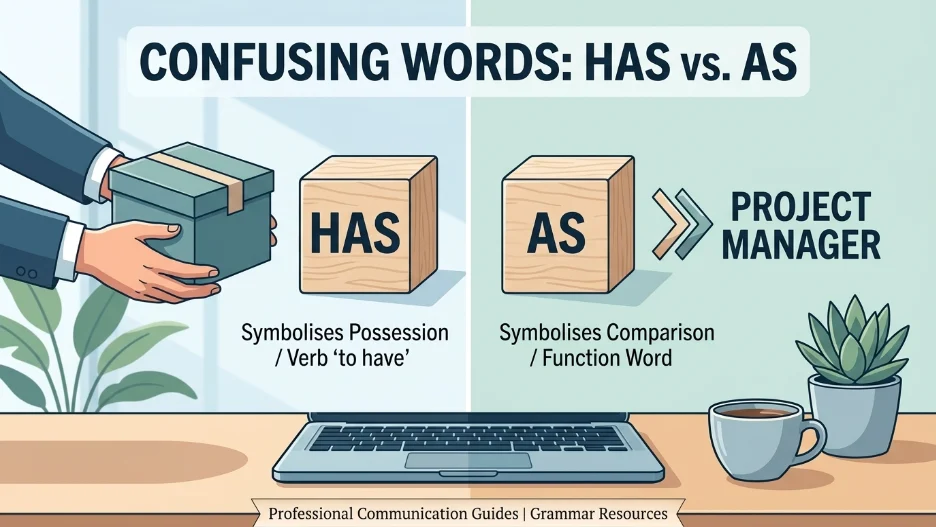
Has and as are often confused, but they have completely different roles in English. Has is a verb that means to possess or own something, and it is used with he, she, or it. As is a function word used for comparison, to indicate a role, or to express time, reason, or manner. Understanding this basic distinction helps you avoid common grammatical mistakes in writing.
Confusion between has and as leads to sentences like “She as a car” or “He works has a teacher.” These errors make writing sound unprofessional. They can also change the meaning of a sentence. The issue matters because both words appear frequently in everyday writing. They show up in emails, reports, and even text messages.
By learning the difference, you will avoid embarrassing mistakes. This article will explain each word in detail. It will provide examples from work, school, and technology. You will also find a decision rule to help you choose correctly every time.
Has vs As: What’s the Difference?
The difference between has and as is clear when you examine their parts of speech and meanings.
Has is a verb. Specifically, it is the third person singular present tense form of the verb to have. It means to possess, own, or hold something. It can also indicate that an action has been completed. Has is used with the pronouns he, she, and it, or with singular nouns. For example, “She has a new car” means she possesses it. “He has finished his homework” means the action is done. This is one of the most common verbs in English.
As is a function word with many uses. It can be a preposition, a conjunction, or an adverb. As a preposition, it means in the capacity or role of something. “She works as a teacher” explains her role. As a conjunction, it can show comparison, as in “as tall as a tree.” It can also indicate time, as in “I saw him as I left.” Or it can show a reason, as in “I stayed home as I was tired.” As has many meanings, but it never acts as a verb.
The following table summarises the core differences.
| Feature | Has | As |
| Part of Speech | Verb (third person singular of have) | Preposition, conjunction, adverb |
| Main Meaning | To possess, own, experience, or complete an action | In the role of, like, for the reason that, while |
| Examples | He has a dog. She has gone home. | He works as a doctor. It is as big as a house. I stayed as I was tired. |
| Usage with Pronouns | He, she, it (or singular nouns) | Can be used with all pronouns and nouns |
| Function | Expresses ownership, relation, or action | Links ideas, compares, shows role, gives a reason |
Mini Recap: The Core Difference
In short, has is a verb that shows possession or past action. As is a connector word used for comparisons, roles, or to show a relationship between two ideas. Remember this simple rule: if you need a verb, choose has. If you need a connector, choose as.
Is Has vs As a Grammar, Vocabulary, or Usage Issue?
This confusion is mainly a grammar and usage issue, not vocabulary. Both words are common and have distinct definitions. The problem lies in understanding their grammatical functions.
The words are not interchangeable. Mixing them up is a grammatical error because you are using a verb where a connector is needed, or vice versa. This type of mistake often happens when typing quickly, as the letters are close on the keyboard.
The usage of both words varies in formality. Has is a standard verb used across all levels of English. As is also standard, but its function changes depending on how it is used. For instance, using as to mean because is perfectly fine in most contexts, though it might be considered more formal than because in some cases. Both words are acceptable in academic and casual writing when used correctly.
Practical Usage: When to Use Has
Has is the go to word when you are talking about what someone or something owns, possesses, or has experienced. It is the singular form of the verb have.
Workplace Example
In a professional setting, you often need to describe ownership or status. Has is essential here. You might say, “The marketing team has a new strategy.” Or, “The CEO has approved the budget.” To talk about a candidate’s qualifications, you could write, “She has ten years of experience in project management.” Using has correctly adds clarity and authority to your business writing.
Academic Example
In school or university, has is just as important. A student might write, “The study has a significant impact on the field.” An instructor could say, “The theory has been proven correct.” When discussing research, you might note, “The data has several limitations.” Has helps you convey facts and research findings clearly.
Technology Example
In the tech world, has is used to describe features, updates, and requirements. For example, “The new software has a better user interface.” Or, “The system has encountered an error.” “The device has 256 gigabytes of storage.” This word is crucial for communicating specifications and statuses in IT.
Usage Recap for Has
Has is the verb you need for possession, completion, and relation when the subject is he, she, it, or a singular noun. It is essential for describing what a person or thing owns, experiences, or does.
Practical Usage: When to Use As
As is a multifunctional word. Its job is to connect other words, phrases, or clauses. It can show a role, make a comparison, or indicate time or reason.
Workplace Example
In the office, you might describe someone’s function. “She works as a project manager.” This defines her role. You might need to compare things: “This quarter’s revenue is not as high as last quarter’s.” This compares two things. You can also give a reason: “We delayed the launch as the product needed more testing.” This explains why something happened.
Academic Example
As is also crucial in academia. A researcher might write, “This study serves as a foundation for future research.” This describes its role. They might compare findings: “The results were not as conclusive as the previous study.” They might also give a reason: “We repeated the experiment as the initial results were inconsistent.” As is used to build logical connections between ideas.
Technology Example
In technology, as is frequently used. “Use this button as a shortcut to open the menu.” You might describe a part’s function: “The circuit acts as a filter.” Comparisons are common: “The old server is not as fast as the new one.” You might also reason: “We chose this platform as it is more scalable.” As helps to define functions and relationships in a technical context.
Usage Recap for As
As is your tool for comparing, defining roles, explaining reasons, and setting a time. It connects ideas and adds nuance to your sentences. It is never a verb.
When You Should NOT Use Has or As
Mistakes with has and as are common. Knowing when not to use each word is just as helpful as knowing when to use them.
When Not to Use Has
- Do not use has with plural subjects. It is incorrect to say, “The students has a question.” Use have instead. The correct sentence is “The students have a question.”
- Do not use has with the pronouns I, you, we, or they. “I has a problem” is wrong. Say “I have a problem.”
- Do not use has to compare things. The sentence “My car is has fast as yours” is wrong. You should use as. The correct sentence is “My car is as fast as yours.”
- Do not use has to describe a role. It is wrong to say, “He works has a manager.” You should use as. The correct sentence is “He works as a manager.”
- Do not use has as a connector. The phrase “The meeting was cancelled has everyone was sick” is incorrect. Use as to give a reason. The correct sentence is “The meeting was cancelled as everyone was sick.”
When Not to Use As
- Do not use as as the main verb in a sentence. “He as a new car” is wrong. The main verb should be has. The correct sentence is “He has a new car.”
- Do not use as to show possession. The sentence “She as a lot of experience” is incorrect. The verb has is needed. The correct sentence is “She has a lot of experience.”
- Do not use as with he, she, or it to indicate a completed action. “He as finished” is a major error. The correct phrase is “He has finished.”
- Do not use as when using present perfect tense. You would never say, “They as been here.” You must say, “They have been here.” For he, she, or it, it is “He has been here.”
- Do not use as to mean the past tense. As is never used to show a past action. Had is the past tense of have, not as.
Common Mistakes and Decision Rules
To help you avoid errors, here is a table that shows common mistakes and how to correct them. Following the table is a simple decision rule.
| Correct Sentence | Incorrect Sentence | Explanation |
| He has a dog. | He as a dog. | “He” requires the verb has to show possession. |
| She works as a nurse. | She works has a nurse. | “A nurse” is a role, so the connector as is needed. |
| It is as big as a house. | It is has big has a house. | Has is a verb, not a comparison word. Use as. |
| I have been there before. | I has been there before. | “I” requires the verb have, not has. |
| The CEO has left the office. | The CEO as left the office. | Left is an action, so it needs the helping verb has. |
| He was hired as a consultant. | He was hired has a consultant. | “A consultant” is a role, so as is the correct choice. |
| The computer has a virus. | The computer as a virus. | Has shows that the computer possesses a virus. |
The Decision Rule Box
To ensure you always choose the right word, follow this simple rule.
- If you mean the action of possessing or the action of completing something, use HAS. Think of ownership, relations, and finished actions (he, she, it).
- If you mean the role, comparison, reason, or time, use AS. Think of connecting ideas and describing how something is.
Has and As in Modern Technology and AI Tools
The confusion between has and as is even more relevant with the rise of AI writing assistants. Tools like grammar checkers and AI content generators often suggest corrections for these words. However, they are not always perfect. Understanding the distinction yourself is still the best way to ensure your writing is correct.
Many AI models are trained on large datasets that contain errors. Sometimes they might miss a mistake or even suggest an incorrect replacement. If you rely solely on a machine to check your work, you might miss a subtle error. For example, an AI tool might not correctly identify that a sentence is using has as a helping verb, leading to a false error flag.
Knowing the difference makes you a better editor, both of your own work and of the content produced by AI. It allows you to proofread quickly and fix mistakes that a machine might overlook. It is also a test of your own language skill. Every time you write, you are building confidence in your ability.
The History of Has and As
The words has and as have deep roots in the English language. Understanding their origins can make their distinct roles clearer.
Has comes from the Old English word hæfþ, which is the third person singular form of habban, meaning to have or possess. This ties it directly to its core meaning of ownership and experience. The word has a Germanic origin, and it has been a part of the language for over a thousand years. Its function as a helping verb evolved alongside its use as a main verb.
As has a more complex history. It can be traced back to the Old English ealswā, meaning “also” and “like.” This origin explains its modern use as a connector and a word of comparison. Over time, its spelling and pronunciation shifted to the simpler as. Its use to mean because came later, showing how its meaning has expanded.
Expert Quote on Mastering Grammar
“Grammar is not a set of arbitrary rules but a system that allows us to communicate with precision and clarity. Mastering distinctions like has and as is not about pedantry; it is about ensuring your message is received exactly as you intended.”
Dr. Steven Pinker, cognitive psychologist and linguist.
Case Studies: The Impact of the Has vs As Error
These case studies show how a simple mix up can affect different situations.
Case Study 1: The Job Application
A candidate named Maria submitted a cover letter for a marketing position. In the final paragraph, she wrote, “I as managed teams of five people.” She sent this to a prestigious agency. The hiring manager saw the error immediately. The mistake created a negative first impression. The manager questioned the candidate’s attention to detail. Maria was not called for an interview. A simple grammatical mistake cost her the opportunity to get her foot in the door.
Case Study 2: The Technical Report
A software engineer named David wrote a report on a recent system update. He stated, “The new system as a new security protocol.” The report was shared with the entire product team. Another engineer had to correct the error during a meeting. The mistake caused a brief moment of confusion. It also made the initial report look unprofessional. While the mistake was corrected, David’s credibility took a small hit. The team spent extra time proofreading his work in future reports.
Error Prevention Checklist
Use this quick checklist to proofread your own work.
Always Use Has When:
- You are using the subject he, she, or it (or a singular noun like the dog or the company).
- You are showing possession (e.g., She has a car).
- You are showing that an action is completed (e.g., He has gone to the store).
- You are creating the present perfect tense (e.g., It has been raining).
Never Use Has When:
- You are using a plural subject (use have).
- You are using the pronouns I, you, we, or they (use have).
- You are making a comparison (use as).
- You are describing a role (use as).
- You are giving a reason for something (use as).
Related Grammar Confusions You Should Master
Other common word pairs often get confused. Here is a list of related topics you should master to become a stronger writer.
- Affect vs Effect
- Then vs Than
- Your vs You’re
- Its vs It’s
- There vs Their vs They’re
- Who vs Whom
- Lie vs Lay
- To vs Too vs Two
- Accept vs Except
- Advice vs Advise
FAQsThese FAQs are clear, but here’s a more polished, SEO-friendly version with improved grammar and readability.
FAQs About Has vs. As
1. What is the difference between has and as in English grammar?
Has is a verb and the third person singular form of have. It shows possession or helps form the present perfect tense (e.g., “He has a book” or “She has finished her work”). As is a preposition, conjunction, or adverb used to show a role, comparison, time, or reason (e.g., “She works as a teacher” or “He is as tall as his brother”).
2. Is it “she has” or “she as”?
The correct phrase is “she has.” Since she is a third person singular subject, it always takes has. “She as” is grammatically incorrect because as is not a verb.
3. Can I use as instead of has in the present perfect tense?
No. The present perfect tense requires have or has as the helping verb. For example, “He has finished the report” is correct, while “He as finished the report” is incorrect.
4. When do I use has and as in a sentence?
Use has to show possession or as an auxiliary verb in perfect tenses, such as “She has a laptop” or “He has arrived.” Use as to express a role, comparison, time, or reason, as in “She works as a designer” or “He smiled as he walked away.”
5. What is the rule for using has?
Use has with he, she, it, and singular nouns. Use have with I, you, we, they, and plural nouns.
6. Is it correct to say “as has been mentioned”?
Yes. “As has been mentioned” is a correct and formal expression. Here, as introduces a reference to something stated earlier, while has functions as the auxiliary verb in the passive construction “has been mentioned.”
7. How do I choose between has and had?
Use has for the present with singular third person subjects (e.g., “She has a meeting today.”). Use had for the past or the past perfect tense (e.g., “She had already left before I arrived.”).
8. Why do people confuse as and has?
People often confuse as and has because the words look and sound similar, especially when typing quickly. However, they serve completely different grammatical functions: has is a verb, while as is used as a conjunction, preposition, or adverb. Understanding their roles makes it easier to choose the correct word.
Conclusion
Mastering the difference between has and as is a straightforward way to improve your writing. Has is the verb you need for possession and action. As is the connector you use for comparisons, roles, reasons, and time. Remember the simple rule: if you mean the action, use has; if you mean the role or comparison, use as. With practice, this distinction will become second nature. You will write with more confidence and precision.

Philip Pullman is an American writer dedicated to creating clear and easy to follow English content. Through his work at LingRoya.com, he helps readers strengthen their language skills with practical and reliable guidance so that they can easily understand.