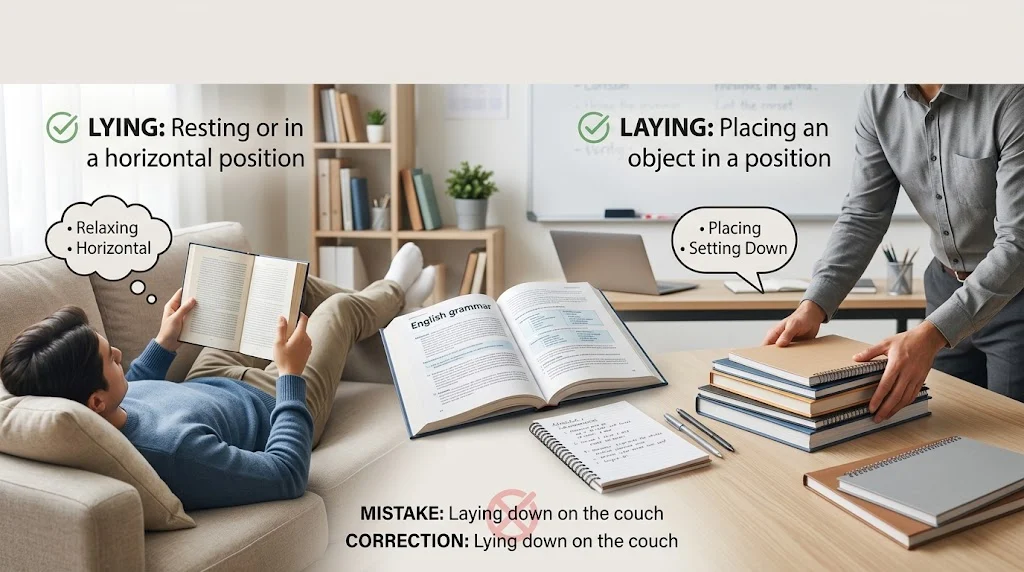
Lying describes someone or something resting in a position, while laying describes the act of putting or placing something somewhere. For example, “I am lying on the sofa” is correct, but “I am laying the book on the desk” is correct because the book is being placed somewhere. The confusion comes from the different forms of the verbs lie and lay.
Few English grammar mistakes create as much confusion as lying or laying because both forms sound natural in conversation but follow different grammatical patterns. The important distinction is simple: lie means to rest or recline, while lay means to put or place something. This difference matters in workplace writing, academic assignments, editing, and professional communication because choosing the wrong verb can change the meaning of a sentence.
English learners often struggle because the past tense of lie is lay, which makes the forms appear interchangeable. Once you understand what the subject is doing and whether an object receives the action, choosing the correct form becomes much easier.
Lying vs Laying: What’s the Difference?
The easiest way to understand these verbs is to focus on the action.
Lie is an intransitive verb. It means to rest, recline, or remain in a particular position. It does not normally take a direct object.
Examples:
“I am lying on the bed.”
“The documents are lying on the desk.”
“Her phone is lying beside the laptop.”
Lay is a transitive verb. It means to put or place something somewhere. It normally needs a direct object.
Examples:
“I am laying the documents on the desk.”
“She is laying the baby in the crib.”
“He is laying the keys beside the computer.”
| Form | Meaning | Example |
| Lie | To rest or recline | I lie on the sofa. |
| Lying | Resting or reclining | I am lying on the sofa. |
| Lay | To put or place something | I lay the book on the table. |
| Laying | Putting or placing something | I am laying the book on the table. |
Mini Recap
Lie describes the position of the subject.
Lay describes an action performed on an object.
Lying is the present participle of lie.
Laying is the present participle of lay.
The presence of a direct object is often the fastest clue.
Is Lying vs Laying a Grammar, Vocabulary, or Usage Issue?
The difference is primarily a grammar and usage issue, rather than simply a vocabulary problem. The two words come from different verbs and perform different grammatical functions.
They are not interchangeable in standard English. If someone is resting, use a form of lie. If someone is placing something, use a form of lay.
The confusion becomes especially difficult because the past tense of lie is lay.
Consider these forms:
“I lie down every afternoon.”
“Yesterday, I lay down after lunch.”
“I am lying down now.”
Meanwhile:
“I lay the book on the table every day.”
“Yesterday, I laid the book on the table.”
“I am laying the book on the table now.”
This difference applies in formal writing, academic English, workplace communication, and careful everyday speech. Informal conversation may contain incorrect forms, but frequent usage does not make the grammar standard.
How to Use Lying Correctly
Use lying when the subject is resting, reclining, or remaining in a particular position.
Workplace Example
“The report is lying on my desk.”
Here, the report is simply located on the desk. Nobody is actively putting it there at that moment.
Academic Example
“The manuscript was lying beside the research notes.”
The sentence describes the position of the manuscript.
Technology Example
“The tablet is lying next to the keyboard.”
The tablet is resting in a location rather than being actively placed there in the sentence.
Usage Recap
Use lying when something or someone is already resting or positioned somewhere. It does not normally need a direct object after it.
How to Use Laying Correctly
Use laying when someone is actively putting or placing something somewhere.
Workplace Example
“I am laying the contracts on the manager’s desk.”
The speaker is actively placing the contracts.
Academic Example
“The researcher is laying the samples on the laboratory tray.”
The samples receive the action.
Technology Example
“She is laying the smartphone beside the charging station.”
The smartphone is the object being placed.
Usage Recap
Use laying when there is an object receiving the action of placing. A useful question is: What is being placed? If you can answer that question, laying may be the correct form.
When You Should NOT Use Lying or Laying
Several common situations create mistakes.
- Do not use laying simply because someone is resting.
Incorrect: “I am laying on the couch.”
Correct: “I am lying on the couch.”
- Do not use lying when someone is actively placing an object.
Incorrect: “She is lying the files on the table.”
Correct: “She is laying the files on the table.”
- Do not confuse the past tense of lie with the present form of lay.
“Yesterday, I lay on the sofa” is correct.
- Do not assume that lay always means placing.
In “He lay on the floor,” lay is the past tense of lie.
- Do not choose the word based only on pronunciation.
Listen for the meaning and identify whether an object receives the action.
- Do not rely on casual speech as a grammar guide.
People often say “I was laying down,” but standard English uses “I was lying down.”
- Do not ignore the object.
If an object is being placed, a form of lay is usually appropriate.
Common Mistakes and Decision Rules
| Correct sentence | Incorrect sentence | Explanation |
| I am lying on the bed. | I am laying on the bed. | The subject is resting. |
| She is laying the book down. | She is lying the book down. | The book receives the action. |
| He lay on the sofa yesterday. | He lied on the sofa yesterday. | Lay is the past tense of lie. |
| They are laying the papers on the desk. | They are lying the papers on the desk. | The papers are being placed. |
| The dog is lying near the door. | The dog is laying near the door. | The dog is resting. |
Decision Rule Box
If you mean resting or reclining, use a form of lie, such as lying.
If you mean putting or placing something, use a form of lay, such as laying.
The most reliable test is to ask whether there is an object receiving the action.
Lying or Laying in Modern Technology and AI Tools
Modern technology creates many sentences where these verbs can appear naturally.
For example:
“The laptop is lying on the desk.”
This describes the laptop’s position.
“The technician is laying the cables along the floor.”
This describes the technician placing the cables.
The same distinction applies to AI generated text. Grammar checking tools may identify obvious errors, but they can sometimes struggle with context because lay has multiple grammatical roles. Human understanding remains important when a sentence contains ambiguous verb forms.
For AI writing, the safest method is to identify the underlying verb first. Ask whether the sentence means resting or placing. Then select the appropriate form.
A Short Etymology of Lie and Lay
The verbs lie and lay have deep roots in English and Germanic language history. Their relationship is partly responsible for the confusion found in modern English.
The verb lie developed from an older Germanic verb associated with resting or remaining in a position. The verb lay developed from another Germanic verb associated with putting or placing something.
Their forms became particularly confusing because the past tense of lie is lay.
That gives us:
Present: lie
Past: lay
Past participle: lain
Present participle: lying
For the other verb:
Present: lay
Past: laid
Past participle: laid
Present participle: laying
Expert Style Principle
“The safest choice is to identify the action first, then choose the verb form that expresses it.”
This principle works because the meaning comes before the spelling. Instead of memorizing isolated examples, determine whether the sentence describes a position or an act of placement.
Two Practical Case Studies
Case Study One: Workplace Editing
Imagine an employee writes:
“The signed contracts are laying on the director’s desk.”
The intended meaning is that the contracts are already there. Since the contracts are resting in a location, the corrected version is:
“The signed contracts are lying on the director’s desk.”
The correction improves grammatical accuracy without changing the intended meaning. In a professional document, this small change can make the writing appear more polished and carefully edited.
Case Study Two: Academic Writing
Consider a student writing:
“The researcher was laying near the equipment after the experiment.”
The sentence sounds incorrect because the researcher is not placing something. The intended meaning is that the researcher was reclining or resting.
The improved sentence is:
“The researcher was lying near the equipment after the experiment.”
The distinction is important because academic writing depends on precise descriptions of actions and condition.
Error Prevention Checklist
Always use Lying when
The subject is resting.
The subject is reclining.
Something is already positioned somewhere.
You are describing a state rather than an act of placement.
Never use Laying when
You mean that someone or something is simply resting.
There is no object receiving the action of placement.
You are describing someone reclining on a surface.
You are talking about the present participle of lie.
Related Grammar Confusions You Should Master
Understanding lying or laying becomes easier when you also understand other commonly confused forms. These topics are closely connected to verb forms, tense, and usage.
- Lie vs lay
- Lay vs laid
- Lain vs laid
- Sitting vs setting
- Rise vs raise
- Sit vs set
- Affect vs effect
- Advice vs advise
- Breathe vs breath
- Their vs there vs they’re
Mastering these distinctions can significantly improve clarity in academic, workplace, and everyday English.
Frequently Asked Questions About Lying or Laying
Is it correct to say “I am laying down”?
In standard English, use “I am lying down” when you mean that you are resting or reclining.
What is the difference between lying and laying?
Lying means resting or being in a position, while laying means putting or placing something somewhere.
Is “laying on the bed” grammatically correct?
It is usually incorrect when you mean that someone is resting on the bed. The standard form is “lying on the bed.”
Is “laying the book on the table” correct?
Yes. “Laying the book on the table” is correct because the book is the object being placed.
What is the past tense of lie?
The past tense of lie, meaning to rest or recline, is lay. For example, “Yesterday, I lay on the sofa.”
What is the past tense of lay?
The past tense of lay is laid. For example, “She laid the book on the desk yesterday.”
Should I say “lying down” or “laying down”?
Use “lying down” when you mean resting or reclining. “Laying down” requires an object, such as “laying down the book.”
Why is lying and laying so confusing?
The forms are confusing because the past tense of lie is lay, while lay is also a separate verb meaning to put or place something.
Can AI grammar tools distinguish lying from laying?
Many grammar tools can identify obvious errors, but context can affect the result. Understanding the meaning of the sentence remains the most reliable method.
Conclusion
The difference between lying or laying becomes much simpler once you focus on the action. Use lying when someone or something is resting, reclining, or remaining in a position. Use laying when someone is actively putting or placing an object somewhere. Remember that lie becomes lay in the past tense, which explains much of the confusion.
For everyday writing, academic work, professional communication, and AI generated content, identifying whether the sentence describes a position or an act of placement will usually lead you to the correct choice.

Philip Pullman is an American writer dedicated to creating clear and easy to follow English content. Through his work at LingRoya.com, he helps readers strengthen their language skills with practical and reliable guidance so that they can easily understand.