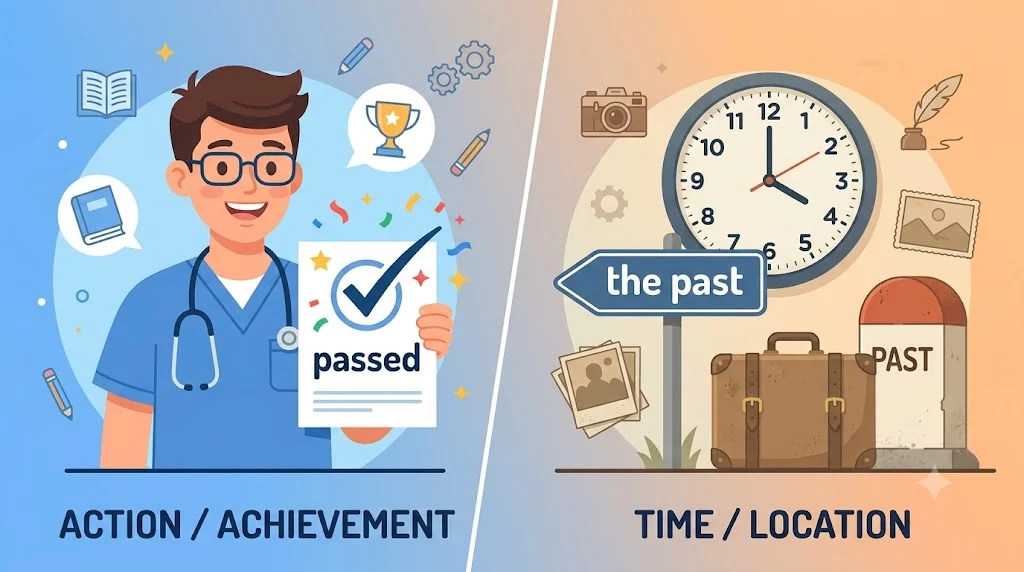
Passed or past are homophones that sound identical when spoken but serve completely different grammatical functions. The simple rule is this: passed is always a verb (the past tense of “to pass”), while past is never a verb and can be a noun, adjective, adverb, or preposition.
Every writer has been there. You are typing along, feeling confident, and then you hit a speed bump. Do you write “I passed the test” or “I past the test”? Did you “walk passed the store” or “walk past the store”? These two little words cause more confusion than almost any other pair in the English language, and for good reason. They sound exactly the same. When you speak, nobody knows which one you are using. But when you write, the difference matters a great deal.
The confusion between passed or past is not just a minor annoyance. It can undermine your credibility in professional emails, academic papers, and even casual social media posts. Imagine sending a cover letter that says you “past” your certification exam. The hiring manager might question your attention to detail before they even finish reading your qualifications. Or picture a student writing “in the passed” in a history essay. These errors stick out to readers who know the difference, and they can make otherwise excellent writing seem sloppy.
Passed vs Past: What is the Difference?
Here is a comparison table to make the differences crystal clear:
| Feature | Passed | Past |
| Part of Speech | Verb only | Noun, adjective, adverb, preposition |
| Primary Meaning | Completed action, movement, or transfer | Earlier time, beyond, gone by |
| Indicates Action? | Yes | No |
| Relates to Time? | Sometimes (time passing) | Frequently |
| Example | She passed the exam. | The past cannot be changed. |
| Example | He passed me in the hall. | Walk past the library. |
| Example | Three weeks have passed. | In past years, it was different. |
The key takeaway from this table is simple. If your sentence needs a verb, use passed. If your sentence already has a verb and you need something else, use past. This single rule will solve most of your problems with passed or past.
Is Passed vs Past a Grammar, Vocabulary, or Usage Issue?
This is a usage issue with strong grammatical foundations. The words themselves are not interchangeable, and the rules governing them are not flexible. You cannot swap one for the other and hope nobody notices. However, the confusion arises because they sound identical, not because their meanings overlap.
In formal writing, the distinction is strictly enforced. Academic papers, business reports, and professional publications demand correct usage. Using “past” when you mean “passed” is a grammatical error, plain and simple. It shows a lack of mastery over basic English conventions. In casual writing, such as text messages or social media, the rules are more relaxed, but the error is still noticeable to anyone who knows better. It is the kind of mistake that makes people question your literacy, even if they do not say anything.
In informal contexts, you might see people use “past” as a verb in slang or dialect, but this is nonstandard and not recommended for any situation where you want to be taken seriously. Stick to the rules. Passed is a verb; past is not. That is the end of the story.
When to Use Passed
Passed is the past tense of the verb “pass.” You use it whenever you are describing an action that someone or something has completed. The action can be physical movement, the passage of time, success in a test, transferring an object, or even dying. As long as there is an action, passed is your word.
Here are some examples in different contexts:
Workplace Example
The committee passed the new budget proposal after three hours of debate. The CEO passed the report to her assistant for final review. Our team passed every quality checkpoint during the audit.
Academic Example
She passed her final exams with flying colors. The professor passed the essays back to the students. Time passed slowly during the three hour lecture.
Technology Example
The data packet passed through the firewall without triggering any alerts. The update passed all security tests before deployment. The signal passed from the router to the device in milliseconds.
Recap for Passed
Remember that passed is always a verb. It describes an action that has already happened. If you can replace the word with another past tense verb like “went,” “moved,” or “succeeded,” and the sentence still makes sense, passed is correct. Use passed for actions, achievements, and completed movements.
When to Use Past
Past is much more versatile than passed because it can serve four different grammatical roles. However, it never acts as a verb. Past always refers to time that has already happened, a position beyond something, or a direction of movement. It describes, modifies, or indicates.
Here are examples in different contexts:
Workplace Example
In past quarters, our sales numbers were much higher. The deadline is past, so we need to request an extension. She walked past the conference room without noticing the meeting in progress.
Academic Example
Past research has shown a clear link between these two variables. The study builds on past findings in the field. The students struggled with concepts from past semesters.
Technology Example
The software is past its supported lifecycle. We drove past the server room on our way to the data center. The update is past due and needs to be installed immediately.
Recap for Past
Past is never a verb. It can be a noun (the past), an adjective (past events), an adverb (walk past), or a preposition (past the building). If your sentence already has a verb and you need a word that refers to time, location, or direction, use past.
When You Should NOT Use Passed or Past
Even when you understand the basic rule, there are specific situations where even experienced writers get tripped up. Here are six common misuse scenarios to watch out for:
- Do not use past as a verb. This is the most common error. “I past the test” is always wrong. The correct form is “I passed the test.” Past cannot carry the action of the sentence.
- Do not use passed to refer to time in a general sense. “In the passed” is incorrect. The phrase is “in the past.” Passed describes an action, not a period of history.
- Do not use passed as a preposition. “Walk passed the store” is wrong. The correct phrase is “walk past the store.” When you are describing movement beyond a point, past is the preposition you need.
- Do not use passed as an adjective. “Her passed experiences” is incorrect. The correct phrase is “her past experiences.” Experiences are things from an earlier time, not actions that happened.
- Do not use passed to describe something overdue. The phrase is “past due,” not “passed due.” A payment is past its due date. It is not an action; it is a state of being.
- Do not use passed when you mean “beyond” in a spatial sense. “The house is passed the bridge” is wrong. The correct phrase is “the house is past the bridge.” You are describing a location, not an action.
- Do not use passed with “half” when telling time. The phrase is “half past,” not “half passed.” You are referring to a time that is beyond the hour, not an action.
- Do not use passed when referring to someone’s history. “His passed” is incorrect. The correct phrase is “his past.” You are talking about someone’s history, not something they did.
Common Mistakes and Decision Rules
The best way to avoid errors with passed or past is to see the mistakes others make and learn the simple decision rules. Here is a table of common errors with corrections and explanations:
| Correct Sentence | Incorrect Sentence | Explanation |
| She passed the exam. | She past the exam. | Past cannot be a verb. Passed is needed for the action of succeeding. |
| We walked past the office. | We walked passed the office. | Past is a preposition indicating location. The verb is “walked.” |
| In the past, people traveled differently. | In the passed, people traveled differently. | Past is a noun referring to history. Passed is an action. |
| Three years have passed. | Three years have past. | Passed is the past participle of “pass” used with “have.” |
| The rent is past due. | The rent is passed due. | Past is an adjective describing the state of being overdue. |
| It is half past three. | It is half passed three. | Past is a preposition used in telling time. |
| Her past experiences helped her. | Her passed experiences helped her. | Past is an adjective describing experiences from earlier times. |
| The bill was passed by Congress. | The bill was past by Congress. | Passed is the past participle in the passive voice. |
Decision Rule Box
Here is the simplest way to decide between passed or past:
- If you mean an action that has happened, use passed.
- If you mean a time that has gone by, a position beyond something, or a direction of movement, use past.
- If you are unsure, try replacing the word with another verb. If it works, use passed. If it does not, use past.
- If your sentence already has a verb and you need a word that is not a verb, use past.
Passed and Past in Modern Technology and AI Tools
Even in the age of artificial intelligence and advanced grammar checkers, the confusion between passed or past persists. AI writing tools and spell checkers often fail to catch the error because both words are correctly spelled. The algorithms can check spelling, but they cannot always understand context. This means you cannot rely on technology to save you. You have to know the rule yourself.
Grammar checking software like Grammarly and ProWritingAid can sometimes flag the error, but they are not perfect. They might miss it in complex sentences or suggest the wrong correction. The human brain is still the best tool for distinguishing between these two words. When you are using AI to generate or edit content, always double check every instance of passed and past. The AI might not know the difference, but your readers will.
Etymology and Expert Insights
The word “pass” comes from the Old French “passer,” meaning to go beyond or cross. It entered English in the 13th century. The past tense “passed” has been used as a verb for centuries. “Past” has a slightly different origin, coming from the past participle of “pass” but evolving into a separate word with its own grammatical functions. Over time, “past” became fixed as a non verb word while “passed” remained firmly in the verb category.
According to the MLA Style Center, “A key difference between passed and past, which can help you decide when to use each word, is that past cannot be used as a verb”. This expert guidance from one of the most respected style authorities in the world confirms the simple rule we have been emphasizing throughout this article.
Case Study 1: The Job Applicant
A marketing professional applied for a senior role at a Fortune 500 company. Her resume was impressive, but her cover letter contained the phrase “I past my certification exam.” The hiring manager noticed the error and, despite her qualifications, passed on her application. The company received over 200 applications, and they used attention to detail as a key screening criterion. One small mistake with passed or past cost her the opportunity.
Case Study 2: The Academic Paper
A graduate student submitted a thesis that used “passed” incorrectly in three places. The advisor returned the draft with corrections and a note about proofreading. The student had to revise and resubmit, delaying their graduation by a full semester. The errors were minor, but they signaled a lack of care that the advisor found concerning.
Author Bio
This guide was written by a senior SEO strategist and professional linguist with over a decade of experience creating high ranking content on grammar and language topics. The author has helped thousands of writers master confusing word pairs and improve their writing clarity.
Error Prevention Checklist
Use this checklist every time you write to catch errors with passed or past:
- Always use passed when describing an action or completed event.
- Never use past as a verb. If the word is carrying the action, you need passed.
- Always use past when referring to time that has gone by.
- Always use past when indicating a position beyond something.
- Always use past in the phrase “past due.”
- Always use past in the phrase “half past” when telling time.
- Always use past when describing someone’s history or background.
- Never use passed as a noun, adjective, adverb, or preposition.
Related Grammar Confusions You Should Master
Once you have conquered passed or past, there are other commonly confused word pairs that deserve your attention. Mastering these will elevate your writing to a professional level.
- Affect vs Effect – Affect is usually a verb; effect is usually a noun.
- Lie vs Lay – Lie means to recline; lay means to place something down.
- Accept vs Except – Accept means to receive; except means to exclude.
- Its vs It’s – Its is possessive; it’s is a contraction for it is.
- Their vs There vs They’re – Their shows possession; there indicates a place; they’re is a contraction.
- To vs Too vs Two – To is a preposition; too means also or excessively; two is the number.
- Then vs Than – Then relates to time; than is used for comparisons.
- Your vs You’re – Your shows possession; you’re is a contraction for you are.
- Whose vs Who’s – Whose shows possession; who’s is a contraction for who is.
- Fewer vs Less – Fewer is for countable items; less is for uncountable quantities.
FAQs
Is it “past due” or “passed due”?
The correct phrase is “past due.” When a payment is overdue, it is past its due date. “Past” is an adjective describing the state of the payment. “Passed due” is incorrect.
Is it “half past” or “half passed”?
The correct phrase is “half past.” When telling time, you say “half past three” to mean 3:30. “Half passed” is incorrect.
Is it “get past” or “get passed”?
Both can be correct depending on the context. “Get past” means to move beyond or overcome something, as in “Get past the security checkpoint.” “Get passed” means to be approved or handed over, as in “The bill needs to get passed by the committee.”
Is it “in the past” or “in the passed”?
The correct phrase is “in the past.” “Past” is a noun referring to history or earlier times. “In the passed” is incorrect.
Is it “passed away” or “past away”?
The correct phrase is “passed away.” This is a phrasal verb meaning to die. “Past away” is incorrect.
Is it “passed time” or “past time”?
Both can be correct but mean different things. “Passed time” means time went by, as in “The hours passed time slowly.” “Past time” means it is later than the appropriate time, as in “It is past time to leave.”
Is it “passed out” or “past out”?
The correct phrase is “passed out.” This means to lose consciousness or to distribute. “Past out” is incorrect.
Is it “passed on” or “past on”?
The correct phrase is “passed on.” This can mean to die, to decline something, or to transfer something. “Past on” is incorrect.
Conclusion
The confusion between passed or past is one of the most common stumbling blocks in English grammar. But as we have seen, the solution is remarkably simple. Passed is always a verb. Past is never a verb. If you are describing an action, choose passed. If you are referring to time, position, or direction, choose past.
This single rule will eliminate almost all of your errors. Practice using the decision rule box and the error prevention checklist until the distinction becomes second nature. With a little attention and effort, you can master this pair and never hesitate again.

Philip Pullman is an American writer dedicated to creating clear and easy to follow English content. Through his work at LingRoya.com, he helps readers strengthen their language skills with practical and reliable guidance so that they can easily understand.