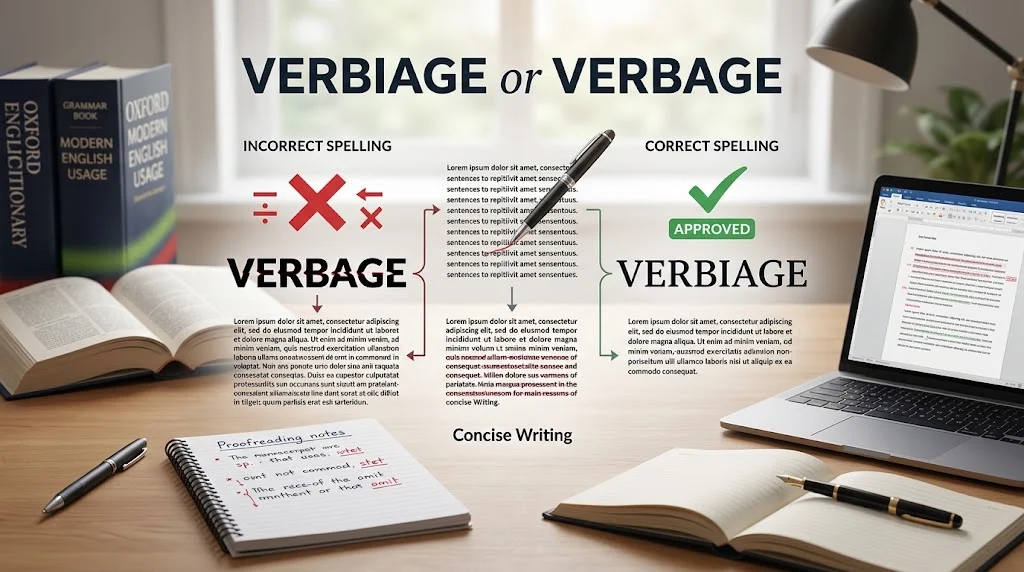
Verbiage is the standard and widely accepted spelling. It refers to the wording or language used to express something and can also suggest unnecessarily complicated or excessive wording. Verbage is generally treated as a misspelling of verbiage and should be avoided in formal, academic, workplace, and professional writing.
Have you ever wondered whether you should write “verbage” or “verbiage” when describing someone’s wording? This small spelling confusion appears frequently in emails, reports, articles, business communication, and online content. The confusion is understandable because verbiage contains a sequence of letters that can make the word look as though it comes directly from “verb.” In reality, verbiage is the established standard form.
Knowing the correct spelling is useful not only for avoiding an obvious vocabulary error but also for understanding the subtle difference between neutral wording and language that feels unnecessarily elaborate. For writers, editors, students, and professionals, choosing the standard form immediately makes communication more polished.
Verbage vs Verbiage: What’s the Difference?
The most important point is straightforward: verbiage is the standard word.
Verbiage is a noun. It refers to the words used to express an idea, particularly when those words are regarded as excessive, complicated, or unnecessarily elaborate.
For example:
“The contract contains too much legal verbiage.”
The sentence suggests that the contract uses unnecessarily complicated language.
Verbage is generally not the standard spelling. It commonly occurs because speakers and writers associate the word with “verb” or with other words ending in “age.” In edited English, it is usually corrected to verbiage.
Mini Recap
Verbiage is the correct standard spelling.
Verbage is generally considered a spelling error.
Verbiage can refer to wording generally, but it often carries a sense of unnecessary or excessive language.
For professional writing, choose verbiage.
Is Verbage vs Verbiage a Grammar, Vocabulary, or Usage Issue?
The distinction is primarily a vocabulary and spelling issue rather than a grammatical one.
Both forms may appear in real world writing, but they do not have equal status in standard English. Verbiage is the established dictionary form, while verbage is commonly treated as an error or nonstandard variant.
This distinction matters because spelling conventions can signal the level of care given to written communication. In an informal conversation or quick online message, a reader may understand verbage immediately. However, that does not make it the preferred form.
Are They Interchangeable?
In practical communication, readers may understand both forms to mean the same thing. Nevertheless, they should not be treated as equally appropriate.
If you are writing an academic paper, business report, professional email, website article, application, or publication, verbiage is the safer and more authoritative choice.
Formal vs Informal Usage
Verbiage is suitable in both formal and informal contexts.
For example:
“The proposal contains excessive verbiage.”
This sounds natural in professional communication.
In casual communication, people may occasionally write verbage because the pronunciation makes the spelling seem intuitive. However, informal frequency does not establish it as the preferred spelling.
Academic vs Casual Usage
Academic writing generally favors precision and established vocabulary. Therefore, verbiage should be used instead of verbage.
A student might write:
“The introduction contains unnecessary verbiage.”
An editor could recommend replacing the phrase with “unnecessary wording” if simplicity is more appropriate.
The important point is that verbiage itself is not necessarily a negative word. Its exact tone depends on context.
How to Use Verbiage Correctly
Verbiage is a noun used to discuss the language, wording, or expressions used to communicate something.
It is especially common when the writer wants to criticize language for being unnecessarily complicated or lengthy.
Consider:
“The instructions contain confusing verbiage.”
Here, verbiage refers to the wording of the instructions.
Another example is:
“The lawyer simplified the legal verbiage.”
In this sentence, verbiage refers to specialized legal wording.
Workplace Example
“The new policy contains too much technical verbiage for ordinary employees.”
The sentence suggests that the policy uses unnecessarily complicated language.
Academic Example
“The researcher removed unnecessary verbiage from the final draft.”
Here, verbiage refers to wording that did not contribute enough to the argument.
Technology Example
“The software documentation uses technical verbiage that beginners may find difficult.”
The word describes specialized wording in technology documentation.
Usage Recap for Verbiage
Use verbiage when discussing wording or language.
It is especially useful when the wording is lengthy, complicated, or unnecessarily elaborate.
In many situations, simpler alternatives such as “wording,” “language,” or “phrasing” may be clearer.
How to Use Verbage Correctly
The safest answer is that you generally should not use verbage in formal standard English.
Writers often produce verbage because the word appears to be related to “verb.” That association is understandable, but it does not establish the spelling.
For example:
Incorrect in standard edited writing:
“The report has unnecessary verbage.”
Preferred:
“The report has unnecessary verbiage.”
The correction involves only a few letters, but the difference is important when accuracy matters.
Workplace Example
Instead of writing:
“The email contains too much verbage.”
Write:
“The email contains too much verbiage.”
Academic Example
Instead of:
“The essay includes unnecessary verbage.”
Use:
“The essay includes unnecessary verbiage.”
Technology Example
Instead of:
“The instructions contain confusing verbage.”
Use:
“The instructions contain confusing verbiage.”
Usage Recap for Verbage
Avoid verbage in formal and professional writing.
Use verbiage instead.
If you want a simpler word, consider “wording,” “phrasing,” or “language.”
When You Should NOT Use Verbage or Verbiage
There are several situations where writers commonly misuse these terms.
- Do not write verbage when you mean the standard word verbiage.
- Do not assume verbiage means every possible group of words in a completely neutral sense. It often suggests excessive, elaborate, or unnecessary wording.
- Do not use verbiage when a simpler word such as “wording” communicates the idea more clearly.
- Do not assume the word comes directly from “verb.” Its spelling has a different historical origin.
- Do not use verbage in formal reports simply because you have seen it online.
- Do not use verbiage as though it were a verb. It is a noun.
- Do not automatically describe all detailed writing as verbiage. Detailed language can be useful and necessary.
- Do not confuse verbiage with verbosity. The words are related in meaning, but they are not identical in every context.
Common Mistakes and Decision Rules
Decision Rule Box
If you mean wording or language, use verbiage.
If you are tempted to write verbage, replace it with verbiage.
A second useful rule is to ask whether “wording” would work in the sentence. If it would, verbiage may also work, particularly when you want to suggest that the wording is excessive or unnecessarily complicated.
Verbiage and Verbage in Modern Technology and AI Tools
The distinction appears frequently in technology and AI generated content.
Software documentation may contain technical verbiage that makes instructions difficult for beginners. User interface designers often try to reduce unnecessary wording so that buttons, instructions, and notifications are easier to understand.
AI writing tools can also generate excessive verbiage. A response may be grammatically correct but still contain unnecessary explanations, repeated ideas, or overly elaborate phrasing. In that context, an editor might say that the AI output contains too much verbiage.
The spelling problem can appear in AI generated text as well. Since verbage resembles words associated with verbs, an automated system may occasionally reproduce the nonstandard spelling. Human review remains useful when accuracy and publication quality matter.
Etymology of Verbiage
The history of verbiage helps explain why the spelling is not simply verb plus a suffix.
Verbiage entered English through French and is related to French terms associated with words and excessive language. Its history is connected to Latin roots concerning words.
The word therefore has a much deeper linguistic history than its modern spelling might suggest. The resemblance to “verb” is one reason writers may mistakenly create the form verbage, but the established English spelling is verbiage.
An Expert Style Principle
“When a familiar looking spelling conflicts with the established form, follow the word’s accepted history and standard usage.”
This is particularly useful with English vocabulary because pronunciation and visual familiarity do not always predict spelling.
Two Practical Case Studies
Case Study 1: Editing a Business Report
Imagine a manager writes:
“The report contains too much verbage and should be shortened.”
The intended meaning is understandable, but the spelling is nonstandard.
A professional editor changes the sentence to:
“The report contains too much verbiage and should be shortened.”
Concrete result: One spelling correction turns a potentially distracting vocabulary error into standard professional English.
The editor could go one step further and make the sentence more direct:
“The report is too wordy and should be shortened.”
This version may be even clearer for a general audience.
Case Study 2: Simplifying Technical Documentation
Suppose a software guide says:
“The user must navigate through several technical verbiage sections before completing the installation.”
The word verbiage is technically recognizable, but the sentence is awkward because verbiage normally refers to wording rather than countable sections.
A clearer revision would be:
“The user must read several technical instructions before completing the installation.”
Concrete result: The revised sentence removes unnecessary abstraction and tells users exactly what they need to do.
These examples demonstrate an important writing principle: using the correct word is only the first step. Strong writing also requires choosing language that communicates efficiently.
Error Prevention Checklist
Always use Verbiage when
You mean wording or language.
You are discussing unnecessarily elaborate language.
You are writing a professional document.
You are writing an academic paper.
You are editing published content.
Never use Verbage when
You need the standard English spelling.
You are preparing a formal report.
You are writing academic content.
You are submitting professional communication.
You want your vocabulary to follow established edited English conventions.
Related Grammar Confusions You Should Master
Learning the correct spelling of verbiage can lead to a broader study of commonly confused English words. Important examples include:
- Advice vs advise
- Affect vs effect
- Compliment vs complement
- Principal vs principle
- Stationary vs stationery
- Lose vs loose
- Breathe vs breath
- Then vs than
- Their vs there vs they’re
- Your vs you’re
These pairs demonstrate why English learners should consider meaning, pronunciation, spelling, and grammatical function together.
FAQs
Which is correct, verbage or verbiage?
Verbiage is the standard and widely accepted spelling. Verbage is generally considered a misspelling or nonstandard variant.
What does verbiage mean?
Verbiage means the words or wording used to express something, often with an implication that the language is excessive, complicated, or unnecessarily elaborate.
Is verbage a real word?
Verbage appears in real world usage, but it is generally not recommended in standard formal English. Verbiage is the established form.
Why do people spell verbiage as verbage?
The spelling error probably occurs because writers associate the word visually with “verb” and naturally remove the second “i.”
Is verbiage a negative word?
Not always. Verbiage can simply refer to wording, but it often carries a mildly negative suggestion that the language is excessive, complicated, or unnecessarily elaborate.
Is verbiage formal English?
Yes. Verbiage is an established English noun and can be used in professional, academic, legal, technical, and everyday contexts.
What is a simple synonym for verbiage?
Depending on context, useful alternatives include wording, language, phrasing, expression, or words.
What is the difference between verbiage and verbosity?
Verbiage refers to wording or language, often excessive wording. Verbosity specifically emphasizes the use of more words than necessary.
Can I use verbiage in academic writing?
Yes. Verbiage is acceptable in academic writing, although “wording” or “language” may sometimes be more precise and straightforward.
Is verbiage related to the word verb?
Despite the visual similarity, verbiage does not simply mean language derived from the grammatical term verb. Its historical development is connected to words and language through French and Latin roots.
Conclusion
The correct choice is verbiage, not verbage, when you need the standard English word for wording or language, particularly language that is excessive, complicated, or unnecessarily elaborate. Although verbage appears in informal and online writing, it is generally treated as a nonstandard spelling and should be avoided in professional and academic work. Remember the simple rule: verbiage is the standard form.
If you want even clearer writing, consider whether “wording,” “phrasing,” or “language” would express your meaning more directly.

Philip Pullman is an American writer dedicated to creating clear and easy to follow English content. Through his work at LingRoya.com, he helps readers strengthen their language skills with practical and reliable guidance so that they can easily understand.