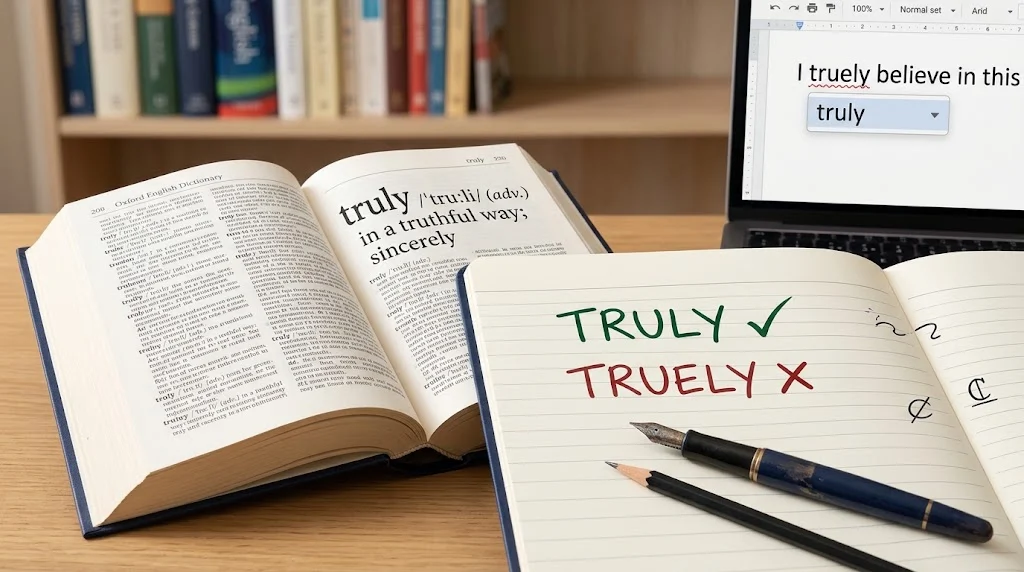
Truly or truely is a common spelling confusion, but only truly is correct in standard English. Truly is an adverb meaning genuinely, honestly, or sincerely, while truely is a misspelling. The confusion occurs because many adjectives ending in “e” keep that letter when forming adverbs, but true drops the final “e” before adding “ly.”
Have you ever paused while writing an email, school assignment, or professional message because you weren’t sure whether to write truly or truely? The correct spelling is truly, and truely is incorrect in standard English. Although the adjective true ends in “e,” that letter is dropped when the suffix “ly” is added. Understanding this spelling rule helps you write with confidence and avoid errors in everyday communication. Whether you’re an English learner, student, or professional writer, knowing why truly is correct will make it easier to remember the right spelling whenever you need it.
Truly vs Truely: What’s the Difference?
The difference between truly and truely is straightforward. Truly is the correct adverb derived from the adjective true. Truely is a common misspelling that doesn’t follow the standard spelling convention.
| Feature | Truly | Truely |
|---|---|---|
| Correct spelling | Yes | No |
| Part of speech | Adverb | InCorrect spelling |
| Meaning | Genuinely, sincerely, or accurately | No standard English meaning |
| Root word | True | Intended to be true |
| Example | I truly appreciate your help. | I truely appreciate your help. |
| Formal writing | Acceptable | Incorrect |
| Academic writing | Acceptable | Incorrect |
Quick Recap
Truly is the only standard spelling.
Truely is a misspelling of truly.
Truly describes how genuinely or sincerely something is done or felt.
The final “e” in true is dropped before adding “ly.”
Remembering this rule helps prevent the same mistake in emails, essays, and online content.
What Does Truly Mean?
Truly is an adverb that means genuinely, honestly, sincerely, or in a way that accurately reflects reality. It modifies verbs, adjectives, or other adverbs to express sincerity, certainty, or authenticity.
For example, consider the sentence, “I truly believe in your abilities.” Here, truly emphasizes the speaker’s genuine belief.
Truly can also express a high degree of something.
Examples:
- She is truly talented.
- I truly appreciate your kindness.
- This is truly an unforgettable experience.
- He truly understands the problem.
In each sentence, truly adds emphasis or communicates that a statement is sincere or genuine.
The word is common in personal messages, professional correspondence, academic writing, and everyday conversation.
What Does Truely Mean?
Truely is not a standard English word. It is an incorrect spelling of truly, usually created by adding “ly” to true without removing the final “e.”
Writers may produce this spelling because they recognize a familiar pattern in words such as safely and wisely. However, spelling rules differ depending on the word.
For example:
Incorrect: I truely appreciate everything you’ve done.
Correct: I truly appreciate everything you’ve done.
The intended meaning is understandable, but the spelling is still incorrect. Spellcheckers may identify truely as an error and suggest truly as the replacement.
Usage recap: Use truly whenever you want to express sincerity, genuineness, or certainty. Avoid truely in both formal and informal writing.
Is Truly vs Truely a Grammar, Vocabulary, or Usage Issue?
The difference between truly and truely is primarily a spelling issue, not a difference in grammar or vocabulary meaning. Truly is a valid adverb, while truely is a misspelling.
Are Truly and Truely Interchangeable?
No. Although readers can usually understand what someone means when they write truely, the two forms aren’t interchangeable in standard English.
Use truly in every context where the intended meaning is genuinely or sincerely.
For example:
Correct: She truly cares about her students.
Incorrect: She truely cares about her students.
Formal vs Informal Usage
Truly is appropriate in both formal and informal writing. You can use it in a business email, a personal letter, a speech, or a social media caption.
Truely is incorrect regardless of the level of formality. Casual writing may contain spelling mistakes, but that doesn’t make them accepted alternatives.
Academic vs Casual Usage
In academic writing, correct spelling supports clarity and credibility. A student who writes truly demonstrates the standard spelling, while truely may be marked as an error.
The same distinction applies to casual messages. Even when writing quickly, remember that truly is the correct form.
When to Use Truly
Use truly when you want to communicate that something is genuine, sincere, real, or accurate. It can add emotional emphasis or clarify the strength of a statement.
Workplace Example
“I truly appreciate your time and consideration.”
This sentence works well in a professional email because it expresses genuine gratitude.
Academic Example
“The findings truly demonstrate the importance of regular practice.”
Here, truly emphasizes the writer’s interpretation of the research findings. In formal academic work, use it only when the emphasis is appropriate and supported by the evidence.
Technology Example
“This application truly simplifies the process of organizing research notes.”
In this example, truly emphasizes how effectively the application performs its intended function.
Usage recap: Use truly to emphasize sincerity, genuineness, or the strength of a statement. It works in professional, academic, and everyday communication.
When to Avoid Truely
Truely should not be used in standard English because it is a misspelling. There is no special situation in which truely becomes the correct spelling of the adverb.
Consider these examples:
Incorrect: I truely believe you can succeed.
Correct: I truly believe you can succeed.
Incorrect: The book was truely inspiring.
Correct: The book was truly inspiring.
Incorrect: We are truely grateful for your support.
Correct: We are truly grateful for your support.
If you encounter truely in a draft, replace it with truly unless you’re reproducing the spelling in a direct quotation, discussing an error, or preserving text exactly as it originally appeared.
When You Should NOT Use Truly or Truely
Although truly is correct, it isn’t always the best word for every sentence. Truely, meanwhile, should be avoided as an ordinary spelling.
Here are seven situations worth understanding.
1. Don’t use truely in published writing. Replace it with truly to follow standard English spelling.
2. Don’t add truly when it contributes no meaning. The sentence “I truly personally believe” may be unnecessarily repetitive.
3. Don’t confuse truly with truthfully. Truly often means genuinely, while truthfully specifically emphasizes honesty in what someone says.
4. Don’t use truly to exaggerate evidence. Academic and scientific claims should be supported by facts rather than emphasis alone.
5. Don’t confuse truly with really in every context. Although the words overlap, their tone and emphasis can differ.
6. Don’t assume every word ending in “e” drops that letter. The rule applies to truly, but English spelling has exceptions and different word formation patterns.
7. Don’t rely entirely on spellcheck. Review your writing carefully, particularly if a misspelling appears in a title, heading, or repeated phrase.
Common Mistakes and Decision Rules
The following table shows frequent spelling mistakes involving truly and related expressions.
| Correct sentence | Incorrect sentence | Explanation |
|---|---|---|
| I truly value your opinion. | I truely value your opinion. | Truly is the correct spelling. |
| She was truly happy with the results. | She was truely happy with the results. | The final “e” in true is dropped. |
| We are truly grateful for your support. | We are truely grateful for your support. | Truely is not a standard spelling. |
| He truly understands the instructions. | He truely understands the instructions. | The adverb is spelled truly. |
| I will answer truthfully. | I will answer truely. | Truthfully is another correct word, with a more specific emphasis on honesty. |
The Decision Rule
If you mean genuinely, sincerely, or really, use truly.
If you are considering truely, change it to truly.
Remember the spelling pattern: true becomes truly, not truely.
Truly and Truely in Modern Technology and AI Tools
Digital communication makes spelling accuracy important because emails, website articles, product descriptions, and social media posts can reach large audiences.
Modern spellcheckers, grammar assistants, and AI writing tools generally recognize truly as the correct form and flag truely as a spelling error. They may suggest the correct replacement automatically, depending on the application and its language settings.
However, automated tools aren’t perfect. A writer should still review the final text, especially when preparing educational content, academic papers, or professional documents.
For website owners, correcting recurring spelling mistakes also improves editorial consistency and creates a better reading experience. While correct spelling alone doesn’t guarantee search rankings, clear and carefully edited content helps establish a professional impression.
Etymology: Why Is Truly Spelled Without an E?
The word truly comes from true, which has roots in Old English trēowe, meaning faithful, trustworthy, or steadfast.
In modern English, the suffix “ly” is commonly added to adjectives to form adverbs. When true takes this suffix, its final “e” is dropped, producing truly.
The same pattern appears in several other words:
| Adjective | Correct adverb |
|---|---|
| True | Truly |
| Due | Duly |
| Whole | Wholly |
| Gentle | Gently |
| Simple | Simply |
These examples illustrate why adding “ly” doesn’t always mean keeping every letter of the original adjective. Learning common spelling patterns can help you recognize similar forms and avoid unnecessary errors.
An Expert Tip for Remembering Truly
A useful spelling principle is to learn the complete word transformation rather than adding suffixes mechanically.
True becomes truly.
Think of the final “e” as disappearing before “ly” is added. When you remember the transformation as a single pattern, you’re less likely to write truely.
This approach is especially useful for English learners because it combines spelling practice with vocabulary development. Writing a few example sentences and checking them afterward can reinforce the correct form.
Two Practical Case Studies
Case Study 1: A Student’s Academic Essay
Imagine a student writing an essay about the importance of education. The first draft includes the sentence, “Education truely changes people’s lives.”
During proofreading, the student checks the spelling and corrects truely to truly. The revised sentence reads, “Education truly changes people’s lives.”
Result: The final sentence follows standard spelling conventions and removes an avoidable error. This is an illustrative example, not a measured study.
Case Study 2: A Business Email
Consider an employee writing a thank you message to a client after a successful project. The draft says, “We truely appreciate your continued support.”
Before sending the email, the employee uses a spelling checker and replaces truely with truly. The final version communicates the intended gratitude without a spelling mistake.
Result: The message is more polished and professionally presented. This is an illustrative scenario rather than a documented business outcome.
Error Prevention Checklist
Always Use Truly When
- You mean genuinely, sincerely, or really.
- You’re writing an academic assignment or professional email.
- You want to emphasize a person’s feelings, beliefs, or experiences.
- You’re preparing website content or social media posts.
- You’re proofreading a sentence containing the incorrect form truely.
Never Use Truely When
- Writing standard English prose.
- Preparing formal or academic documents.
- Publishing professional website content.
- Writing a message where correct spelling matters.
- Adding “ly” to true without removing its final “e.”
The exception is when you need to preserve an original misspelling in a quotation or discuss the error itself. Otherwise, choose truly.
Related Grammar Confusions You Should Master
If you often struggle with English spelling, these related topics can help you recognize common patterns.
- Definitely vs Definately: Learn the correct spelling of definitely.
- Separate vs Seperate: Understand the correct vowel sequence in separate.
- Beautiful vs Beautifull: Learn why beautiful has one final “l.”
- Really vs Realy: Understand the correct spelling of really.
- Genuinely vs Genuineley: Learn the standard adverb form genuinely.
- Truthful vs Truely: Distinguish a correct adjective from a misspelled adverb.
- Quiet vs Quite: Understand the difference in meaning and pronunciation.
- Lose vs Loose: Learn how two similar looking words have different meanings.
- Your vs You’re: Distinguish possession from a contraction.
- Its vs It’s: Understand the difference between possession and a contraction.
These comparisons reinforce the importance of learning a word’s standard spelling instead of relying only on how it sounds.
Frequently Asked Questions About Truly or Truely
1. Is it truly or truely?
The correct spelling is truly. Truely is a misspelling and should be avoided in standard English writing.
2. Why is truly spelled without an e?
The final “e” in true is dropped before the suffix “ly” is added. This produces truly, the standard adverb form.
3. Is truely a real word?
Truely is not an accepted standard English spelling. It sometimes appears as a typing error, but truly is the correct form.
4. What does truly mean in English?
Truly means genuinely, sincerely, honestly, or in a way that reflects reality. It is an adverb used to emphasize the truth or sincerity of a statement.
5. How do you spell truly correctly?
Spell it T R U L Y. Remember that true becomes truly when the final “e” is dropped and “ly” is added.
6. Can I use truely in formal writing?
No. Use truly in formal writing, academic assignments, professional correspondence, and published content. Truely is a spelling error.
7. Is truly an adverb?
Yes. Truly is an adverb that modifies verbs, adjectives, or other adverbs to express sincerity, genuineness, or emphasis.
8. What is the difference between truly and truthfully?
Truly generally means genuinely or sincerely, while truthfully emphasizes telling the truth or being honest. For example, “I truly admire her” expresses genuine admiration, while “I answered truthfully” means the answer was honest.
9. What is the spelling rule for true and truly?
When forming the adverb truly from true, drop the final “e” before adding “ly.” This gives you truly rather than truely.
Conclusion: Truly or Truely
When choosing between truly or truely, remember that truly is the only correct spelling in standard English. It is an adverb that means genuinely, sincerely, or honestly, while truely is a common spelling mistake. The difference comes from how the suffix “ly” combines with the adjective true.

Margaret Atwood is an American writer who contributes to LingRoya.com creating clear and engaging content about the English language and everyday communication. She enjoys helping readers build confidence in their writing through simple, practical guidance.