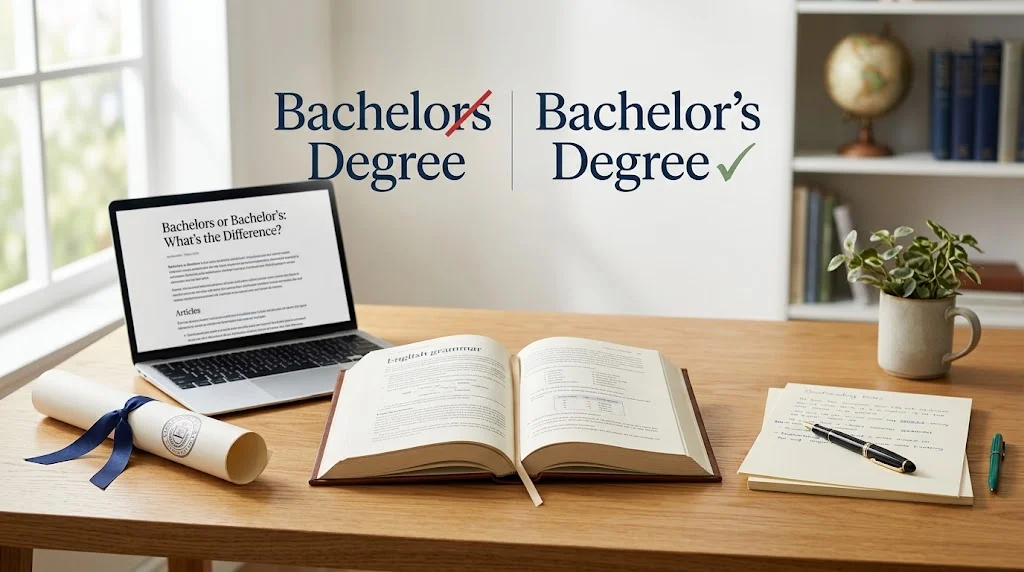
Bachelors is the plural of bachelor, referring to unmarried men or, in some contexts, people who hold bachelor’s degrees. Bachelor’s is the possessive form of bachelor, commonly used in phrases such as bachelor’s degree.
Choosing between bachelors or bachelor’s may seem like a small spelling decision, but it can affect the clarity and professionalism of your writing. In academic applications, résumés, and university documents, the correct form matters. As a practical grammar principle, bachelors refers to more than one bachelor, while bachelor’s is the standard form used in expressions such as bachelor’s degree. Recognizing the difference helps students, job seekers, and writers avoid common punctuation mistakes and communicate with confidence.
Bachelors vs Bachelor’s: What’s the Difference?
The main difference between bachelors and bachelor’s is the apostrophe and the meaning it communicates. Although the words look almost identical, they serve different grammatical purposes.
Bachelors is a plural noun referring to two or more bachelors. A bachelor traditionally means an unmarried man. The word can also appear in discussions about people holding undergraduate qualifications, although the conventional degree name is usually written with the possessive form bachelor’s degree.
Bachelor’s is the possessive form of bachelor. It is most commonly used in the name of an undergraduate qualification, such as a bachelor’s degree. The apostrophe followed by s is part of the standard spelling of this degree name.
| Feature | Bachelors | Bachelor’s |
| Part of speech | Plural noun | Possessive noun form |
| Main meaning | More than one bachelor | Belonging to or associated with a bachelor |
| Apostrophe | No | Yes |
| Common usage | Bachelors attended the gathering. | She earned a bachelor’s degree. |
| Academic writing | Less common in degree descriptions | Standard in bachelor’s degree |
| Example | The bachelors shared an apartment. | He completed his bachelor’s degree. |
Quick Recap
Bachelors means more than one bachelor.
Bachelor’s is the possessive form of bachelor.
Use bachelor’s degree when referring to the undergraduate qualification.
The apostrophe changes the grammatical meaning, so the two forms aren’t interchangeable in every sentence.
Is Bachelors vs Bachelor’s a Grammar, Vocabulary, or Usage Issue?
The distinction between bachelors and bachelor’s is primarily a grammar and punctuation issue. Both forms are valid English, but they communicate different meanings.
Are Bachelors and Bachelor’s Interchangeable?
No. The correct form depends on the sentence.
Consider these examples:
Correct: Several bachelors lived in the same building.
Correct: She received a bachelor’s degree in psychology.
Incorrect: She received a bachelors degree in psychology.
The final example is incorrect in standard writing because the conventional expression requires an apostrophe in bachelor’s degree.
Formal vs Informal Usage
In informal messages, people sometimes omit apostrophes while typing quickly. Readers may still understand the intended meaning, but the omission is inappropriate in polished writing.
In formal documents, including university applications, academic papers, professional biographies, and résumés, use the standard spelling. Correct punctuation shows attention to detail and makes qualifications easier to understand.
Academic vs Casual English
Academic writing generally uses bachelor’s degree when referring to the qualification. Casual conversation may include phrases such as “I have a bachelor’s in business,” where the word degree is understood.
The plural bachelors remains appropriate when the sentence refers to multiple people described as bachelors.
When to Use Bachelors
Use bachelors when you need the plural of bachelor. The word describes more than one person who fits that noun’s meaning. Context determines whether the reference concerns unmarried men or people described as bachelors in a particular setting.
Workplace Example
A company newsletter might say:
“Several bachelors from the department attended the weekend social event.”
Here, bachelors refers to multiple people. No apostrophe is necessary because the sentence uses an ordinary plural noun.
Academic Example
A historical essay might state:
The village was home to several bachelors who worked as merchants.
The word identifies multiple individuals rather than naming an academic qualification.
When discussing degrees, however, avoid using bachelors as a substitute for the standard phrase bachelor’s degree.
Technology Example
A university’s student management system might display a report titled “Bachelors living in university housing” if the report specifically concerns residents described as bachelors.
For a list of qualifications, a more suitable label would be “Bachelor’s degree programs” or “Bachelor’s degree holders,” depending on the information being presented.
Usage recap: Use bachelors for a plural noun referring to people. Don’t remove the apostrophe from bachelor’s degree.
When to Use Bachelor’s
Use bachelor’s when the sentence requires the possessive form of bachelor. Its most familiar use is in the name of an undergraduate academic qualification.
Workplace Example
A résumé might include this sentence:
“She holds a bachelor’s degree in computer science.”
The apostrophe is part of the conventional degree name. The sentence communicates the candidate’s educational qualification clearly.
Academic Example
A university application might state:
“I plan to complete a bachelor’s degree in environmental science.”
The phrase identifies the type of qualification the student intends to earn.
You may also encounter the formal name Bachelor of Science or Bachelor of Arts. These degree titles are normally written without an apostrophe because they follow a different naming convention.
Technology Example
An online education platform might list these options:
- Bachelor’s degree in information technology
- Bachelor’s degree in data science
- Bachelor’s degree in business administration
In each example, the apostrophe is necessary in the generic degree description. When an official degree title is used, follow the institution’s capitalization and naming conventions.
Usage recap: Use bachelor’s in bachelor’s degree and similar possessive expressions. Use the official title, such as Bachelor of Arts, when naming a specific degree.
When You Should NOT Use Bachelors or Bachelor’s
Several recurring mistakes can make your writing look unprofessional. These scenarios explain when each form should be avoided.
1. Do not write “bachelors degree” in standard academic English. Write bachelor’s degree.
2. Do not add an apostrophe to an ordinary plural. Write “The bachelors attended the event,” not “The bachelor’s attended the event,” when referring to multiple people.
3. Do not use bachelor’s when you mean several people. The apostrophe changes the grammatical function.
4. Do not write “bachelor’s degrees” when you mean multiple unmarried men. That phrase refers to more than one academic qualification.
5. Do not confuse a generic degree description with an official degree title. Write bachelor’s degree but Bachelor of Science.
6. Do not assume every degree title uses an apostrophe. Official names follow their own established conventions.
7. Do not omit punctuation in professional documents. A résumé or application should use standard spelling and grammar throughout.
Common Mistakes: Bachelors vs Bachelor’s
The following table highlights errors and their corrections.
| Correct sentence | Incorrect sentence | Explanation |
| She earned a bachelor’s degree. | She earned a bachelors degree. | The standard degree expression requires an apostrophe. |
| The bachelors attended dinner. | The bachelor’s attended dinner. | An ordinary plural does not need an apostrophe. |
| He completed a Bachelor of Arts. | He completed a Bachelor’s of Arts. | The formal degree title normally has no apostrophe. |
| They earned bachelor’s degrees. | They earned bachelors degree’s. | The plural form of degrees does not use an apostrophe. |
| He holds a bachelor’s in history. | He holds a bachelors in history. | The shortened degree expression retains the apostrophe. |
| Several bachelors rented the house. | Several bachelor’s rented the house. | The sentence refers to multiple people. |
Decision Rule Box
If you mean more than one bachelor, use bachelors.
When you mean an undergraduate qualification, use bachelor’s degree.
If you are naming an official qualification such as Bachelor of Science, follow the formal degree title instead.
Bachelors and Bachelor’s in Modern Technology and AI Tools
Modern writing tools, including grammar checkers and AI writing assistants, can help identify missing apostrophes. However, automated corrections depend on context.
For example, an AI tool may recommend bachelor’s degree when it detects an academic qualification. If the sentence describes several people, changing bachelors to bachelor’s could introduce an error.
Search engines also rely on context to interpret queries. Someone searching for “bachelors or bachelor’s” may want a spelling correction, a grammar explanation, or guidance on describing an undergraduate qualification.
The best approach is to review the meaning of the entire sentence before accepting an automated suggestion. Technology can assist with proofreading, but understanding the grammatical difference remains essential.
Etymology: Where Does Bachelor Come From?
The word bachelor entered English through Old French, with its earlier history linked to Medieval Latin baccalarius. Its precise deeper origin remains uncertain, although the word developed associations with a young man or an unmarried man.
Over time, bachelor also became part of academic terminology. English adopted expressions such as Bachelor of Arts and bachelor’s degree to describe undergraduate qualifications.
The plural bachelors follows the ordinary English pattern of adding s to a noun. The possessive bachelor’s follows the standard apostrophe convention for a singular noun in a possessive construction.
As a practical grammar principle, remember that spelling, punctuation, and context work together to communicate meaning.
Expert Grammar Insight
“An apostrophe is not merely a decorative mark. It can signal possession or distinguish a grammatical form, so writers should choose punctuation according to meaning rather than appearance.”
This principle explains why bachelors and bachelor’s require different treatment. The words share the same base noun, but the apostrophe changes how the form functions in a sentence.
Two Practical Case Studies
Case Study 1: A Graduate’s Résumé
Consider a graduate applying for an entry level position. The education section reads:
“BAchelors degree in marketing, completed in 2025.”
The unusual capitalization and missing apostrophe make the entry look careless. A corrected version reads:
“Bachelor’s degree in marketing, completed in 2025.”
The revision improves consistency and follows the standard spelling of the qualification. It also makes the education section easier to scan.
Result: The résumé entry becomes grammatically correct and more professional. This is a concrete editorial improvement, not a claim that the correction guarantees an interview.
Case Study 2: A University Website
Imagine a university website with a page listing undergraduate courses. Its heading reads “Bachelors Degree Programs.”
The heading should generally be “Bachelor’s Degree Programs.” The correction makes the label consistent with conventional English usage and improves the quality of the university’s public facing content.
If the same website has a report about several unmarried men living in campus housing, bachelors may be correct in that separate context.
Result: Context specific wording helps prevent readers from confusing people with academic qualifications.
These examples illustrate practical editing decisions. They are hypothetical scenarios, not independently measured research studies.
Error Prevention Checklist
Use this checklist when proofreading an assignment, résumé, article, or university application.
- Always use bachelors when referring to more than one bachelor.
- Always use bachelor’s degree when referring to the conventional undergraduate qualification.
- Always check whether the sentence refers to people or qualifications.
- Always preserve the apostrophe in the shortened phrase “a bachelor’s.”
- Never use bachelor’s as an ordinary plural.
- Never write bachelors degree when the intended phrase is bachelor’s degree.
- Never add an apostrophe to the formal title Bachelor of Arts without a specific naming convention that requires it.
- Always proofread headings and résumé entries for consistent punctuation.
Related Grammar Confusions You Should Master
Understanding these related distinctions can improve your overall English grammar and punctuation.
- Bachelor’s vs Bachelors Degree: Learn why the apostrophe matters in academic terminology.
- Master’s vs Masters: Distinguish the possessive degree expression from the plural noun.
- Associate Degree vs Associate’s Degree: Understand differences in conventional American English degree naming.
- Its vs It’s: Separate possession from the contraction meaning “it is” or “it has.”
- Your vs You’re: Distinguish a possessive determiner from a contraction.
- Students vs Student’s: Recognize the difference between a plural noun and a singular possessive.
- Teachers vs Teacher’s: Understand plural and possessive forms in professional writing.
- Degrees vs Degree’s: Use the plural form without an unnecessary apostrophe.
- Bachelors vs Bachelor: Know when a singular noun needs a plural ending.
- Bachelor of Science vs Bachelor’s Degree: Distinguish an official qualification title from a general degree description.
Frequently Asked Questions About Bachelors or Bachelor’s
1. Is it bachelors or bachelor’s degree?
The standard expression is bachelor’s degree. The apostrophe is included in the conventional name of the undergraduate qualification.
2. What is the difference between bachelors and bachelor’s?
Bachelors is the plural of bachelor, while bachelor’s is the possessive form used in expressions such as bachelor’s degree.
3. Should bachelor’s degree have an apostrophe?
Yes. In standard English, bachelor’s degree includes an apostrophe before the s because it follows the conventional possessive form.
4. Is bachelors degree grammatically correct?
No, not when referring to the standard undergraduate qualification. Write bachelor’s degree instead.
5. Is it Bachelor of Science or Bachelor’s of Science?
The standard formal degree title is Bachelor of Science, without an apostrophe or an s after Bachelor.
6. How do you pluralize bachelor’s degree?
Write bachelor’s degrees. The word degree becomes plural, while bachelor’s retains its apostrophe.
7. Is it correct to say I have a bachelor’s?
Yes. In conversational and informal contexts, “I have a bachelor’s” is acceptable when the word degree is understood from context.
8. Should I write bachelors or bachelor’s on a résumé?
Use bachelor’s degree when listing your undergraduate qualification. Use bachelors only when the sentence genuinely refers to multiple people described as bachelors.
9. Why does bachelor’s degree have an apostrophe?
The expression follows the conventional possessive form of bachelor. The apostrophe distinguishes it from bachelors, which is an ordinary plural noun.
Conclusion: Bachelors or Bachelor’s
Choosing between bachelors or bachelor’s becomes straightforward when you focus on meaning. Use bachelors when referring to more than one bachelor, and use bachelor’s degree when describing an undergraduate qualification. For official academic titles, such as Bachelor of Arts and Bachelor of Science, follow the established title without adding an apostrophe.
These small distinctions matter in résumés, university applications, academic assignments, and professional content. When in doubt, identify whether you’re describing people, a possessive expression, or an official qualification. That simple check will help you write with greater accuracy and confidence.

Neil Gaiman is an American writer who contributes educational content to LingRoya.com. His work focuses on helping readers improve their English with clear, practical and easy to follow guidance.