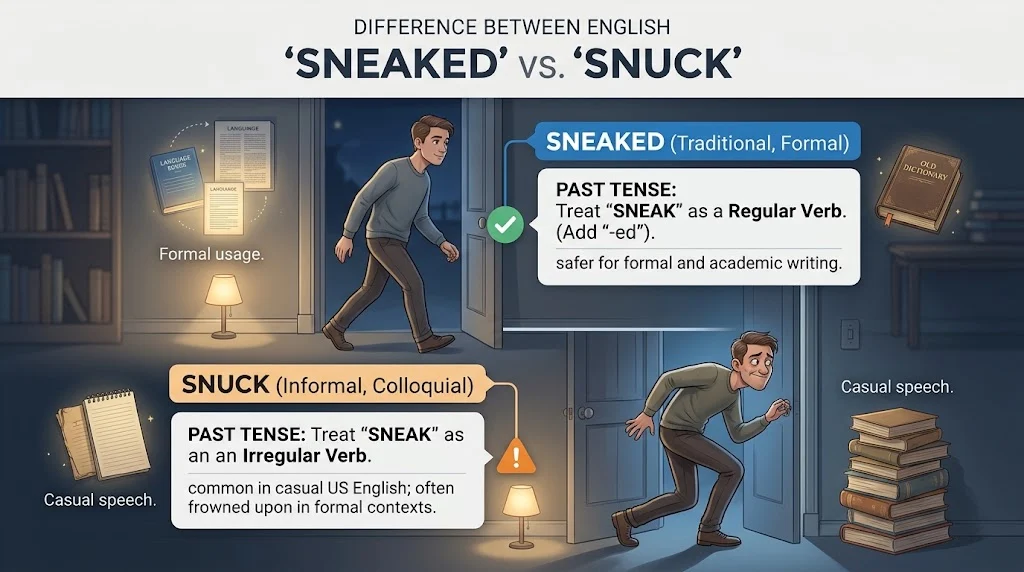
Both sneaked and snuck are accepted past tense forms of the verb sneak. The main difference is usage and regional preference. Sneaked is more traditional and remains common in formal English, while snuck is widely accepted, especially in American English and everyday conversation.
The question sneaked or snuck creates confusion because English has two accepted past tense forms for the same verb. The verb sneak means to move quietly, secretly, or without attracting attention. Its traditional past tense is sneaked, while snuck developed later as an alternative form.
This creates a situation that feels unusual to many learners. English speakers are accustomed to verbs such as walked, talked, and jumped forming their past tense with the regular ending. At the same time, English also contains irregular verbs such as go and went or take and took. Sneak sits somewhere between these patterns because both a regular form and an irregular form are accepted.
Sneaked vs Snuck: What’s the Difference?
Sneaked and snuck are both past tense and past participle forms of the verb sneak. Neither form is automatically incorrect.
| Feature | Sneaked | Snuck |
| Base verb | Sneak | Sneak |
| Part of speech | Verb | Verb |
| Past tense | Sneaked | Snuck |
| Past participle | Sneaked | Snuck |
| Meaning | Moved secretly or quietly | Moved secretly or quietly |
| Formal writing | Widely acceptable | Acceptable, but style dependent |
| Casual speech | Common | Very common |
| Regional tendency | Traditional and widespread | Particularly common in American English |
The central difference is not meaning. Both forms describe the same action.
Sneaked follows the regular pattern of adding ed to the base verb.
Snuck is an irregular form that became established through usage.
In most sentences, replacing one with the other does not change the basic meaning. The more important question is which form fits the audience, region, and style of your writing.
Mini recap:
Sneaked and snuck are both legitimate English forms.
They normally have the same meaning.
Snuck is especially common in American English.
Sneaked can sound more traditional or formal.
Is Sneaked vs Snuck a Grammar, Vocabulary, or Usage Issue?
This is primarily a usage issue, rather than a simple right or wrong grammar question.
Both forms belong to the vocabulary and grammar of modern English, but their frequency varies according to region and context. A speaker in the United States may naturally say, “She snuck into the room,” while another English speaker may prefer, “She sneaked into the room.”
The two forms are therefore interchangeable in many ordinary sentences, but they are not equally natural in every variety of English.
In formal academic writing, sneaked may sometimes be the safer choice if you want a traditional and conservative style. However, snuck is not inherently ungrammatical or unsuitable for serious writing. Modern dictionaries recognize it as an established form.
In casual conversation, snuck often sounds completely natural, particularly in American English.
The key lesson is simple: do not treat snuck as a mistake simply because it does not end in ed.
When to Use Sneaked
Sneaked is the regular past tense and past participle form of sneak. It is especially useful when you want a traditional, straightforward form.
Consider these examples.
Workplace example:
“Daniel sneaked into the conference room before the meeting began.”
This sentence works well in professional prose, especially when the writer wants a conventional tone.
Academic example:
“The researcher sneaked a brief observation into the final section of the report.”
Although the sentence itself is somewhat informal in meaning, sneaked is perfectly grammatical.
Technology example:
“The application sneaked an unexpected feature into the latest update.”
This could be used in technology journalism when describing a feature that appeared without much publicity.
There is also a practical stylistic advantage to sneaked: readers who learned English through traditional grammar instruction are unlikely to question it.
Usage Recap for Sneaked
Use sneaked when you prefer the regular form of the verb.
It is particularly useful in traditional or formal styles.
It is grammatically correct across major varieties of English.
It can be a good choice when consistency with conventional edited prose matters.
When to Use Snuck
Snuck is an established irregular form of sneak. It is particularly common in American English and is extremely natural in everyday speech.
Workplace example:
“Maria snuck out of the office before anyone noticed.”
This sounds natural in an informal workplace conversation or a conversational article.
Academic example:
If an academic writer is describing an informal event, snuck can still be grammatically correct: “The student snuck into the laboratory after hours.”
The form itself is not grammatically wrong simply because the sentence appears in an academic context. However, an editor may prefer sneaked depending on the publication’s style.
Technology example:
“The developers snuck a new setting into the latest version of the software.”
This construction is especially natural in technology discussions, product reviews, and conversational reporting.
Usage Recap for Snuck
Use snuck when it fits the variety of English and the tone of the writing.
It is especially common in American English.
It is very natural in conversation and informal digital writing.
It is accepted in modern standard English, although some style preferences may favor sneaked.
When You Should NOT Use Sneaked or Snuck
The biggest mistake is not choosing the wrong form. It is assuming that one form is universally correct and the other is universally wrong.
Here are common situations where writers should be careful.
1. Do not treat snuck as automatically incorrect
Older grammar lessons sometimes present sneaked as the only correct form. Modern usage does not support such a blanket rule.
2. Do not assume sneaked is always more correct
A word does not become grammatically superior simply because it is older or more traditional. Snuck is a recognized form.
3. Do not mix styles without a reason
If a document consistently uses traditional forms, switching suddenly to snuck can create an unnecessary stylistic inconsistency.
4. Do not judge regional English by your own variety
A form that sounds unusual to a British English speaker may sound completely ordinary to an American English speaker.
5. Do not use either form when the intended meaning is different
Sneak describes quiet or secret movement. It should not replace verbs such as walk, enter, leave, or hide unless the context actually involves stealth or secrecy.
6. Do not assume pronunciation determines correctness
The fact that snuck sounds different from the expected regular form does not make it incorrect.
7. Do not alternate randomly within formal documents
Choose a style that suits your audience and maintain it unless there is a deliberate reason to change.
Common Mistakes and Decision Rules
| Correct sentence | Incorrect sentence | Explanation |
| She sneaked into the room. | She sneak into the room yesterday. | The past tense requires sneaked or snuck. |
| She snuck into the room. | She snucked into the room. | Snuck is already the irregular past form. |
| They sneaked away quietly. | They sneak away quietly yesterday. | The past time marker requires a past form. |
| They snuck away quietly. | They snucked away quietly. | Snuck does not take an additional past ending. |
| He has sneaked into the building. | He has snucked into the building. | In styles using the regular participle, sneaked is appropriate. |
| He has snuck into the building. | He has sneak into the building. | The perfect construction requires a past participle. |
Decision Rule Box
If you mean that someone moved quietly, secretly, or without being noticed, use either sneaked or snuck according to your preferred variety and style.
If you are writing formal or traditional prose, sneaked is often the conservative choice.
If you are writing natural American English or casual dialogue, snuck will often sound more natural.
The important point is that this pair is not a situation where one word describes an action and the other describes a person or tool. They are alternative verb forms.
Sneaked and Snuck in Modern Technology and AI Tools
Modern technology writing frequently uses sneaked and snuck when describing software features that appear quietly or without prominent announcement.
For example:
“The company sneaked a new privacy control into the update.”
Or:
“The developers snuck a new feature into the application.”
The second sentence has a conversational quality that often suits technology blogs, product reviews, and online discussions. The first can sound slightly more traditional or editorial.
AI generated text can also create confusion because language models may select either form depending on the surrounding context and the patterns represented in their training data. Neither selection should automatically be treated as an error.
For editors using AI writing tools, the better approach is to check regional English, publication style, and consistency rather than automatically replacing snuck with sneaked.
The Etymology of Sneaked and Snuck
The verb sneak has a long history in English and originally referred to moving stealthily or behaving in a secretive way. The regular form sneaked developed naturally according to the common English pattern of forming past tense verbs with ed.
Snuck emerged later as an irregular variant. Its development reflects a broader tendency in English for verbs to develop alternative past tense forms through analogy and everyday speech.
This is not unusual in English. Language changes as speakers use words repeatedly, and forms that once seemed informal can eventually become accepted parts of standard usage.
An Expert View on Sneaked and Snuck
“The best choice is the form that matches your audience, variety of English, and publication style.”
This principle is more useful than memorizing a rigid rule. Standard English contains many words with regional or stylistic variation, and sneaked and snuck are a clear example.
Two Practical Case Studies
Case Study 1: Workplace Communication
Imagine an American company publishing an internal newsletter. The sentence reads:
“The manager snuck into the meeting five minutes early.”
Readers are unlikely to find snuck unusual. In fact, replacing it with sneaked may make the sentence sound more formal than the surrounding newsletter.
Result: Snuck preserves the conversational workplace tone.
Case Study 2: Formal Editorial Writing
Now imagine an edited language guide explaining a historical event:
“The group sneaked across the border during the night.”
Here, sneaked provides a traditional and restrained tone that may fit the publication’s editorial style.
Result: Sneaked supports a more conventional written register.
These examples demonstrate that the best choice is often determined by context rather than grammar alone.
Error Prevention Checklist
Always use sneaked when
- You want the regular past tense form of sneak.
- You prefer traditional or conservative written English.
- Your publication style favors regular verb forms.
- You want to maintain consistency with surrounding formal prose.
Never use snuck when
- You are trying to create the present tense of sneak.
- You are writing snucked as though it were the past tense.
- You are replacing sneak with snuck in a sentence that describes a different action.
- Your publication specifically requires sneaked for house style.
Remember that the last point is a style restriction, not evidence that snuck is grammatically invalid.
Related Grammar Confusions You Should Master
Understanding sneaked and snuck can also help you recognize other English variations where grammar, vocabulary, and usage overlap.
- Learned or learnt
- Burned or burnt
- Spelled or spelt
- Dreamed or dreamt
- Leaped or leapt
- Gotten or got
- Toward or towards
- Among or amongst
- Traveling or travelling
- Realize or realise
These pairs often require attention to regional English, style, historical usage, or grammatical context.
FAQs
Is snuck grammatically correct?
Yes. Snuck is a recognized past tense and past participle form of sneak. It is especially common in American English and is widely accepted in modern usage.
Is snuck more common than sneaked?
Usage varies by region and context. Snuck is particularly common in American English, while sneaked has remained established in many forms of edited English.
Should I use sneaked or snuck in academic writing?
Either can be grammatically correct. If your academic institution or publication has a specific style guide, follow it. Otherwise, sneaked may be a conservative choice, while snuck can be appropriate when natural modern usage is desired.
Is snuck informal English?
It can sound informal or conversational, especially in certain contexts, but it is not simply an incorrect informal invention. It is an established English form.
Is sneaked better than snuck?
No. Neither is universally better. The appropriate choice depends on regional preference, audience, tone, and editorial style.
Can I say snucked instead of snuck?
No. Snucked is not the standard past tense form. The correct irregular form is snuck.
What is the past tense of sneak?
Both sneaked and snuck can function as the past tense of sneak.
What is the past participle of sneak?
Both sneaked and snuck can function as past participles. For example, “She has sneaked away” and “She has snuck away” are both found in standard usage, although preferences vary.
Is sneaked or snuck better for American English?
Snuck is especially natural and common in American English. Sneaked is also correct and remains available when a more traditional style is preferred.
Conclusion
The choice between sneaked and snuck is not a simple matter of correct versus incorrect English. Both are established forms of the verb sneak, and both can describe the same action. Sneaked is the regular form and often suits traditional or formal prose, while snuck is especially common in American English and everyday communication.
If you are writing for a specific audience, consider regional English and the tone of the document. Most importantly, avoid snucked, which is not the standard form. Once you understand that sneaked and snuck are legitimate alternatives, this common English confusion becomes much easier to handle.

Philip Pullman is an American writer dedicated to creating clear and easy to follow English content. Through his work at LingRoya.com, he helps readers strengthen their language skills with practical and reliable guidance so that they can easily understand.