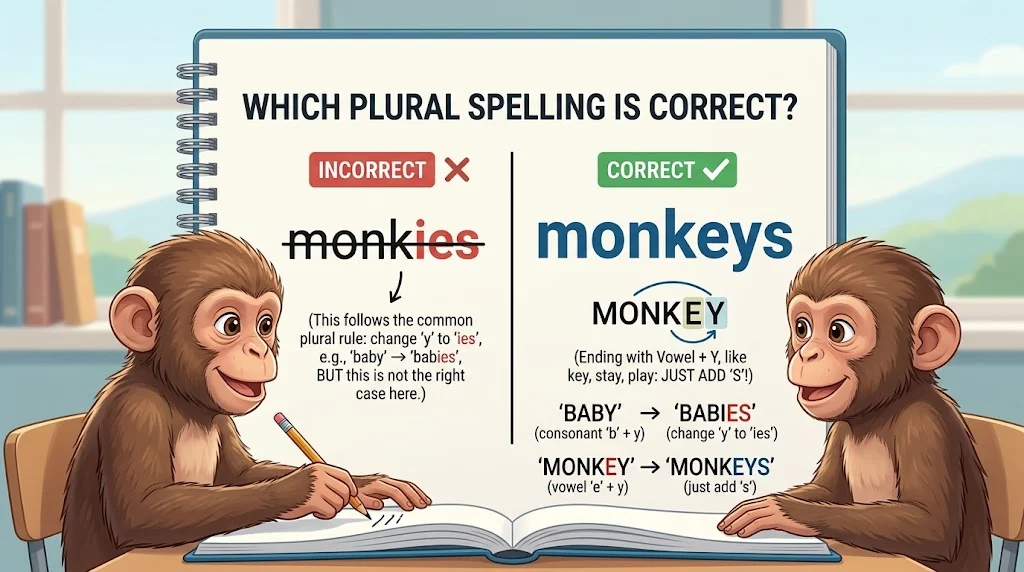
Monkeys is the correct plural form of monkey. Monkies is an incorrect spelling in standard English. The confusion happens because many nouns ending in a consonant plus y change y to ies in the plural, but monkey ends in a vowel plus y. Therefore, you write one monkey and two monkeys.
If you’ve ever hesitated between monkies or monkeys, you’re dealing with a small spelling question that reveals an important English plural rule. Monkies is not the standard plural of monkey, while monkeys is the correct form for more than one of these animals. The mistake is easy to make because English has a familiar rule in which words such as baby become babies, but that rule does not apply to every word ending in y.
Understanding the sound and spelling pattern behind monkey makes the answer simple and helps prevent similar mistakes with words such as key, toy, and boy. Cambridge specifically lists monkey → monkeys among regular plural formations, while Merriam Webster gives monkeys as the plural form.
Monkies or Monkeys: What’s the Difference?
The difference is straightforward: monkeys is the correct plural noun, while monkies is a misspelling.
| Word | Part of speech | Status | Meaning | Example |
| monkey | Noun | Correct | One animal of the group | A monkey climbed the tree. |
| monkeys | Noun | Correct | More than one monkey | The monkeys climbed the trees. |
| monkies | Noun | Incorrect | Nonstandard spelling of the plural | The monkies climbed the trees. |
A monkey is a noun referring to a type of primate. The plural is monkeys, which means more than one monkey. Merriam Webster explicitly records the plural as monkeys, and Cambridge uses monkeys when explaining the animal and the plural form.
The important point is that y does not automatically become ies in a plural noun.
The rule depends on what comes immediately before the y.
Mini Recap
- Monkey is singular.
- Monkeys is plural.
- Monkies is a spelling error.
- The y stays because it follows a vowel.
- The plural is made by simply adding s.
Is Monkies or Monkeys a Grammar, Vocabulary, or Usage Issue?
Primarily, this is a spelling and word formation issue, with a small grammatical connection because the spelling represents a singular or plural noun.
The word monkey itself is established English vocabulary. Its plural form follows the regular English plural pattern. Cambridge explains that most nouns form their plurals by adding s, while nouns ending in a consonant plus y generally change y to i and add es. Examples include baby → babies and university → universities. The same source specifically gives monkey → monkeys as an example of the regular s pattern.
This means monkies isn’t an informal alternative to monkeys. It isn’t a British versus American spelling difference either. In standard English, the accepted plural is monkeys.
In academic writing, workplace documents, school assignments, websites, reports, and formal correspondence, use monkeys.
In casual digital communication, people may type monkies because of a spelling mistake or autocorrect behavior, but that does not make it an accepted standard spelling.
How to Use Monkeys Correctly
The word monkeys is used whenever you are talking about two or more monkeys.
Workplace Example
A wildlife organization might write:
The research team observed several monkeys during the morning survey.
Here, monkeys is plural because the sentence refers to several animals.
A business report could say:
The sanctuary has introduced new feeding procedures for its monkeys.
The plural form is necessary because the report concerns more than one animal.
Academic Example
A biology student might write:
Researchers observed how monkeys interacted with their environment.
This is appropriate because the sentence refers to multiple animals.
An academic paper might also say:
Several species of monkeys were observed during the study.
The spelling remains monkeys regardless of whether the context is scientific, educational, or general.
Technology Example
Technology can create another opportunity for the spelling to appear in search queries, image labels, databases, and artificial intelligence prompts.
For example:
The image classification system identified several monkeys in the photographs.
If a database contains a category for multiple animals, the correct label is monkeys, not monkies.
Usage Recap
Use monkeys whenever monkey refers to more than one animal. It is the standard plural in formal, academic, professional, and casual English.
How to Use Monkey Correctly
The singular noun monkey refers to one animal.
For example:
A monkey is sitting on the branch.
Here, monkey is singular, so the article a is appropriate.
You can also use monkey after certain determiners:
One monkey escaped from the enclosure.
Each monkey received food.
This monkey appears to be younger than the others.
Merriam Webster defines monkey as a noun and records monkeys as its plural. It also recognizes monkey as a verb with meanings related to mimicking, fooling around, or tampering.
Workplace Example
A monkey was rescued from the damaged enclosure.
Academic Example
The researcher recorded the behavior of one monkey.
Technology Example
The software detected a monkey in the uploaded image.
Usage Recap
Use monkey for one. Use monkeys for more than one. The spelling should not change to monkies.
When You Should NOT Use Monkies or Monkeys
There are several situations where writers commonly make mistakes.
- Do not write monkies when you mean multiple monkeys.
Write monkeys. - Do not change y to ies simply because a word ends in y.
Check whether the letter before y is a vowel or consonant. - Do not treat monkies as a British spelling.
It is not a standard regional alternative. - Do not use monkeys when referring to one animal.
Write monkey for a singular noun. - Do not assume every y ending follows the same plural rule.
Compare baby → babies with boy → boys. - Do not rely entirely on pronunciation.
The plural may sound straightforward while the spelling still requires attention. - Do not preserve monkies in formal writing simply because you see it online.
Online frequency does not make a nonstandard spelling correct. - Do not confuse a spelling error with a new vocabulary word.
Monkies does not represent a separate standard English noun.
Common Mistakes and Decision Rules
Decision Rule Box
If you mean one animal, use monkey.
If you mean more than one animal, use monkeys.
If you see monkies, treat it as a spelling error in standard English.
The easiest memory trick is to look at the letter immediately before y. In monkey, the y follows e, which is a vowel. Therefore, simply add s: monkey → monkeys.
Compare this with baby. The y follows b, a consonant, so the standard plural becomes babies.
Monkies or Monkeys in Modern Technology and AI Tools
Modern spelling tools, search engines, grammar checkers, word processors, and AI systems generally recognize monkeys as the standard plural.
This matters because users frequently type questions exactly as they think them. Someone searching for monkies or monkeys may be trying to verify a spelling before publishing an article, completing an assignment, writing a report, or creating an image prompt.
AI tools can also encounter monkies in user generated text. A good language system should interpret the intended meaning from context while recognizing that standard English uses monkeys.
For content creators, the safest approach is simple: use monkeys in titles, headings, captions, metadata, educational content, and formal copy unless you are specifically discussing the misspelling itself.
Why Is It Monkeys Instead of Monkies?
The answer comes from English plural formation.
A common rule says that when a noun ends in a consonant followed by y, the y changes to i and es is added.
For example:
- baby becomes babies
- city becomes cities
- country becomes countries
- library becomes libraries
But when the y follows a vowel, the y normally remains and s is added.
For example:
- boy becomes boys
- toy becomes toys
- key becomes keys
- day becomes days
- monkey becomes monkeys
Cambridge explicitly gives monkey → monkeys as an example of this regular plural pattern.
That single distinction explains most of the confusion.
Etymology of Monkey
The history of monkey is interesting because the word has changed in spelling over time. Merriam Webster dates the noun to around 1530 and describes its origin as probably Low German, related to Moneke, with a possible connection to Romance forms including Old Spanish mona.
Historical sources also record earlier spellings such as monkie, munkie, and munkye. Etymonline notes that these forms appeared in the sixteenth century before the modern spelling became established.
This history is useful because it shows that English spelling has never been completely static. However, historical variants should not be confused with the modern standard plural. Today, the accepted plural is monkeys.
An Expert Rule to Remember
“The spelling of the plural depends on the letter before y, not simply on the presence of y.”
This principle explains why baby becomes babies, while monkey becomes monkeys. Cambridge’s grammar guidance supports this distinction by separating consonant plus y endings from vowel plus y endings.
Two Practical Case Studies
Case Study 1: The Student Essay
Imagine a student writing:
The monkies in the enclosure displayed different social behaviors.
The correction is:
The monkeys in the enclosure displayed different social behaviors.
Concrete result: one spelling correction changes the sentence from nonstandard to standard English without changing its meaning, grammar, or vocabulary.
The lesson is that the problem isn’t word choice. It is plural spelling.
Case Study 2: The Wildlife Website
Suppose a wildlife website publishes the heading:
Facts About Monkies
The corrected heading is:
Facts About Monkeys
Concrete result: the corrected version uses the dictionary recognized plural and removes the spelling error from a prominent heading. This matters because headings are highly visible and are often copied into social posts, educational materials, image descriptions, and search snippets.
These examples demonstrate a practical editorial principle: small spelling errors can become more noticeable when they appear in high visibility content.
Error Prevention Checklist
Always use X when
- You mean more than one monkey.
- You are writing an academic paper about multiple monkeys.
- You are creating a workplace report about several monkeys.
- You are writing a website heading about the animal.
- You are labeling multiple monkey images.
- You are writing formal or educational English.
Never use Y when
- You mean the standard plural of monkey.
- You are submitting formal academic work.
- You are publishing professional content.
- You are writing a dictionary style definition.
- You are creating polished website copy.
- You are checking standard English spelling.
Related Grammar Confusions You Should Master
Understanding monkeys becomes easier when you know similar spelling patterns. These related topics are worth mastering:
- Baby or babies
- Boy or boys
- City or cities
- Toy or toys
- Key or keys
- Country or countries
- Day or days
- Lady or ladies
- Story or stories
- Journey or journeys
The key question is always the same: What letter comes immediately before y?
If it is a consonant, the plural commonly changes y to i and adds es. If it is a vowel, the y generally remains and s is added.
FAQs
Is monkies or monkeys correct?
Monkeys is correct. Monkies is a misspelling. The plural of monkey is formed by adding s because y follows the vowel e.
Why is the plural of monkey monkeys?
The plural is monkeys because monkey ends in a vowel plus y. English normally keeps the y in this pattern and adds s.
Is monkies a real word?
Monkies is not the standard plural spelling of monkey. In modern standard English, use monkeys.
What is the plural of monkey?
The plural of monkey is monkeys.
Why does baby become babies but monkey become monkeys?
Baby ends in a consonant plus y, so it becomes babies. Monkey ends in a vowel plus y, so it becomes monkeys.
Is monkeys singular or plural?
Monkeys is plural. The singular form is monkey.
How do you spell more than one monkey?
Spell it monkeys.
Is monkeys correct in academic writing?
Yes. Monkeys is the standard plural form and is appropriate in academic writing when referring to more than one monkey.
Does British English use monkies?
No. Monkies is not the standard British plural. Monkeys is the standard spelling.
What is the easiest way to remember monkeys?
Remember this pattern: vowel plus y usually keeps y and adds s. Since monkey has e before y, the plural is monkeys.
Conclusion
When choosing between monkies or monkeys, the correct answer is monkeys. The word monkey is a regular count noun, and its plural is formed by adding s. The spelling monkies results from applying the consonant plus y plural rule to a word that actually has a vowel before y.
Remember the simple contrast: baby → babies, but monkey → monkeys. The same pattern explains city → cities but boy → boys, and lady → ladies but toy → toys. Once you recognize the letter before y, this spelling question becomes much easier.

Neil Gaiman is an American writer who contributes educational content to LingRoya.com. His work focuses on helping readers improve their English with clear, practical and easy to follow guidance.