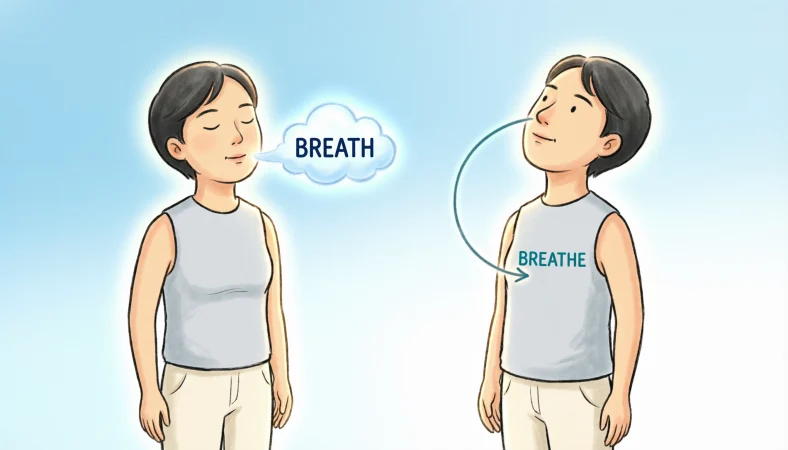
Quick Answer: Breath is a noun that means the air you take into or let out of your lungs, while breathe is a verb that means to take air into your lungs and release it. For example, “Take a deep breath” and “Remember to breathe slowly.”
Many English learners confuse breath and breathe because the two words look almost identical and are closely related in meaning. However, they have different pronunciations, grammatical functions, and uses in sentences. Breath is a noun that refers to the air you take into or release from your lungs, while breathe is a verb that describes the action of taking air in and letting it out.
Understanding the difference between breath or breathe can help you avoid common spelling and grammar mistakes in both everyday conversations and professional writing. In this guide, we will explain the meanings, pronunciation, and correct usage of both words with simple examples, so you can confidently choose breath or breathe in any sentence.
Breath vs Breathe: What’s the Difference?
Here is a simple comparison to help you visualize the difference:
| Aspect | Breath | Breathe |
| Part of Speech | Noun | Verb |
| Meaning | The air itself | The action of taking air |
| Pronunciation | rhymes with “death” | rhymes with “seethe” |
| Example | Take a deep breath | Remember to breathe |
| Common Mistake | Using it as a verb | Using it as a noun |
| Associated Words | breathless, breathy | breathing, breather |
To recap, breath is the air, and breathe is the action. If you can substitute “air” for the word, you want breath. If you can substitute “inhale and exhale,” you want breathe. This simple test will catch most errors instantly.
Is Breath vs Breathe a Grammar, Vocabulary, or Usage Issue?
This question gets to the heart of why so many people struggle with these terms. The confusion is primarily a spelling and vocabulary issue rather than a grammar rule about sentence structure. You are not breaking any grammatical laws when you mix them up; you are simply choosing the wrong word for your meaning.
These words are not interchangeable. You cannot use breath as a verb, and you cannot use breathe as a noun. They serve completely different functions in a sentence, just like “advice” and “advise” or “effect” and “affect.”
Practical Usage of Breath
Let us explore how to use breath correctly in various contexts. Since breath is a noun, it functions as the subject or object of a sentence. It can be countable, as in “several breaths,” or uncountable, as in “a lack of breath.”
Workplace Example
During a stressful presentation, a manager might say, “Take a moment to collect your thoughts and take a deep breath before answering the client’s question.” Here, breath refers to the calming air the person inhales to steady their nerves.
Academic Example
In a biology paper, you might write, “The study measured the oxygen content of each breath taken by participants during exercise.” Breath is the measurable substance being studied.
Usage Recap for Breath
Breath is always a noun. It refers to the actual air or the act of respiration as a thing. You take it, hold it, or let it out. If you can put “a” or “the” before it, you are likely using it correctly.
Practical Usage of Breathe
Breathe is a verb, and verbs describe actions, occurrences, or states of being. When you use breathe, you are describing what someone or something does.
Workplace Example
In a high stress meeting, a colleague might whisper, “Just breathe and stay calm.” This encourages the person to perform the action of respiration to manage anxiety.
Academic Example
A psychology textbook might state, “Patients with panic disorder often struggle to breathe normally during anxiety attacks.” The focus is on the action and its impairment.
When You Should NOT Use Breath or Breathe
Using these words incorrectly can create confusing or even humorous sentences. Here are some common scenarios where the wrong choice undermines your meaning.
Do not use breath as a verb. You cannot say “I need to breath.” The correct form is “I need to breathe.”
Do not use breathe as a noun. You would not say “Take a deep breathe.” The correct form is “Take a deep breath.”
Avoid using breath when describing prolonged action. Saying “I cannot breath underwater” is incorrect. You should say “I cannot breathe underwater.”
Do not use breathe when referring to a single instance of air. Saying “She took a long breathe before speaking” is wrong. You need “She took a long breath before speaking.”
Be careful in idiomatic expressions. Phrases like “catch your breath” use the noun. “Breathe easy” uses the verb.
Avoid using breath with auxiliary verbs. You would not write “She is breath.” You would write “She is breathing” or “She breathes.”
Do not use breathe in expressions about visible air. “I saw my breathe in the cold” is incorrect. It should be “I saw my breath in the cold.”
Never use breathe to describe air quality. You would not say “The breathe was fresh.” You would say “The breath was fresh” or more naturally “The air was fresh.”
Common Mistakes and Decision Rules
Let us examine common errors and how to fix them. The table below shows correct usage alongside incorrect usage with explanations.
| Correct Sentence | Incorrect Sentence | Explanation |
| Take a deep breath and relax. | Take a deep breathe and relax. | You need the noun breath, not the verb breathe. |
| I need to breathe fresh air. | I need to breath fresh air. | The action requires the verb breathe. |
| She held her breath underwater. | She held her breathe underwater. | Holding is done to the air, so use breath. |
| Breathe deeply during yoga class. | Breath deeply during yoga class. | The instruction is an action, so use breathe. |
| His breath smelled like onions. | His breathe smelled like onions. | The noun is needed to describe the air. |
| The patient struggled to breathe. | The patient struggled to breath. | The struggle is with the action, so use breathe. |
Decision Rule Box
If you mean the action of inhaling and exhaling, use breathe.
If you mean the air itself or a single instance of taking air, use breath.
When in doubt, try replacing the word with “inhale” or “exhale.” If the replacement fits, you need breathe. If you cannot replace it, use breath.
Breath and Breathe in Modern Technology and AI Tools
The confusion between these words has not escaped the attention of technology developers. AI writing tools, autocorrect features, and grammar checking software frequently flag breath and breathe errors. However, these tools are not perfect.
Most modern word processors include built in spell checkers that will highlight misspellings, but they often cannot determine whether you meant the noun or the verb. They simply check if the word is spelled correctly for its form. This is why you must understand the difference yourself.
Voice activated AI assistants also struggle with homophones or near homophones. When you dictate “I can’t breath” to a virtual assistant, it might transcribe the verb incorrectly because spoken English often blurs the subtle pronunciation differences. Relying solely on technology to catch these errors is risky.
Moreover, the increasing use of AI in customer service, chatbots, and content generation means that businesses must be especially careful. Automated messages that misuse breath or breathe can make a brand appear unprofessional and diminish customer trust.
The History and Etymology of Breath and Breathe
Understanding the origins of these words can make them easier to remember. Both terms trace back to Old English.
Breath comes from the Old English word “bræth,” which meant odor, exhalation, or vapor. It has always been a noun, describing the air or smell emitted from the body.
Breathe comes from the Old English “bræthan,” which meant to breathe or to exhale. This verb form evolved separately from the noun, and the additional “e” emerged as a spelling convention to differentiate the two.
Over centuries, the spellings standardized into what we use today. The extra “e” in breathe is a visual cue that signals the verb form. This is similar to other verb noun pairs in English, like “cloth” and “clothe” or “bath” and “bathe.” The pattern is consistent enough that recognizing it helps with other words too.
Expert Insight
“The English language is full of traps for unwary writers. Breath and breathe are among the most commonly confused pairs because they look alike and relate to the same physical process. Mastering the distinction is a sign of careful editing and respect for your readers.” A sentiment shared by many language educators and professional editors.
Case Studies
Case Study 1: The Medical Report
A hospital intern wrote in a patient’s chart, “The patient complained of difficulty breath.” This error was caught by a senior physician who corrected it to “difficulty breathing.” While the mistake did not change the medical course of action, it highlighted the intern’s lack of attention to detail and prompted a review of documentation standards.
Case Study 2: The Marketing Email
A marketing team sent a promotional email to 50,000 subscribers with the subject line “Can’t breath? Try our new wellness program.” The error was immediately noticed by dozens of recipients, many of whom replied to point out the mistake. The campaign’s open rates were lower than expected, and the company spent an embarrassing week apologizing and correcting the error.
Error Prevention Checklist
Always use breath when:
You are talking about a single intake of air.
describing the smell or quality of air.
using idiomatic phrases like “catch your breath.”
substitute the word “air.”
You are using it after a possessive pronoun like “my breath.”
Never use breathe when:
You are describing a single unit of air.
You are using it as the subject or object of a sentence without an auxiliary verb.
Referring to visible exhalation in cold weather.
You can substitute the word “air” in its place.
Related Grammar Confusions You Should Master
After you master breath and breathe, you might want to tackle these other common confusions. They follow similar patterns of noun verb pairs or near homophones.
advice vs advise
affect vs effect
accept vs except
complement vs compliment
principal vs principle
stationary vs stationery
desert vs dessert
its vs it’s
your vs you’re
there vs their vs they’re
to vs too vs two
then vs than
FAQs
What is the difference between breath and breathe?
Breath is a noun that means the air taken into or expelled from the lungs. Breathe is a verb that means to take air into the lungs and expel it again. The extra ‘e’ in breathe signals the verb form.
When should I use breath in a sentence?
Use breath when you need a noun. For example, “She took a deep breath before diving.” The word refers to the air itself.
How do you use breathe correctly?
Use breathe when you need a verb. For example, “He needs to breathe more slowly during the race.” The word describes the action of respiration.
What are some common mistakes with breath and breathe?
Common mistakes include using breath as a verb, like “I want to breath,” or using breathe as a noun, like “Take a deep breathe.” These errors are frequent in casual writing.
Why do people confuse breath and breathe?
The confusion arises because both words relate to the same physical process, look similar, and are pronounced with only slight differences. The spelling difference of a single ‘e’ is easy to overlook.
How can I remember breath vs breathe?
Remember that breathe has an extra ‘e’ for the extra action. Think of the ‘e’ as standing for “exhale” or “extra effort.”
Is “breath” or “breathe” used in medical terms?
Both are used. Breath often appears in terms like “breath sounds” or “shortness of breath.” Breathe appears in terms like “breathe deeply” or “mechanical ventilation to help patients breathe.”
Are there other words like breath and breathe?
Yes, bath and bathe, cloth and clothe, and wreath and wreathe follow the same pattern. The verb forms add an ‘e’ at the end.
Conclusion
Mastering the difference between breath and breathe is a small but significant step toward clearer, more professional writing. These two words are deceptively simple, yet they trip up even experienced writers. By remembering that breath is the noun for the air and breathe is the verb for the action, you can avoid a common source of embarrassment and confusion.
Practice with examples, use the checklist, and soon the correct choice will become automatic. Your readers will notice the precision in your language, and you will write with greater confidence. Always double check your usage, especially in important communications, because every word counts.

Margaret Atwood is an American writer who contributes to LingRoya.com creating clear and engaging content about the English language and everyday communication. She enjoys helping readers build confidence in their writing through simple, practical guidance.