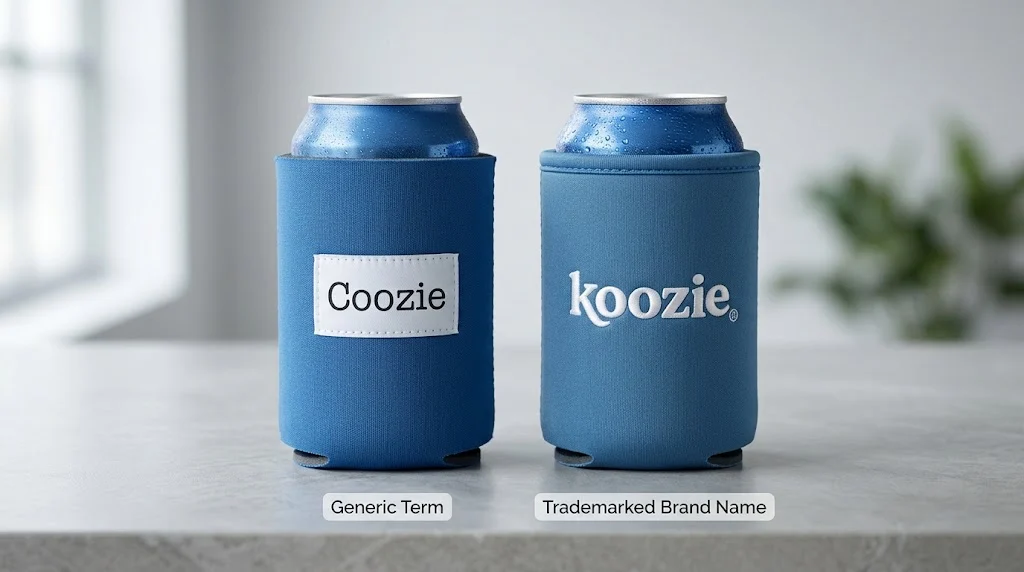
Coozie or koozie refers to the same type of insulated sleeve used to keep a can or bottle cool. Koozie is the original brand name, while coozie is a commonly used alternative spelling that has entered general usage.
The confusion is understandable because people usually hear these words rather than see them written. Both are pronounced approximately KOO zee, and both describe the familiar sleeve that fits around a beverage can or bottle. The difference is therefore not primarily grammatical. It is a question of spelling, naming, trademark usage, and context.
For writers, marketers, students, editors, and anyone creating online content, understanding this distinction helps prevent a surprisingly common vocabulary mistake. Choosing the right form also makes your writing more precise when you are discussing the original Koozie brand rather than the broader category of insulated beverage holders.
Coozie or Koozie: Coozie vs Koozie, What’s the Difference?
The simplest distinction is this: Koozie is the established trademarked brand name, while coozie is a commonly used alternative spelling for the same type of beverage sleeve. Cambridge Dictionary specifically labels Koozie as a US trademark and notes coozie as another form.
| Feature | Coozie | Koozie |
| Part of speech | Noun | Noun |
| Meaning | An insulated beverage sleeve | A beverage sleeve and established brand name |
| Pronunciation | KOO zee | KOO zee |
| Common context | General informal usage | Brand and general usage |
| Capitalization | Usually lowercase when generic | Usually capitalized when referring to the brand |
| Meaning difference | Usually none in everyday speech | Usually none when used generically |
| Formal writing | Better to use a descriptive term when precision matters | Use Koozie when the brand is specifically intended |
The important point is that coozie and Koozie are not two completely different objects.
They normally describe the same basic product.
The major distinction involves brand identity versus generic usage.
When referring to the specific Koozie brand, use the capitalized form Koozie. When discussing the object generally, many speakers and writers use lowercase forms such as coozie or coozy. Cambridge recognizes coozie and coozy as related forms.
Mini Recap
Koozie is the established brand spelling.
Coozie is a widely recognized alternative spelling.
Both are pronounced the same way.
The main issue is usage and branding rather than grammar.
Coozie or Koozie: Is This a Grammar, Vocabulary, or Usage Issue?
This is primarily a vocabulary and usage issue, not a grammar problem.
Grammar determines how a word functions in a sentence. For example, both forms can function as nouns:
I bought a new coozie for my drink.
I bought a new Koozie for my drink.
The sentence structure is grammatically sound in both cases. The question is which spelling and naming convention is most appropriate.
In casual conversation, people rarely worry about the distinction. In professional writing, however, precision becomes more important.
Interchangeable or Not?
In ordinary conversation, the terms are often interchangeable because readers generally understand the intended object.
They are not perfectly interchangeable when trademark identity matters.
If a company is referring specifically to its branded product, Koozie is the appropriate brand form. Koozie Group states that the Koozie name and logos are protected brand elements and that approved licensees must follow its brand guidelines.
Formal vs Casual Usage
In casual writing, coozie is widely understandable.
In formal business writing, a more precise phrase such as insulated beverage holder may be preferable unless the actual brand is relevant.
In academic writing, descriptive terminology is often better because academic readers need clarity rather than promotional language.
How to Use Coozie Correctly
The lowercase form is common when someone is referring to an insulated sleeve generally rather than making a specific claim about a brand.
For example:
We handed each guest a coozie for the outdoor event.
This sentence treats the word as an ordinary noun.
Workplace Example
The marketing team ordered custom coozies for the company picnic.
Here, the writer is talking about promotional beverage holders rather than identifying a specific trademarked product.
Academic Example
An insulated beverage sleeve can reduce heat transfer from the surrounding environment.
An academic writer would probably prefer insulated beverage sleeve rather than either informal spelling.
Technology Example
The smart bottle fits inside a standard insulated coozie.
This usage is natural when discussing compatibility between a technology product and an ordinary beverage sleeve.
Usage Recap
Use coozie when the context is informal and the term is being treated as a general noun.
For technical, academic, or highly formal writing, consider using insulated beverage sleeve or insulated beverage holder instead.
How to Use Koozie Correctly
Use Koozie when you specifically mean the established brand or when the brand identity is important to the context.
The company behind the brand traces its history as an insulated beverage holder to 1979 and continues to describe Koozie as a protected brand.
Workplace Example
The company ordered licensed Koozie products for the promotional campaign.
The capital letter signals that the writer is referring to the brand rather than merely describing the type of product.
Academic Example
The survey asked participants whether they recognized the Koozie brand.
Here, capitalization is appropriate because the research concerns brand recognition.
Technology Example
The device was tested inside a Koozie branded beverage holder.
This sentence makes the brand connection explicit.
Usage Recap
Use Koozie when the established brand is intended.
Use a lowercase generic form only when the word is being used broadly as a common noun.
For maximum precision, identify the product as an insulated beverage holder when brand identity is irrelevant.
When You Should NOT Use Coozie or Koozie
There are several situations where neither informal spelling is the best choice.
- Do not use Koozie as a brand name if you are not actually referring to the brand. A generic product may be better described as an insulated beverage holder.
- Do not automatically capitalize coozie. Lowercase usage is appropriate when the word is being treated as a generic noun.
- Do not assume the two spellings represent different products. They normally refer to the same basic type of beverage sleeve.
- Do not use Koozie in formal academic writing simply because it sounds familiar. A descriptive term may communicate the concept more precisely.
- Do not treat the spelling as a grammar rule. The issue concerns vocabulary, spelling, branding, and usage.
- Do not change the official spelling of a brand. When referring to the Koozie brand, preserve its established capitalization.
- Do not use the term when a technical description is required. In engineering or scientific contexts, insulated beverage sleeve may be clearer.
- Do not assume every insulated drink holder is officially a Koozie product. Product type and brand identity are separate concepts.
Common Mistakes and Decision Rules
| Correct sentence | Incorrect sentence | Explanation |
| I bought a coozie for my can. | I bought a Koozie for my can. | The first sentence clearly uses the word generically. The second may imply the brand. |
| The company promoted its Koozie products. | The company promoted its koozie brand. | The official brand form uses capitalization. |
| We need an insulated beverage holder. | We need a Koozie. | The descriptive term is more precise when no brand is intended. |
| She placed the bottle inside a coozie. | She placed the bottle inside a CoOzie. | Random capitalization is unnecessary. |
Decision Rule Box
If you mean a general insulated beverage sleeve, use coozie or a descriptive term such as insulated beverage holder.
If you mean the established brand, use Koozie.
If you are writing formally and brand identity is irrelevant, use insulated beverage sleeve or insulated beverage holder.
Coozie or Koozie in Modern Technology and AI Tools
Modern search engines and AI tools generally understand the relationship between these spellings because the terms occur in overlapping contexts.
Someone searching for coozie may be looking for the same product category as someone searching for Koozie. Dictionary data reinforces this connection because Cambridge identifies Koozie as a brand name and also lists coozie as an alternative form.
For AI generated content, product descriptions, and search optimized writing, context is especially important. If the article is discussing the brand, the wording should preserve the brand identity. If it is discussing beverage sleeves generally, descriptive language can eliminate ambiguity.
This is also why writers should not blindly replace every instance of one spelling with the other. Semantic context matters more than simple keyword matching.
A Short Etymology and Naming History
The modern term is closely associated with the Koozie brand. Koozie Group states that its history with the insulated beverage holder dates to 1979.
Over time, the brand name became strongly associated with the entire product category in everyday speech. That process is common in English. Brand names sometimes become so familiar that speakers begin using them as ordinary nouns.
The spelling coozie reflects this broader informal usage. Cambridge lists it as an alternative form of Koozie, showing that the spelling is not simply an obvious misspelling.
One useful expert style observation is that Koozie Group describes the product as beginning as an insulated beverage holder and emphasizes the continuing integrity of the Koozie brand.
That distinction explains why ordinary conversation and trademark usage can coexist without meaning exactly the same thing.
Two Practical Case Studies
Case Study 1: Promotional Marketing
Imagine a company preparing promotional merchandise for a summer event.
The marketing team writes:
Order 500 Koozie products for the event.
If the company is purchasing the actual licensed brand, the wording is appropriate.
If it is simply ordering generic insulated beverage sleeves, the phrase 500 insulated beverage holders is more precise.
Result: The revised wording makes the product category clear and avoids accidentally implying a specific brand.
Case Study 2: Academic Product Research
Consider a university researcher studying consumer preferences for beverage insulation.
Writing:
Participants evaluated Koozie products.
suggests that the research concerns a particular brand.
Writing:
Participants evaluated insulated beverage sleeves.
makes the research category broader.
Result: The second wording produces a clearer research scope because readers know that the study concerns the product type rather than one trademarked brand.
These examples demonstrate an important principle: spelling accuracy is only part of effective language use. Context determines whether the chosen word communicates exactly what the writer intends.
Authoritative Usage Guidance
A reliable dictionary source is particularly useful here because informal spellings can become established through repeated everyday use. Cambridge Dictionary currently lists Koozie as a US trademark and notes coozie as an alternative form.
The brand owner also provides a separate distinction by maintaining official Koozie brand standards and requiring authorized licensees to follow those standards.
Author bio: Written and reviewed from a professional linguistics and SEO perspective, with emphasis on English vocabulary, spelling variation, contextual usage, search intent, and editorial accuracy.
Error Prevention Checklist
Always use Coozie when
- You are using the word informally as a generic noun.
- The context clearly refers to an insulated beverage sleeve rather than a specific brand.
- The audience is familiar with casual American English.
Never use Koozie when
- You do not intend to refer to the established brand.
- You are using capitalization simply because the object is a product.
- A formal technical description would be clearer.
- You are making an unsupported claim that every beverage sleeve is a Koozie product.
Related Grammar Confusions You Should Master
Understanding spelling and usage differences becomes easier when you study similar English distinctions.
Here are several useful topics:
- Cozy or cosy: American and British spelling differences.
- Cozie or cozy: Historical and variant spellings of a related word.
- Everyday or every day: Adjective versus time expression.
- Setup or set up: Noun versus verb.
- Advice or advise: Noun versus verb.
- Practice or practise: American and British usage differences.
- License or licence: American and British spelling conventions.
- Canceled or cancelled: Differences in spelling conventions.
- Traveling or travelling: Regional spelling variation.
- Realize or realise: American and British spelling preferences.
Studying these pairs helps writers understand a larger principle: English spelling often reflects region, history, pronunciation, word function, and established usage rather than a single universal rule.
FAQs
Is coozie or koozie the correct spelling?
Both spellings are used for an insulated beverage sleeve, but Koozie is the established brand spelling. Coozie is a recognized alternative form in common usage.
Is Koozie a brand name or a generic word?
Koozie is an established brand name. Its owner maintains brand standards and identifies the name as a protected brand element.
Is coozie a real word?
Yes. Cambridge Dictionary lists coozie as an alternative form associated with Koozie.
How do you pronounce coozie and Koozie?
Both are generally pronounced KOO zee, with the same pronunciation in standard English usage.
Should Koozie always be capitalized?
Capitalize Koozie when referring specifically to the brand. Generic use may appear in lowercase, depending on the writer’s intended meaning and editorial style.
What is another word for a coozie?
Common descriptive alternatives include insulated beverage sleeve, drink holder, can sleeve, and bottle sleeve.
Is coozie the same as a can cooler?
In everyday usage, the terms can describe essentially the same type of product. However, can cooler is a more descriptive generic phrase, while Koozie has brand associations.
Is Koozie a trademark?
Yes. Cambridge identifies Koozie as a US trademark, and Koozie Group maintains official brand standards for the name.
Which spelling should I use in formal writing?
If you are referring to the brand, use Koozie. If you mean the general product, insulated beverage holder is usually the clearest formal choice.
Conclusion
The answer to coozie or koozie is more nuanced than simply choosing one spelling and declaring the other wrong. Koozie is the established brand name, while coozie is a widely recognized alternative form used for the same type of insulated beverage sleeve.
For everyday conversation, readers will usually understand either form. For professional, academic, and technical writing, however, context should guide your choice. Use Koozie when the brand is intended, use coozie when a generic informal term fits the context, and choose insulated beverage holder when maximum clarity is more important than familiarity.

Neil Gaiman is an American writer who contributes educational content to LingRoya.com. His work focuses on helping readers improve their English with clear, practical and easy to follow guidance.