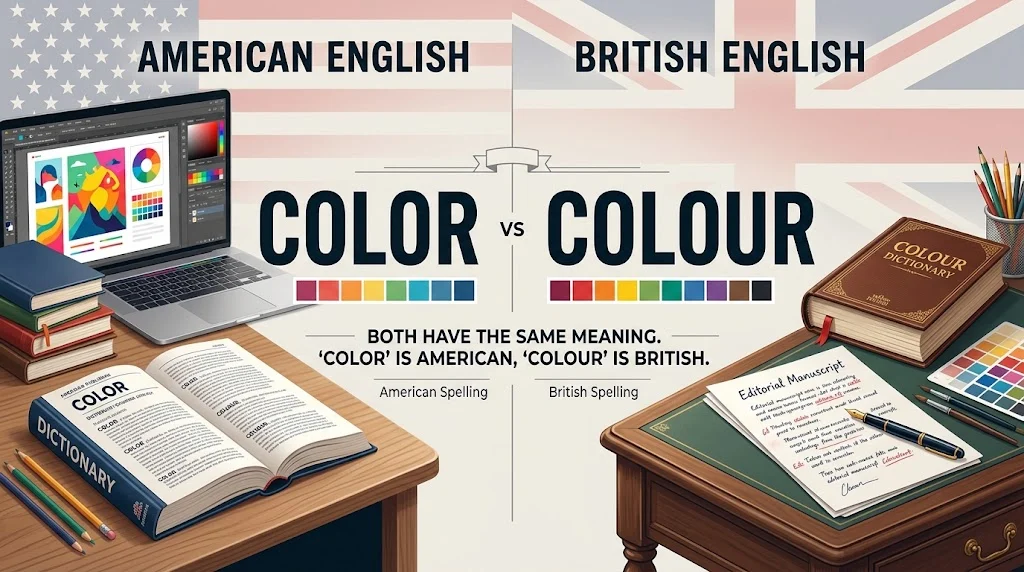
Color is the standard spelling in American English, while colour is standard in British English and is also widely used in Canada, Australia, and other varieties of English.
Color and colour mean exactly the same thing: the visual quality produced when light is reflected or emitted by an object, and the word can also describe the act of adding color to something. The only significant difference is spelling convention. American English generally uses color, while British English generally uses colour.
Color vs Colour: What’s the Difference?
Color and colour are both nouns and verbs.
As a noun, the word refers to the visual characteristic of an object caused by the way it reflects, absorbs, or emits light. It can also refer to a distinctive quality, character, or appearance.
Example:
Blue is my favorite color.
As a verb, the word means to change the appearance of something by applying a pigment, dye, or similar substance. It can also mean to influence something in a particular way.
Example:
The artist will colour the drawing tomorrow.
The distinction between the two forms is therefore not about meaning or grammar. It is about regional spelling.
| Feature | Color | Colour |
| Part of speech | Noun and verb | Noun and verb |
| Meaning | Visual appearance or act of coloring | Visual appearance or act of colouring |
| Main variety | American English | British English |
| Common regions | United States | United Kingdom, Australia, Canada, New Zealand |
| Example | What color is the car? | What colour is the car? |
Mini Recap
Color is standard American English spelling.
Colour is standard British English spelling.
Both forms have the same meaning and grammatical function.
The best choice depends on your audience, location, publication, or style guide.
Is Color vs Colour a Grammar, Vocabulary, or Usage Issue?
The difference between color and colour is primarily a spelling and usage issue, not a difference in vocabulary or grammar.
The two forms are not different words with different definitions. They represent the same word in different regional varieties of English.
In American English, color is the expected spelling. This applies to formal writing, academic papers, business documents, websites, newspapers, and casual communication.
In British English, colour is the standard spelling. The same applies to formal and informal contexts in countries that generally follow British spelling conventions.
This means neither version is more formal than the other. You should not assume that colour is formal and color is informal. Both are perfectly acceptable in appropriate varieties of English.
Academic writing requires consistency. If you’re writing an essay according to an American style guide, use color. If your institution follows British English conventions, use colour.
The same principle applies to business communication. A company targeting customers in the United States will generally benefit from American spelling, while a British audience expects British spelling.
How to Use Color Correctly
Use color when writing in American English or when your chosen style guide specifies American spelling.
As a noun:
The color of the walls makes the room feel brighter.
As a verb:
Please color the diagram before submitting it.
Workplace Example
Please select a background color for the presentation.
An American workplace document would normally use color.
Academic Example
The researchers examined how color affects visual perception.
An American academic paper would use color consistently throughout the document.
Technology Example
You can change the color of the interface from the settings menu.
Software developed primarily for an American audience will often use color in its menus, documentation, and interface descriptions.
Usage Recap for Color
Use color when your content follows American English.
It is correct in formal and informal writing.
It is especially appropriate for American websites, academic work, business documents, and software interfaces.
How to Use Colour Correctly
Use colour when writing in British English or another variety that follows British spelling conventions.
For example:
The colour of the building has faded over time.
The sentence is completely standard in British English.
The same spelling applies to related words. British English generally uses colourful, colouring, and coloured.
Workplace Example
The designer selected a warm colour for the company’s new brochure.
This is natural British English usage.
Academic Example
The study explored how colour influences human perception.
A British academic publication would normally retain the ou spelling.
Technology Example
Select a colour from the available options.
British software interfaces may use colour instead of color, particularly when designed for British English users.
Usage Recap for Colour
Use colour when following British English conventions.
It is fully correct in formal and academic writing.
It is common in the United Kingdom, Australia, New Zealand, and other regions influenced by British spelling.
When You Should NOT Use Color or Colour
The issue isn’t that either spelling is wrong. The problem occurs when writers use the wrong regional convention for their audience or switch between conventions without a reason.
Here are eight common misuse scenarios.
Writing color in one paragraph and colour in another makes the content look inconsistent.
- Following the wrong style guide
A publication may specifically require American or British English. Ignoring that requirement can create unnecessary editing work.
- Assuming one form is universally correct
Neither spelling is universally preferred across all English speaking countries.
- Changing the spelling inside quotations
If a quotation uses colour, don’t automatically change it to color. Preserve the original wording unless your editorial rules say otherwise.
- Using inconsistent derived forms
If you choose American English, use forms such as coloring and colored. If you choose British English, use colouring and coloured.
- Switching conventions for SEO keywords without considering readability
Keyword research may reveal searches using both forms. However, your primary spelling should still match your target audience and overall editorial style.
- Assuming British spelling is more sophisticated
Regional spelling does not determine the quality of writing.
- Assuming American spelling is less formal
American spelling can be used in highly formal academic, scientific, legal, and professional writing.
Common Mistakes: Correct Sentence, Incorrect Sentence, and Explanation
| Correct sentence | Incorrect sentence | Explanation |
| The color is too dark. | The colour is too dark. | The second form is not grammatically wrong, but it conflicts with an American English context. |
| The colour is too dark. | The color is too dark. | The second form may conflict with a British English style requirement. |
| She chose a blue color. | She chose a blue colour. | Use the spelling required by your regional English convention. |
| The designer changed the colour. | The designer changed the color. | British English normally uses colour. |
| The coloring process takes time. | The colouring process takes time. | American English normally uses coloring. |
| The colouring process takes time. | The coloring process takes time. | British English normally uses colouring. |
Decision Rule Box
If you’re writing for an American audience, use COLOR.
If you’re writing for a British English audience, use COLOUR.
When your audience is international, choose one spelling system and apply it consistently. Your style guide should be the final authority when a publication, university, employer, or client has a specified preference.
Color and Colour in Modern Technology and AI Tools
Technology makes the distinction particularly visible because software interfaces often reveal the regional English conventions chosen by developers.
An American application may contain settings such as color scheme, color picker, or background color. A British application may use colour scheme, colour picker, or background colour.
AI writing tools also encounter both spellings because their training data contains different varieties of English. A good AI system should consider the user’s requested language variety rather than treating one spelling as universally correct.
For content creators, this matters when generating website copy, product descriptions, user interfaces, documentation, or marketing material. Consistency helps establish a professional voice.
Etymology: Where Did Color and Colour Come From?
The history of these spellings can be traced back through French and Latin.
The English word ultimately developed from Latin color, meaning appearance or hue. Old French influenced the form used in English, and colour became established in British English.
The spelling color became especially prominent in American English. Noah Webster, whose dictionaries strongly influenced American spelling conventions, favored shorter spellings in several cases. This contributed to the wider acceptance of forms such as color in American English.
The same regional pattern appears in related words such as honor and honour, favor and favour, and labor and labour.
Expert Explanation: Which Form Should You Choose?
“Color and colour are regional spelling variants, so the correct choice depends on the variety of English being used rather than on the meaning of the word.”
For professional writers, the most important principle is consistency. Select the spelling that matches your audience and maintain the same convention throughout the document.
Two Practical Case Studies
Case Study One: American Website Localization
Imagine an ecommerce website selling interior design products primarily to customers in the United States. Its product page says:
Choose your colour.
The spelling isn’t grammatically incorrect, but it may feel inconsistent with the rest of an American English interface.
Changing the wording to:
Choose your color.
aligns the interface with American spelling conventions.
The concrete result is greater editorial consistency and a more natural regional voice.
Case Study Two: British Academic Writing
Consider a university assignment written according to British English conventions. The student uses colour throughout the essay but accidentally writes:
The color spectrum was examined.
Changing color to colour makes the spelling consistent with the rest of the paper.
The concrete result is a cleaner manuscript that follows the institution’s expected English variety and avoids unnecessary correction during proofreading.
Author expertise: This guide is prepared by a language and SEO specialist with a focus on English grammar, regional spelling, search intent, and clear educational content.
Error Prevention Checklist
Always use Color when:
- You’re writing in American English.
- Your American client requires US spelling.
- Your publication follows an American style guide.
- Your software documentation targets US users.
- Your academic institution specifies American English.
- Your website consistently uses American spelling.
Never use Colour when:
- Your required style guide specifically mandates American spelling.
- You’re localizing an American interface that consistently uses color.
- You’re editing American English content and maintaining its regional convention.
- Your client has specifically requested US spelling.
- You are switching to British spelling without a clear editorial reason.
The reverse principle applies when writing in British English: choose colour and maintain the British spelling system consistently.
Related Grammar Confusions You Should Master
Learning color or colour is part of understanding regional English differences. Several other commonly confused spellings follow similar patterns.
- American English versus British English
- Center versus centre
- Theater versus theatre
- Favorite versus favourite
- Honor versus honour
- Analyze versus analyse
- Realize versus realise
- License versus licence
- Practice versus practise
- Traveling versus travelling
These differences are especially important for bloggers, students, editors, translators, businesses, and anyone producing content for an international audience.
FAQs
Is color or colour correct?
Both color and colour are correct. Color is the standard American English spelling, while colour is the standard British English spelling and is also used in several other varieties of English.
Is color American or British English?
Color is primarily the American English spelling. It is commonly used in the United States and in writing that follows American spelling conventions.
Is colour British or American?
Colour is the standard British English spelling. It is also common in Australia, New Zealand, Canada, and other English speaking regions, although regional preferences can vary.
Why does American English spell color without a u?
The spelling color became established in American English partly through historical spelling preferences associated with American dictionary makers such as Noah Webster. American English adopted several shorter spellings that differ from British conventions.
Why do British people spell color as colour?
Colour reflects the historical British spelling influenced by French and Latin forms. It became the established conventional spelling in British English.
Is colour more correct than color?
No. Neither form is inherently more correct. Each is standard in a different regional variety of English. The correct choice depends on your audience and style guide.
Should I use color or colour in academic writing?
Use the spelling required by your academic institution, instructor, publisher, or style guide. American academic writing normally uses color, while British academic writing normally uses colour.
Conclusion
The choice between color or colour is straightforward once you understand regional English spelling. Color is the standard American English form, while colour is standard British English and common in several other English varieties. Both have the same meaning, grammatical function, and pronunciation in ordinary usage.
The best rule is to identify your audience first. If you’re writing for readers in the United States, choose color. If you’re following British English conventions, choose colour. Most importantly, don’t mix the two spelling systems without a clear reason.
For websites, academic papers, business documents, and professional publications, consistency matters more than choosing one form over the other.

Philip Pullman is an American writer dedicated to creating clear and easy to follow English content. Through his work at LingRoya.com, he helps readers strengthen their language skills with practical and reliable guidance so that they can easily understand.