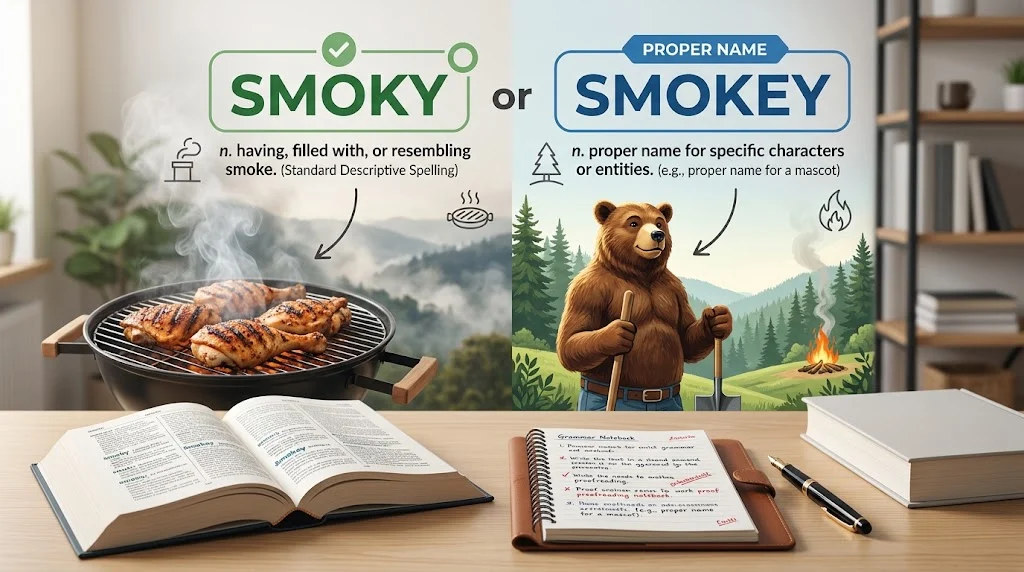
Smoky is generally the preferred spelling of the adjective meaning full of smoke, resembling smoke, or having a smoky flavor or smell. Smokey is also found in English, but it is less common and often appears in proper names or informal contexts.
The spelling difference between smoky and smokey looks minor, but choosing the wrong form can make polished writing appear inconsistent. Both forms are recognizable, and both have appeared in English usage, which makes the confusion understandable. Still, modern dictionaries and established writing conventions generally favor smoky when the adjective is formed from the noun smoke.
You’ll encounter this word in food descriptions, weather reports, fire safety information, photography, literature, and everyday conversation. Knowing when to use smoky, and understanding why smokey still appears in certain contexts, helps writers make confident choices in professional, academic, and digital content.
Smoky vs Smokey: What’s the Difference?
Smoky and smokey are adjectives. They describe something that contains smoke, resembles smoke, smells or tastes like smoke, or has characteristics associated with smoke.
The important distinction is spelling and usage rather than a major difference in meaning.
| Word | Part of Speech | Meaning | Typical Usage | Example |
| Smoky | Adjective | Full of smoke or resembling smoke | Standard modern English | The room became smoky. |
| Smoky | Adjective | Having a smoky taste or aroma | Food and drinks | The sauce has a smoky flavor. |
| Smokey | Adjective or proper name element | Variant spelling associated with smoke | Less common or established names | Smokey is used in some proper names. |
The standard adjective is generally spelled smoky.
For example:
“The kitchen became smoky after the food burned.”
“Her barbecue sauce has a rich, smoky flavor.”
“Smoke created a smoky haze over the city.”
Mini Recap
Smoky is the standard spelling for the adjective.
Smokey is a less common variant.
Smoky is preferred in most formal and general writing.
Smokey frequently appears in proper names and established expressions.
The pronunciation is essentially the same, so context and spelling determine the correct form.
Is Smoky vs Smokey a Grammar, Vocabulary, or Usage Issue?
The difference between smoky and smokey is mainly a spelling and usage issue rather than a major grammatical distinction.
Both forms can function as adjectives, but they do not have equal status in contemporary standard English. Smoky is the conventional spelling when describing something associated with smoke.
For example:
“The room was smoky.”
“The whiskey had a smoky aroma.”
“The air became smoky after the fire.”
The spelling smokey may still appear in certain contexts, especially in names, branding, informal writing, or established expressions.
Formal vs Informal Usage
In formal writing, smoky is generally the better choice.
A scientific report might say:
“Smoke produced a smoky atmosphere inside the building.”
A restaurant menu might describe:
“Our signature sauce has a smoky flavor.”
Using smoky in these contexts follows the conventional spelling.
Smokey can be appropriate when it forms part of a recognized name or title. In those situations, changing the spelling may actually make the name incorrect.
Academic vs Casual Usage
Academic and professional writing generally favors smoky because it is the standard adjective.
Casual writing may contain smokey because spelling variants often appear in informal communication. However, familiarity does not necessarily make the variant preferable in formal prose.
How to Use Smoky Correctly
Use smoky when describing something that contains smoke, resembles smoke, or has the flavor, smell, appearance, or atmosphere associated with smoke.
Workplace Example
“The conference room became smoky after the electrical equipment malfunctioned.”
Here, smoky describes the condition of the room.
Academic Example
“The researchers observed a smoky layer developing above the burning material.”
The adjective describes an observable condition associated with smoke.
Technology Example
“The camera captured a smoky atmosphere during the outdoor test.”
Smoky describes the appearance of the environment.
Food Example
“The grilled vegetables have a delicious smoky flavor.”
Here, smoky describes taste and aroma.
Usage Recap for Smoky
Use smoky as the default adjective.
Choose it when describing smoke filled air, a smoky smell, smoky flavor, or a smoke like appearance.
For standard English writing, smoky is normally the preferred spelling.
How to Use Smokey Correctly
Smokey is a less common spelling of the adjective and appears in particular contexts. It is especially important when the spelling forms part of a proper name, established title, or brand identity.
One famous example is Smokey Bear, the American wildfire prevention mascot. The name is spelled Smokey, not Smoky, because that is the established proper name.
This distinction matters because proper names should normally retain their official spelling.
If you are describing an ordinary smoky room, however, use smoky.
Correct:
“The room was smoky.”
Established name:
“Smokey Bear is associated with wildfire prevention.”
Workplace Example
“The office became smoky after the incident.”
But if an employee is referring to a person or established name spelled Smokey, the original spelling should be preserved.
Academic Example
“Researchers described the atmosphere as smoky.”
In academic prose, smoky is the natural choice for the ordinary adjective.
Technology Example
“The image has a smoky visual effect.”
If a software feature or product uses Smokey as an official name, its official spelling should be retained.
Usage Recap for Smokey
Use smokey cautiously in ordinary descriptive writing.
Use it when it appears in a proper name or established expression.
Do not automatically replace smoky with smokey simply because both forms exist.
When You Should NOT Use Smoky or Smokey
Several situations can help prevent spelling mistakes.
- Do not use smokey as your default spelling for the ordinary adjective. Use smoky instead.
- Do not change an established proper name from Smokey to Smoky simply because smoky is the standard adjective.
- Do not assume that every appearance of smokey is a spelling error. Context matters.
- Do not use smoky when the intended word is smoke itself. “The smoke filled the room” is different from “The room was smoky.”
- Do not use smokey in formal academic writing when you simply mean filled with smoke.
- Do not judge the spelling by pronunciation because smoky and smokey are pronounced similarly.
- Do not treat branding conventions as ordinary spelling rules.
- Do not automatically correct a proper name without checking its established form.
Common Mistakes and Decision Rules
| Correct Sentence | Incorrect Sentence | Explanation |
| The kitchen became smoky. | The kitchen became smokey. | Smoky is the standard adjective. |
| The sauce has a smoky flavor. | The sauce has a smokey flavor. | Standard descriptive writing uses smoky. |
| The air was smoky after the fire. | The air was smokey after the fire. | Smoky is the conventional form. |
| Smokey Bear is a wildfire prevention mascot. | Smoky Bear is a wildfire prevention mascot. | The established proper name uses Smokey. |
| The photograph has a smoky appearance. | The photograph has a smokey appearance. | Smoky is preferred for ordinary description. |
Decision Rule Box
If you mean something containing smoke, resembling smoke, or having a smoky taste or smell, use smoky.
If you are referring to an established name or title that is officially spelled Smokey, preserve Smokey.
The easiest rule is simple: smoky is the standard adjective, while Smokey is often a name.
Smoky and Smokey in Modern Technology and AI Tools
The distinction appears frequently in modern digital content.
Photography software may describe a smoky effect, smoky background, or smoky atmosphere. Video games may feature smoky environments, while artificial intelligence image generators may be prompted to create smoky lighting or smoky textures.
AI writing tools can occasionally produce either spelling because both forms exist in English. Context is therefore important. If the sentence describes a normal visual, smell, taste, or atmospheric quality, smoky is generally the appropriate choice.
If the generated text refers to a proper name, the official spelling must be preserved.
For example:
“The AI generated a smoky background.”
But:
“The article mentioned Smokey Bear.”
Etymology of Smoky and Smokey
The adjective smoky comes from the noun smoke, with the suffix that forms an adjective describing something characterized by or associated with smoke.
English has many similar formations:
Rain becomes rainy.
Cloud becomes cloudy.
Wind becomes windy.
Smoke becomes smoky.
The spelling smoky follows a familiar English pattern in which a final e is removed before adding the adjective ending.
The variant smokey has also appeared historically and continues in particular contexts, but it is not generally the preferred spelling for the ordinary adjective in contemporary standard English.
An Expert Style Principle
“When a spelling variant has a specialized role, context should determine whether it belongs in ordinary description or a proper name.”
This principle is especially useful with words that have standard spellings alongside established variants.
Two Practical Case Studies
Case Study 1: Restaurant Description
Imagine a restaurant menu describing a barbecue sauce as:
“Our signature sauce has a rich smokey flavor.”
The sentence is understandable, but smoky is the more conventional spelling for a standard food description.
A polished version would be:
“Our signature sauce has a rich smoky flavor.”
Result: The revised spelling follows standard modern usage and gives the menu a more professionally edited appearance.
Case Study 2: Proper Name
Now consider a sentence about the American wildfire prevention mascot:
“Smoky Bear teaches children about fire safety.”
This changes the established name.
The correct form is:
“Smokey Bear teaches children about fire safety.”
Result: Retaining Smokey preserves the official spelling of the proper name.
These examples demonstrate why the choice cannot be reduced to “one spelling is always correct.” Standard descriptive usage generally favors smoky, while proper names may intentionally preserve Smokey.
Error Prevention Checklist
Always use Smoky when
You are describing something full of smoke.
Describing a smoky smell or taste.
You are describing a smoke like appearance.
Writing formal or academic prose.
You are describing food, drinks, weather, photography, or atmosphere.
Never use Smokey when
You simply mean the standard adjective related to smoke.
When you are writing formal prose and have no proper name or established expression requiring the variant.
You are describing an ordinary smoky room, flavor, or atmosphere.
However, preserve Smokey when it is part of an established proper name.
Related Grammar Confusions You Should Master
Understanding smoky and smokey can lead to other useful spelling distinctions:
- Gray vs grey
- Color vs colour
- Theater vs theatre
- Labeled vs labelled
- Realize vs realise
- Traveling vs travelling
- Whiskey vs whisky
- Cancelled vs canceled
- Practice vs practise
- Adviser vs advisor
These examples show how English spelling can vary by region, tradition, style, and proper naming conventions.
FAQs
Is smoky or smokey correct?
Smoky is generally the standard spelling for the adjective meaning full of smoke or resembling smoke. Smokey appears in some variants, proper names, and established expressions.
Which spelling is more common, smoky or smokey?
Smoky is more common as the ordinary adjective in contemporary standard English.
Is smokey a correct spelling?
Yes, smokey exists as a spelling variant, but it is not normally the preferred spelling for ordinary descriptive writing.
Should I write smoky flavor or smokey flavor?
The standard form is smoky flavor.
Is it Smoky Bear or Smokey Bear?
The established proper name is Smokey Bear. The spelling should be preserved because it is part of the official name.
Why is Smokey spelled with an e?
Smokey is used as the established spelling in certain names and expressions. Proper names can preserve spellings that differ from ordinary descriptive conventions.
Is smoky an adjective?
Yes. Smoky is an adjective describing something characterized by smoke or having a smoke like quality.
Should I use smoky in academic writing?
Yes. Smoky is generally the preferred spelling for ordinary descriptive use in academic and professional writing.
Are smoky and smokey pronounced the same?
They are generally pronounced alike or very similarly, which is one reason the spelling distinction can be confusing.
Can I use smokey in formal writing?
You can use Smokey when the context specifically requires that spelling, such as a proper name. For ordinary descriptive writing, smoky is usually preferable.
Conclusion
The distinction between smoky or smokey is primarily a matter of spelling and usage. Smoky is the standard choice when describing something filled with smoke, resembling smoke, or having a smoky flavor, smell, or appearance.
Smokey is less common as an ordinary adjective but remains important in established names and expressions, such as Smokey Bear. When writing normal descriptive English, choose smoky. When the spelling is part of an official name, preserve Smokey exactly as established.

Margaret Atwood is an American writer who contributes to LingRoya.com creating clear and engaging content about the English language and everyday communication. She enjoys helping readers build confidence in their writing through simple, practical guidance.