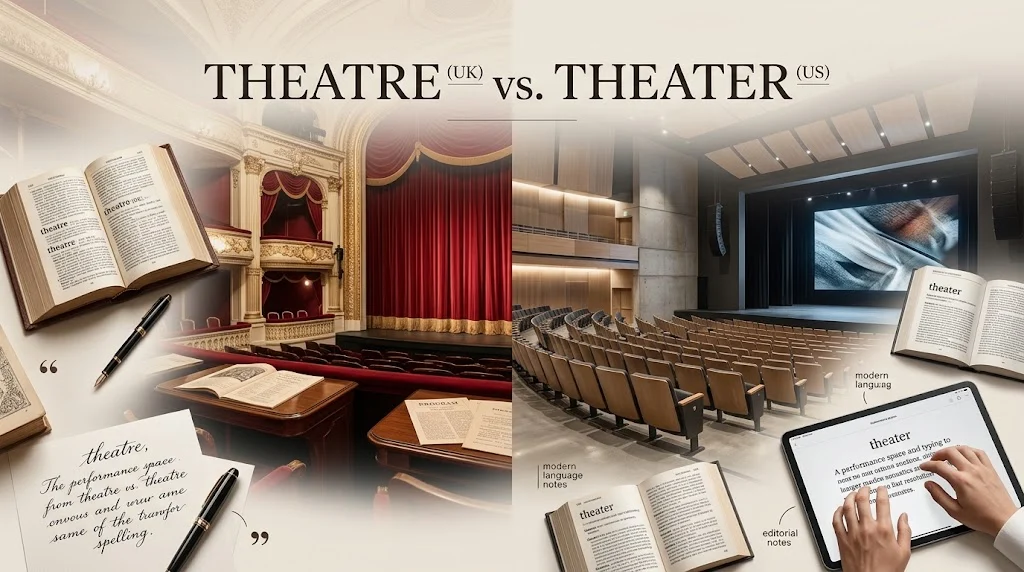
Both theatre and theater are correct. Theatre is preferred in British English, while theater is the usual spelling in American English. Both refer to a building where plays and performances take place, the art of dramatic performance, or the world of live drama.
If you have ever wondered whether to write theatre or theater, you are dealing with one of the most recognizable differences between British and American English. The two words have the same pronunciation and essentially the same meanings, but their spellings differ because English developed distinct regional conventions on opposite sides of the Atlantic.
The word can refer to a building where audiences watch plays, the art and profession of dramatic performance, or a particular field of entertainment. The confusion becomes important when writers switch between English varieties without realizing it. A British publication may consistently use theatre, while an American publication may use theater. Mixing the forms within one article, report, website, or academic paper can make the writing look inconsistent.
Theatre vs Theater: What’s the Difference?
Theatre and theater are nouns with the same basic meanings. The principal difference is regional spelling.
Theatre is the standard form in British English. It is also widely used in countries and institutions influenced by British English, including many organizations in the United Kingdom, Australia, New Zealand, and other English speaking regions.
Theater is the standard form in American English. It is common throughout the United States and is often preferred by American publishers, universities, businesses, and media organizations.
The distinction is especially noticeable in proper names. Some organizations deliberately retain theatre because it is part of their established name or reflects an artistic tradition. Likewise, an American institution may officially use theater even when its productions have an international audience.
Comparison Table
| Feature | Theatre | Theater |
| Part of speech | Noun | Noun |
| Main meaning | Place or art of dramatic performance | Place or art of dramatic performance |
| Common variety | British English | American English |
| Pronunciation | Generally the same | Generally the same |
| Formality | Standard | Standard |
| Meaning | Same | Same |
| Best choice | British style | American style |
Mini Recap
Theatre is the usual British English spelling.
Theater is the usual American English spelling.
Both forms have the same basic meaning.
Choose one spelling according to your target variety of English.
Consistency matters more than choosing one form as universally superior.
Is Theatre vs Theater a Grammar, Vocabulary, or Usage Issue?
This is primarily a spelling and regional usage issue, not a grammar problem. The two forms are not different grammatical words with different definitions. They are regional spelling variants of the same noun.
In most situations, they are interchangeable in meaning. You can say that someone visited a theater or a theatre, and the basic meaning remains unchanged. The important consideration is the variety of English being used.
In formal British writing, theatre is normally expected. In formal American writing, theater is normally expected. Both are completely acceptable within their respective systems.
Academic writing follows the same principle. A British university assignment will generally use British spelling, whereas an American university assignment will normally follow American conventions. Casual writing is more flexible, but consistency is still desirable.
The biggest mistake is not choosing one spelling over the other. The bigger problem is switching between them without a reason. For example, using theatre in one paragraph and theater in the next may make an article appear poorly edited.
How to Use Theatre Correctly
Use theatre when you are writing in British English or following a style guide that uses British spelling.
The word can describe the physical venue where performances occur.
Workplace Example
“The company has arranged a private event at the local theatre.”
Here, theatre identifies a performance venue. The spelling is appropriate for British English.
Academic Example
“The study examines how modern theatre reflects changes in society.”
In this sentence, theatre refers to dramatic art rather than a particular building. British academic writing would normally retain this spelling.
Technology Example
“New digital technology is changing how theatre productions are designed and presented.”
The spelling remains theatre even though the sentence discusses modern technology.
Usage Recap for Theatre
Use theatre when following British English conventions.
It can refer to a venue, dramatic art, or the professional world of stage performance.
It is particularly appropriate when your audience expects British spelling.
How to Use Theater Correctly
Use theater when writing in American English. It has the same meanings as theatre and is fully standard in American usage.
Workplace Example
“The company rented a theater for its annual presentation.”
Here, theater refers to a performance venue and follows American spelling conventions.
Academic Example
“The research explores the influence of contemporary theater on American culture.”
In American academic writing, theater is the expected spelling.
Technology Example
“Artificial intelligence is being used to create new visual effects for theater productions.”
The spelling theater is appropriate when the surrounding content follows American English.
Usage Recap for Theater
Use theater in American English.
It has the same meanings as theatre.
It is standard in American professional, academic, commercial, and casual writing.
When You Should NOT Use Theatre or Theater
There are several situations in which choosing between the two spellings requires extra attention.
1. Do Not Mix British and American Spelling Without a Reason
If your article follows American English, consistently use theater. If it follows British English, consistently use theatre.
2. Do Not Assume One Form Is Incorrect
Calling theatre incorrect because you normally use American English is inaccurate. The same applies to calling theater incorrect in British English.
3. Do Not Change an Official Name
If a venue, organization, company, or institution officially uses one spelling, preserve its established name.
4. Do Not Change Quoted Material
When reproducing an exact quotation, retain the spelling used in the original source unless your publication rules specifically require editorial changes.
5. Do Not Mix Regional Styles in Academic Work
Students should check whether their institution expects British or American English and apply that convention consistently.
6. Do Not Choose Based Only on Personal Preference
For professional content, the intended audience should normally determine the spelling.
7. Do Not Treat the Difference as a Difference in Meaning
In ordinary usage, theatre and theater do not represent two different concepts.
8. Do Not Ignore Brand and Institutional Style
Some organizations intentionally use one spelling regardless of the writer’s personal English variety. Their official style should take priority.
Common Mistakes and Decision Rules
| Correct sentence | Incorrect sentence | Explanation |
| The theatre opens at seven. | The theater opens at seven. | The second form is not grammatically incorrect, but theatre is preferable in British English. |
| The theater opens at seven. | The theatre opens at seven. | The second form is not grammatically incorrect, but theater is preferable in American English. |
| She studies theatre at university. | She studies theater at university. | British academic style generally prefers theatre. |
| She studies theater at college. | She studies theatre at college. | American academic style generally prefers theater. |
| We visited the Royal Theatre. | We visited the Royal Theater. | Official names should retain their established spelling. |
Decision Rule Box
If you are writing in British English, use theatre.
If you are writing in American English, use theater.
If you are following a specific publication or institutional style guide, follow that guide.
The simplest strategy is to identify your target audience before beginning a document. Once you choose a regional variety, keep the spelling consistent throughout.
Theatre and Theater in Modern Technology and AI Tools
Modern technology has made regional spelling differences more visible rather than eliminating them. Search engines, grammar checkers, word processors, translation systems, and AI writing assistants can recognize both forms and often infer the intended English variety from surrounding content.
For example, an AI writing tool may recommend theater when editing text written for an American audience. If the same content is being prepared for a British publication, theatre may be the appropriate choice.
This distinction is especially important for websites targeting international audiences. A company should decide whether its content strategy follows American English, British English, or another established regional convention. Once that choice is made, automated writing tools should be configured or prompted accordingly.
AI can identify spelling patterns, but human editorial judgment remains important. A proper name may intentionally use a spelling that differs from the general regional convention, and automated rewriting should not alter it without a reason.
Etymology: Where Do Theatre and Theater Come From?
The word ultimately traces back through French and Latin to the ancient Greek word associated with a place for viewing performances. English adopted forms of the word during its historical development, and different spelling traditions eventually became established.
The spelling theatre reflects the French influenced form that became conventional in British English. The spelling theater developed as an American English variant and became firmly established in the United States.
Neither spelling represents a modern invention or a spelling mistake. Both belong to the history of English and have been used for a long time.
Expert Style Guidance
“The best spelling is the one that matches your chosen variety of English and remains consistent throughout the document.”
This principle is useful beyond this particular word. Regional spelling differences are common in English, so professional writers should think about audience and style rather than assuming that one national convention is universally correct.
Two Practical Case Studies
Case Study 1: International Business Website
Imagine a global entertainment company preparing a website for customers in both the United States and the United Kingdom. The original draft uses theater on some pages and theatre on others.
An editorial review identifies the inconsistent regional spelling and assigns American English to the United States version and British English to the United Kingdom version. The result is two internally consistent versions without changing the company’s underlying message.
The concrete improvement is consistency across regional pages rather than claiming that either spelling is more correct.
Case Study 2: University Assignment
Consider a student writing a 3,000 word essay about dramatic performance. The student uses theatre throughout most of the essay but switches to theater several times after consulting American sources.
An editorial review replaces the inconsistent forms with the spelling required by the student’s university style. The argument, evidence, and citations remain unchanged, while the paper gains a consistent regional voice.
The practical lesson is simple: sources may use different English varieties, but your own writing should normally follow one consistent convention.
Error Prevention Checklist
Always use Theatre when:
☐ You are writing in British English.
☐ Your publication follows British spelling.
☐ Your academic or professional style guide specifies British English.
☐ You are referring to an institution whose official name uses theatre.
Never use Theater when:
☐ Your British English style guide specifically requires theatre.
☐ You are changing an official name that deliberately uses theatre.
Always use Theater when:
☐ You are writing in American English.
☐ Your American publication or institution follows American spelling.
☐ Your target readers are primarily American and your content follows American conventions.
Related Grammar Confusions You Should Master
Understanding regional spelling can help you recognize many other English differences. Some useful comparisons include:
Color or colour: American English generally uses color, while British English generally uses colour.
Realize or realise: American English commonly uses realize, while British English commonly uses realise.
Center or centre: American English uses center, while British English uses centre.
Traveler or traveller: American English commonly uses traveler, while British English commonly uses traveller.
Favorite or favourite: American English generally uses favorite, while British English generally uses favourite.
License or licence: American English generally uses license for both noun and verb, while British English commonly distinguishes licence as a noun and license as a verb.
Practice or practise: British English generally uses practice as a noun and practise as a verb, while American English commonly uses practice for both.
Program or programme: American English generally uses program, while British English often uses programme, with some exceptions such as computer programs.
Organize or organise: Both forms exist, with organize strongly associated with American English and also accepted in British English alongside organise.
Whisky or whiskey: Usage varies according to regional and product traditions, making this distinction more complicated than a simple British versus American spelling rule.
FAQs
Is theatre or theater correct?
Both spellings are correct. Theatre is the standard British English form, while theater is the standard American English form.
Is theatre British or American spelling?
Theatre is primarily associated with British English. It is also used in several other English speaking regions that follow British spelling conventions.
Is theater American or British spelling?
Theater is the standard American English spelling. It is widely used throughout the United States in academic, professional, commercial, and everyday writing.
What is the difference between theatre and theater?
There is generally no difference in meaning. The main difference is regional spelling. British English normally uses theatre, while American English normally uses theater.
Which is more correct, theatre or theater?
Neither is universally more correct. The appropriate form depends on the variety of English you are using and the style guide you are following.
Should I use theatre or theater in academic writing?
Use the spelling required by your institution or academic style guide. British institutions generally prefer theatre, while American institutions generally prefer theater.
Is theatre more formal than theater?
No. Neither spelling is inherently more formal. Both are standard forms. The difference is mainly regional and stylistic.
Conclusion
When deciding between theatre or theater, the safest approach is to consider your audience and maintain consistency. Theatre is the conventional British English spelling, while theater is the conventional American English spelling. Both refer to the same basic concept and neither is grammatically wrong.
For websites, academic papers, business documents, and professional publications, choose the regional variety that matches your readers or style guide. If you are writing for a British audience, theatre is usually the natural choice. If your audience is American, theater is normally preferable. The important thing is not to treat one form as universally correct, but to use the appropriate form consistently.

Philip Pullman is an American writer dedicated to creating clear and easy to follow English content. Through his work at LingRoya.com, he helps readers strengthen their language skills with practical and reliable guidance so that they can easily understand.