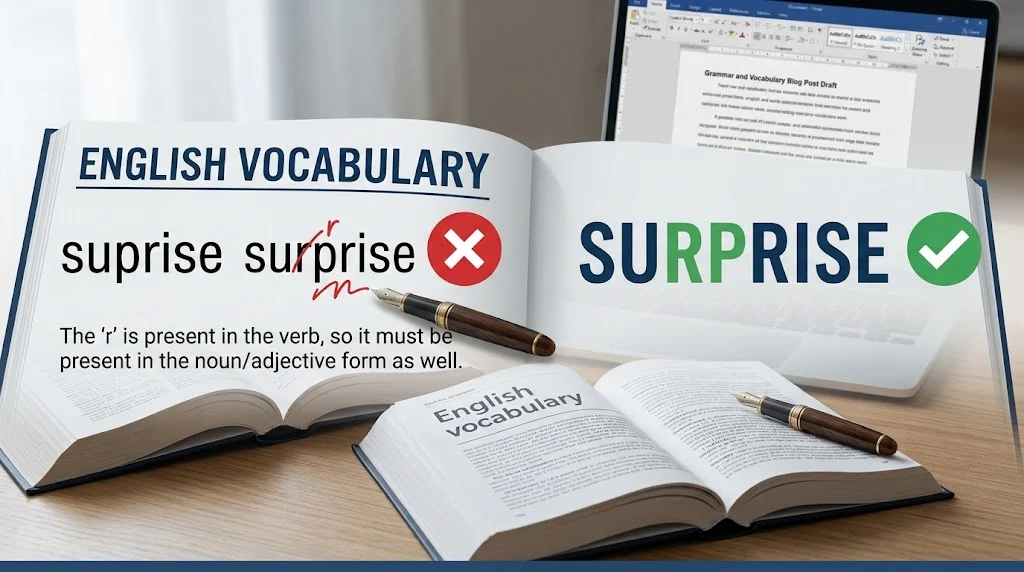
The correct spelling is surprise, not suprise. Surprise is a noun meaning an unexpected event or feeling, and it can also be a verb meaning to catch someone unexpectedly. Suprise is a common spelling mistake.
If you are wondering whether suprise or surprise is correct, remember one simple rule: surprise is the standard English spelling, while suprise is incorrect. The mistake is easy to make because the word is pronounced without strongly emphasizing the first r in ordinary speech. That small spelling error can make an otherwise polished message look careless, especially in academic or professional writing.
Understanding why the correct form contains two r sounds in its spelling can help you remember it permanently. In this guide, we will examine the meaning, pronunciation, grammar, common mistakes, practical examples, memory tricks, and modern usage of surprise, so you can use it confidently in any context.
Suprise vs Surprise: What’s the Difference?
The difference is straightforward: surprise is the correct English spelling, while suprise is a misspelling.
Surprise
Surprise can function as both a noun and a verb.
As a noun, it refers to something unexpected or the feeling produced by something unexpected.
Example:
The birthday party was a complete surprise.
As a verb, surprise means to cause someone to experience unexpected feelings or to encounter someone unexpectedly.
Example:
Her friends surprised her with a birthday celebration.
Suprise
Suprise is not the standard spelling of the English word. It is generally considered a spelling error rather than an alternative form.
| Feature | Surprise | Suprise |
| Correct spelling | Yes | No |
| Standard English | Yes | No |
| Part of speech | Noun and verb | Not a standard word |
| Meaning | Something unexpected or to catch someone unexpectedly | No standard English meaning |
| Suitable for formal writing | Yes | No |
| Suitable for academic writing | Yes | No |
Mini Recap
Surprise is always the correct spelling in standard English.
Suprise leaves out the first r and should be corrected.
The word can be used as both a noun and a verb.
The easiest memory trick is to remember that surprise contains two r letters.
Is Suprise vs Surprise a Grammar, Vocabulary, or Usage Issue?
The difference between suprise and surprise is primarily a spelling issue, not a grammar distinction.
The two forms do not represent two different grammatical meanings. Instead, one is the standard spelling and the other is an error.
This distinction is important because some English spelling variations are legitimate. For example, color and colour are both accepted depending on the variety of English being used. Theater and theatre are also standard variants.
That is not the case with suprise and surprise.
There is no major British English versus American English distinction that makes suprise acceptable. Whether you are writing for an American, British, Canadian, Australian, or international audience, surprise is the standard spelling.
In academic writing, business communication, formal documents, and professional publishing, always use surprise.
In casual digital communication, people may type suprise because of speed, habit, autocorrect issues, or simple oversight. However, frequent informal usage does not make the spelling standard.
Surprise: Meaning and Practical Usage
The word surprise has several closely related uses, which explains why it appears so frequently in English.
As a noun, it describes an unexpected event, discovery, result, or emotional reaction.
Workplace Example
The manager’s announcement came as a surprise to the entire team.
Here, surprise is a noun because it identifies the unexpected nature of the announcement.
Another example is:
We prepared a surprise celebration for our colleague.
The word describes something deliberately kept unknown until the appropriate moment.
Academic Example
The researchers were surprised by the results of the experiment.
Here, surprised is the past participle form of the verb surprise.
A different academic example is:
The unexpected finding was a surprise to the research team.
In this sentence, surprise functions as a noun.
Technology Example
The software update surprised users by introducing several new features.
Here, surprised functions as a verb.
Technology writing also frequently uses expressions such as surprise update, surprise announcement, and surprise release when something occurs unexpectedly.
Usage Recap
Use surprise when referring to something unexpected.
Surprised when describing a person’s reaction.
Use surprising when describing something that causes surprise.
Examples:
The news was a surprise.
She was surprised by the news.
The news was surprising.
Suprise: Why This Form Is Incorrect
Suprise is usually produced when a writer remembers the general sound of the word but does not remember its complete spelling.
The problem becomes understandable when you consider pronunciation. In ordinary speech, the first part of surprise may not sound as prominent as its spelling suggests. This can cause writers to remember the word as something like “suprise.”
However, standard spelling preserves the complete form:
s u r p r i s e
The first r should not be removed.
A useful way to remember the structure is to divide the word mentally:
sur + prise
This visual pattern makes the two r letters easier to notice.
When You Should NOT Use Suprise or Surprise
There are several situations where writers commonly make mistakes involving this word.
1. Do not write suprise in formal documents
A spelling error can reduce the professional appearance of an email, report, application, or proposal.
2. Do not treat suprise as a British spelling
It is not a standard British alternative to surprise.
3. Do not use suprise because it matches your pronunciation
English spelling often contains letters that are less obvious in everyday pronunciation.
4. Do not assume spellcheck makes every error harmless
Some typing environments may identify the error, but writers should still proofread important content.
5. Do not replace surprise with suprise in headlines
Website headings, advertisements, and article titles are highly visible. A spelling mistake there can damage reader confidence.
6. Do not use suprise in academic assignments
Academic writing requires standard spelling and careful editing.
7. Do not treat suprise as a casual variant
Informal mistakes seen online do not automatically become accepted spellings.
8. Do not confuse surprise with surprised
Surprise can be a noun or verb, while surprised commonly describes a person’s reaction.
Common Mistakes: Correct and Incorrect Examples
| Correct sentence | Incorrect sentence | Explanation |
| The party was a surprise. | The party was a suprise. | The standard spelling contains the first r. |
| She surprised her brother. | She suprised her brother. | The verb form also retains the correct spelling pattern. |
| We planned a surprise visit. | We planned a suprise visit. | Surprise is the standard noun form. |
| I was surprised by the result. | I was suprised by the result. | The incorrect form changes the established spelling pattern. |
| The announcement came as a surprise. | The announcement came as a suprise. | Suprise is a spelling error. |
Decision Rule Box
If you mean something unexpected, use “surprise.”
When you mean to cause someone to encounter something unexpected, use “surprise.”
If you are writing the word at all, spell it with both r letters: surprise.
Never use “suprise” as the standard spelling.
Surprise, Surprised, and Surprising
One reason learners sometimes struggle with this word family is that English uses several related forms.
Surprise is the base form.
I want to surprise my parents.
Surprised describes someone who experiences an unexpected reaction.
My parents were surprised.
Surprising describes something that causes surprise.
The result was surprising.
These forms share the same basic spelling structure. Learning them as a word family can make accurate spelling easier.
Suprise and Surprise in Modern Technology and AI Tools
Modern technology has not created a separate spelling for this word. Search engines, writing assistants, grammar checkers, and AI writing tools generally recognize surprise as the standard spelling.
Someone might type suprise into a search box, message, prompt, or document, but the intended word is normally clear from context.
AI tools can also help identify spelling mistakes, but writers should understand the correction rather than relying entirely on automated suggestions. A writing assistant may correct suprise to surprise, but knowing why the correction is necessary makes the knowledge more reliable.
This is particularly useful when producing website content, academic assignments, business correspondence, or published material.
The Etymology of Surprise
The history of surprise helps explain why its spelling is somewhat less intuitive than its pronunciation.
The English word developed through French, ultimately tracing back to the Old French form related to surprendre, meaning to overtake or seize unexpectedly. The word entered English with the general idea of something unexpected or an unexpected occurrence.
Its historical development also explains why English spelling does not always correspond perfectly to modern pronunciation.
Understanding word origins can therefore be useful, but you do not need to memorize the entire etymological history to spell the word correctly.
The practical rule remains simple: surprise contains two r letters.
An Expert Perspective on the Spelling
“When pronunciation makes a spelling uncertain, rely on the established written form and learn the word as a visual pattern.”
This principle applies especially well to surprise. English contains many words whose pronunciation does not make every written letter obvious. Building visual familiarity with the correct form is often more effective than trying to spell entirely from sound.
Two Practical Case Studies
Case Study 1: Academic Writing
Consider a student writing:
The experiment produced a suprise result.
The intended meaning is clear, but the spelling error creates an unnecessary weakness in otherwise understandable academic writing.
After correction:
The experiment produced a surprise result.
The meaning remains exactly the same, but the sentence now follows standard spelling conventions.
The concrete improvement is straightforward: one missing letter is restored, and the sentence becomes suitable for standard academic writing.
Case Study 2: Professional Communication
Imagine a workplace email containing:
We have a suprise announcement for the team.
The recipient will probably understand the sentence, but the spelling mistake is especially noticeable because workplace communication often represents an organization.
The corrected version is:
We have a surprise announcement for the team.
The practical result is improved spelling accuracy and a more polished presentation without changing the message.
Error Prevention Checklist
Always use Surprise when:
Something unexpected.
You are writing an academic assignment.
Preparing a professional email.
You are publishing website content.
Writing a report, article, announcement, or formal document.
You are describing the act of catching someone unexpectedly.
Never use Suprise when:
You are writing standard English.
Submitting academic work.
You are publishing professional content.
Preparing a business communication.
You are writing a website headline.
Editing content for public readers.
A Simple Memory Trick for Surprise
If you frequently write suprise, use the following visual trick.
Think of the word as two parts:
SUR + PRISE
The first part ends with r, and the second part begins with p after another r appears in the complete spelling pattern.
Another useful memory sentence is:
A surprise has two r letters.
Write the word several times correctly and pay particular attention to the position of both r letters.
Visual memory is especially useful because the pronunciation of the word can make the first r easy to overlook.
Related Grammar Confusions You Should Master
Learning surprise can also encourage you to review other commonly confused English forms. Some useful topics include:
Advice vs Advise: one is generally a noun and the other is a verb.
Affect vs Effect: these words have different grammatical roles and meanings in common usage.
Breath vs Breathe: one refers to air taken into the lungs, while the other is a verb.
Lose vs Loose: one commonly refers to failing to keep something, while the other means not tight.
Than vs Then: these words have different grammatical functions.
Your vs You’re: one shows possession and the other is a contraction.
Its vs It’s: one is possessive and the other is a contraction.
Their vs There vs They’re: three forms with different meanings and functions.
Principal vs Principle: one commonly refers to a person or something primary, while the other refers to a rule or belief.
Whether vs Weather: these words sound similar in some varieties of English but have completely different meanings.
Mastering these distinctions can make your writing more accurate and professional.
Frequently Asked Questions
Is suprise or surprise correct?
Surprise is correct. Suprise is a common spelling mistake caused by leaving out the first r.
Why do people spell surprise as suprise?
People often spell it suprise because the first r is not strongly noticeable in ordinary pronunciation. The writer may remember the sound rather than the complete written form.
Is suprise a word?
Suprise is not the standard spelling of the English word. In ordinary English writing, use surprise.
How do you spell surprise correctly?
The correct spelling is surprise. A useful memory trick is to remember that the word contains two r letters.
What is the difference between surprise and surprised?
Surprise can be a noun or verb, while surprised is commonly used to describe someone who experiences an unexpected reaction.
Is surprise an adjective?
No. Surprise is primarily a noun and verb. The related adjective forms are surprising and surprised, depending on the meaning.
How do you remember the spelling of surprise?
Break it into a visual pattern such as sur plus prise and remember that the standard spelling contains both r letters.
Is surprise spelled the same in American and British English?
Yes. Surprise is the standard spelling in both American and British English. Suprise is not a standard regional alternative.
Can I use suprise in informal writing?
It may appear as a typo in informal messages, but it is still not the standard spelling. Use surprise whenever you want accurate English.
Conclusion
When choosing between suprise or surprise, the answer is clear: surprise is the correct spelling. The incorrect form suprise usually occurs because the first r is easy to overlook when the word is pronounced naturally. Remember the visual structure of surprise, particularly its two r letters, and the spelling becomes much easier to retain.
Whether you are writing an academic assignment, professional email, website article, social media post, or everyday message, choosing surprise keeps your writing aligned with standard English. Once you recognize the pattern, this common spelling mistake becomes easy to prevent.

Margaret Atwood is an American writer who contributes to LingRoya.com creating clear and engaging content about the English language and everyday communication. She enjoys helping readers build confidence in their writing through simple, practical guidance.