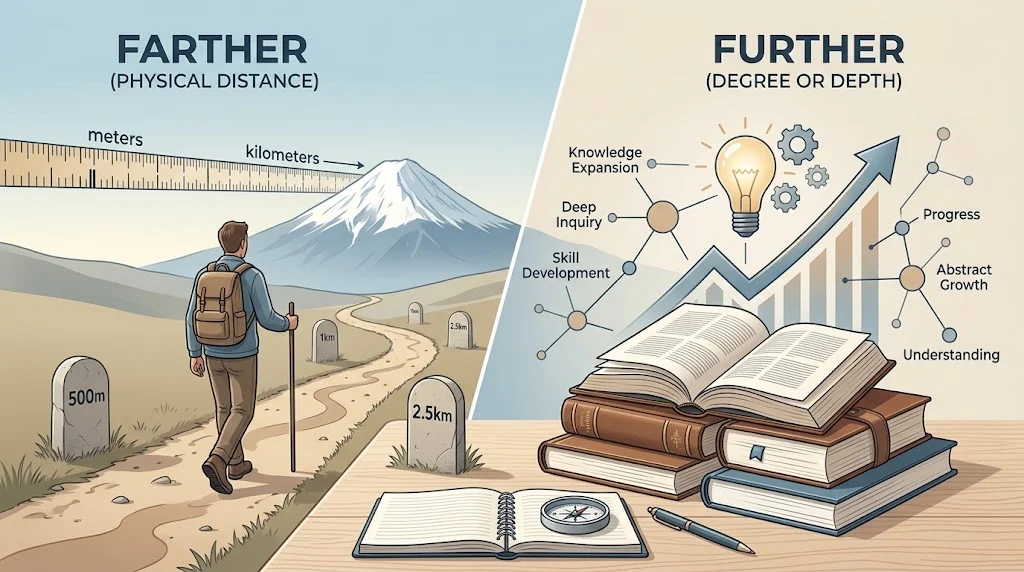
Quick Answer: Farther usually refers to greater physical distance, while further commonly refers to figurative distance, additional progress, or something extra.
Have you ever paused while writing and wondered whether you should say “farther” or “further”? The confusion is understandable because both words are comparative forms related to distance, and in everyday English they sometimes overlap. Traditionally, farther is associated with measurable physical distance, while further is preferred for figurative distance, advancement, continuation, or additional information.
However, modern dictionaries recognize that further can also describe physical distance. This makes the choice less rigid than many grammar guides suggest. Understanding the difference helps writers avoid awkward phrasing in academic work, professional communication, essays, and everyday English. The key is to consider what kind of distance or meaning you intend to express.
Farther vs Further: What’s the Difference?
Farther is an adjective or adverb used primarily to describe greater physical distance. It is commonly connected with something that can be measured, observed, or imagined as a literal distance.
Further can also function as an adjective or adverb, but its meaning is broader. It commonly expresses additional progress, advancement, continuation, degree, or information. It can also describe physical distance, particularly in contemporary English.
| Word | Part of speech | Main meaning | Typical use | Example |
| Farther | Adjective or adverb | Greater physical distance | Literal distance | We walked farther today. |
| Further | Adjective or adverb | Additional, greater, or more advanced | Figurative distance and addition | We need further discussion. |
| Farther | Adverb | To a greater physical distance | Movement or location | She ran farther than me. |
| Further | Adverb | To a greater degree or extent | Progress or development | The evidence supports this further. |
| Further | Adjective | Additional or supplementary | Information or action | Please provide further details. |
Mini Recap
Farther traditionally refers to physical distance.
Further often refers to figurative distance, progress, or addition.
Further can also be used for physical distance in modern English.
When the meaning is “additional,” further is the correct choice.
Is Farther vs Further a Grammar, Vocabulary, or Usage Issue?
The difference between farther and further is primarily a usage issue, although grammar plays a role because both words can function as adjectives and adverbs.
They aren’t always interchangeable.
If you’re describing a journey from one physical location to another, farther is often the clearest choice. For example, “The second village is farther from the city.”
If you’re talking about an abstract idea, development, discussion, investigation, or additional information, further is generally preferred. For example, “The committee needs further evidence.”
The distinction becomes less strict when physical distance is involved. Major English dictionaries recognize further as a word that can refer to physical distance as well as figurative advancement. This means that saying “How much further do we have to drive?” is entirely natural in contemporary English.
In formal and academic writing, maintaining the traditional distinction can make your meaning clearer. In casual conversation, further is extremely common when discussing physical distance.
The important point is not to treat the two words as completely separate grammatical categories. Their meanings overlap, but each has contexts in which it is more natural.
How to Use Farther Correctly
Farther is the traditional choice when you’re talking about measurable physical distance.
Consider a hiking example. If one trail is longer than another, you might say, “The northern trail takes you farther into the mountains.”
The distance can be understood geographically, so farther works naturally.
Workplace Example
A project manager might say:
“Our new office is farther from the city center than the previous location.”
The statement compares actual physical locations.
Academic Example
A geography student could write:
“The river extends farther north than previously estimated.”
Here, farther describes a measurable geographical distance.
Technology Example
Imagine comparing wireless devices:
“Device A can transmit data farther than Device B.”
The word refers to physical range, so farther is a logical traditional choice.
Usage Recap
Use farther when the emphasis is on literal physical distance. If you can imagine measuring the distance with a map, ruler, GPS system, or similar method, farther is often the safest traditional choice.
How to Use Further Correctly
Further has a much wider range of meanings. It can refer to additional information, continued progress, greater development, or movement toward an abstract goal.
For example:
“We need further research before making a conclusion.”
Here, further means additional.
You could also say:
“She wants to further her career.”
In this sentence, further means advance or develop.
Workplace Example
A manager might write:
“We need further discussion before approving the proposal.”
The discussion is not physically moving anywhere. Further means additional or continued.
Academic Example
A researcher might write:
“Further investigation is required to understand the results.”
Again, further means additional investigation.
Technology Example
A software developer could say:
“The update will further improve system performance.”
Here, further means advance or improve to a greater degree.
Usage Recap
Use further when you mean additional, continued, advanced, or to a greater extent. It is particularly common with abstract concepts such as research, discussion, development, progress, investigation, education, and improvement.
When You Should NOT Use Farther or Further
The biggest mistake is assuming that one word can replace the other in every sentence.
Here are common situations where careful selection matters.
- Do not use farther when you mean additional.
Incorrect: “Please send me farther information.”
Correct: “Please send me further information.”
- Do not use further when you are trying to preserve a traditional distinction about measurable distance.
Less precise: “The house is further away.”
Preferred in traditional usage: “The house is farther away.”
- Do not use farther with abstract nouns such as discussion or research when you mean additional.
Incorrect: “We need farther research.”
Correct: “We need further research.”
- Do not automatically assume further is wrong for physical distance.
Modern English frequently uses further for physical distance, particularly in conversational language.
- Do not use farther when you mean career advancement.
Incorrect: “She wants to farther her career.”
Correct: “She wants to further her career.”
- Do not confuse further with the unrelated phrase “furthermore.”
Furthermore means in addition or moreover. It isn’t simply a replacement for farther.
- Do not choose based only on pronunciation.
The words sound different, but pronunciation alone doesn’t determine which one belongs in a sentence.
- Do not apply an overly strict rule to every variety of English.
Language changes, and modern usage accepts further for both literal and figurative distance.
Common Mistakes and Decision Rules
| Correct sentence | Incorrect sentence | Explanation |
| We walked farther than yesterday. | We walked further than yesterday. | Farther is traditionally preferred for physical distance. |
| We need further information. | We need farther information. | Further means additional here. |
| She wants to further her education. | She wants to farther her education. | Further means advance or develop. |
| How much farther is the station? | How much farther is the station? | This is a natural use for physical distance. |
| The project requires further investigation. | The project requires farther investigation. | Further means additional. |
| The company wants to further improve its service. | The company wants to farther improve its service. | Further indicates continued improvement. |
Decision Rule Box
If you mean measurable physical distance, choose farther when following the traditional distinction.
If you mean additional information, continued progress, advancement, or a greater degree, choose further.
If you are discussing physical distance in modern conversational English, further is also widely accepted.
This rule is more accurate than the simplistic idea that further can never describe physical distance.
Farther and Further in Modern Technology and AI Tools
Modern technology provides plenty of examples where the distinction becomes interesting.
Navigation applications routinely deal with physical distance. A user might ask, “How much farther until we reach the destination?” Here, farther clearly refers to remaining physical distance.
AI systems, however, frequently work with abstract concepts. An AI writing assistant might suggest “further analysis,” “further research,” or “further explanation.” In these expressions, further means additional or continued.
Technology also demonstrates why language rules cannot always be reduced to one rigid formula. Search engines, writing assistants, grammar checkers, and modern dictionaries increasingly reflect actual usage rather than only traditional classroom rules.
For writers, the practical lesson is simple: understand the traditional distinction, then consider context.
Etymology of Farther and Further
Farther and further have a shared historical connection with the idea of being distant or advanced.
Farther developed as a comparative form associated with far and came to be strongly connected with physical distance.
Further also developed from the same general family of words but acquired broader meanings involving advancement, continuation, and additional degree.
Over time, the meanings began to overlap. This explains why modern English speakers sometimes use further for physical distance without considering it unusual.
The historical relationship between the words is one reason their spelling and meanings remain closely connected.
An Expert View on the Distinction
“The most useful distinction is not that farther is always physical and further is always abstract, but that farther remains especially clear for physical distance while further has developed a much broader range of meanings.”
This approach reflects how contemporary English actually works. Traditional rules are useful because they help writers make precise choices, but they shouldn’t be turned into absolute laws when established modern usage says otherwise.
Two Practical Case Studies
Case Study One: Academic Writing
Consider two sentences:
“The researchers traveled farther into the region to collect samples.”
“The researchers conducted further analysis of the samples.”
The first sentence concerns physical movement. The second concerns additional intellectual work.
Using the words this way immediately makes the distinction clear. A reader can understand whether the researchers moved through space or continued an investigation.
Case Study Two: Professional Communication
Now consider a workplace situation.
“Our new warehouse is farther from the headquarters, so delivery times may increase.”
“Further planning is required before we change the distribution system.”
The first sentence describes geographic distance. The second describes additional planning.
These examples demonstrate why the traditional distinction remains useful even though further can also describe physical distance.
Error Prevention Checklist
Always use farther when
[ ] You are emphasizing measurable physical distance.
You are comparing how far two places or objects are.
[ ] You want to follow the traditional grammar distinction in formal writing.
The sentence describes literal movement through space.
Never use further when
[ ] You mean additional information and are tempted to use farther.
[ ] You are using it simply because it sounds similar to farther.
You are writing a formal sentence where a clear physical distance distinction would improve precision.
At the same time, remember that further is not automatically wrong for physical distance. Modern standard English accepts it in many such contexts.
Related Grammar Confusions You Should Master
If you’re improving your English usage, learning this distinction is only one part of developing precise word choice. These related topics are also worth mastering:
- Affect vs effect
- Lay vs lie
- Fewer vs less
- Then vs than
- Who vs whom
- Among vs between
- Compliment vs complement
- Advice vs advise
- Principal vs principle
- Everyday vs every day
These pairs cause similar problems because their meanings overlap, their sounds can be similar, or their grammatical functions are easily confused.
FAQs
What is the difference between farther and further?
Farther traditionally refers to greater physical distance, while further usually means additional, continued, or more advanced. However, further can also refer to physical distance in modern English.
Should I use farther or further for physical distance?
Farther is the traditional choice for physical distance, especially in careful formal writing. However, further is also widely accepted for physical distance in contemporary English.
Is farther or further more grammatically correct?
Neither word is universally more correct. Farther is more specific when referring to physical distance, while further has a broader meaning that includes additional information, progress, and advancement.
Is it farther away or further away?
Both expressions are used. “Farther away” follows the traditional distinction for physical distance, while “further away” is common and accepted in modern English.
Should I say further information or farther information?
You should say “further information.” Here, further means additional. “Farther information” is incorrect because information is not a physical distance.
Is it further education or farther education?
The correct expression is “further education.” Further means additional or advanced education.
Can further mean physical distance?
Yes. Although traditional grammar advice often reserves farther for physical distance, modern English commonly uses further for physical distance as well.
Is farther more formal than further?
Not exactly. Farther is not simply a more formal version of further. The two words have overlapping but different traditional meanings, and formality does not by itself determine the choice.
Which is correct: further away or farther away?
Both can be correct. Farther away is particularly useful when emphasizing literal physical distance, while further away is also widely accepted in contemporary English.
Conclusion
The distinction between farther and further is easier once you stop treating it as an absolute rule. Farther is traditionally associated with physical distance, while further commonly expresses additional information, progress, continuation, or advancement. Yet modern English also permits further for physical distance.
For formal and academic writing, farther remains a clear choice when you mean measurable distance. Use further for expressions such as further research, further information, further discussion, and further development.

Neil Gaiman is an American writer who contributes educational content to LingRoya.com. His work focuses on helping readers improve their English with clear, practical and easy to follow guidance.