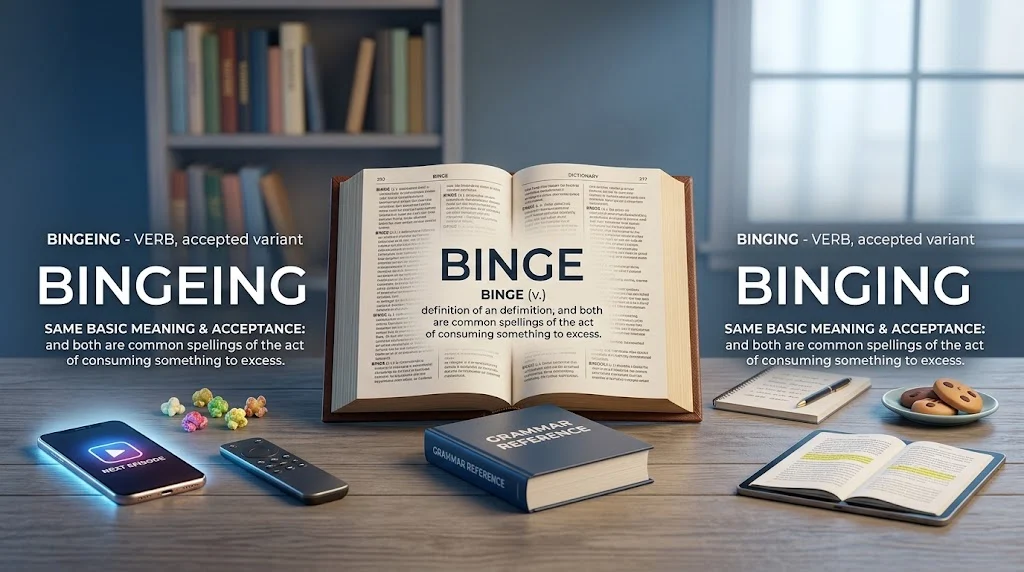
Both bingeing and binging are accepted spellings of the present participle of the verb “binge.” They describe doing something excessively or continuously, such as watching several episodes or eating too much. In formal writing, either form can be correct, although bingeing is often preferred when clarity and consistency matter.
If you have ever stopped while writing and wondered whether bingeing or binging is correct, you are not alone. Both spellings are legitimate, and major dictionaries recognize them as forms of the verb “binge.” The difference is mainly one of spelling preference rather than meaning. Oxford lists both forms, while Cambridge also identifies both as present participles. This means you do not need to treat one as grammatically wrong. The real challenge is choosing the form that fits your audience, publication style, and context.
Bingeing vs Binging: What’s the Difference?
The short answer is that there is no difference in basic meaning between the two spellings.
Bingeing is the present participle form of the verb “binge.” It can describe consuming food, watching entertainment, shopping, drinking, or engaging in another activity excessively.
Binging is also the present participle form of “binge.” It has the same meaning and grammatical function.
| Feature | Bingeing | Binging |
| Base verb | binge | binge |
| Part of speech | Present participle | Present participle |
| Meaning | Doing something excessively | Doing something excessively |
| Grammar | Correct | Correct |
| Formal writing | Accepted | Accepted |
| Casual writing | Common | Common |
| Meaning difference | None | None |
Oxford’s dictionary gives both bingeing and binging as valid forms of the verb. Cambridge does the same, confirming that this is a spelling variation rather than a difference in meaning.
In simple terms, both forms are correct.
Bingeing may look more transparent because it preserves the original word “binge.”
Binging is shorter and follows a spelling pattern that many readers naturally recognize.
Your best choice is therefore based on consistency and style, not grammar.
Is Bingeing vs Binging a Grammar, Vocabulary, or Usage Issue?
This is primarily a spelling and usage issue, not a difference in vocabulary.
Both forms come from the same verb, “binge.” The verb itself means to engage in an activity excessively, particularly eating or drinking. Modern usage has expanded the word to activities such as watching television, shopping, gaming, reading, and consuming online content. Cambridge identifies “bingeing” and “binging” as present participles of “binge.”
The two forms are therefore interchangeable in meaning. You can write:
“I was bingeing on a television series.”
or:
“I was binging on a television series.”
Both sentences communicate essentially the same idea.
In formal and academic writing, consistency is more important than choosing one spelling over the other. If your organization uses a particular style guide, follow it throughout the document.
In casual communication, social media, blogs, and everyday conversation, either form is widely understandable.
How to Use Bingeing Correctly
Bingeing is particularly useful when you want the spelling to make the connection with the base word “binge” immediately obvious.
Workplace example
“Several employees admitted to bingeing on online videos during their lunch breaks.”
Here, bingeing functions as the present participle of “binge.”
Academic example
“The study examined the relationship between bingeing behavior and sleep quality.”
In academic writing, the spelling works naturally when discussing behavioral patterns.
Technology example
“Users are spending more time bingeing video content on streaming platforms.”
The word can describe excessive or prolonged digital consumption just as naturally as it can describe eating.
Usage recap
Use bingeing when you prefer the more visibly connected spelling of the verb “binge.” It is grammatically correct and recognized by major English dictionaries.
How to Use Binging Correctly
Binging is equally legitimate and is often encountered in everyday American English and online communication.
Workplace example
“The team spent the weekend binging a popular documentary series.”
The sentence describes watching several episodes continuously.
Academic example
“Frequent binging may be associated with changes in daily routines.”
The spelling can appear in research discussions and formal contexts when the writer’s chosen style permits it.
Technology example
“Many users are binging short video content for several hours each evening.”
Here, binging describes prolonged consumption of digital media.
Usage recap
Use binging when it matches the spelling convention or editorial style you are following. It is not an incorrect version of the word. Cambridge explicitly lists it as a present participle of “binge.”
When You Should NOT Use Bingeing or Binging
Although both spellings are correct, there are situations where neither form is the best choice.
- When you mean a single event
Use the noun binge when referring to the event itself.
Correct: “The weekend binge lasted several hours.”
- When you mean a person
Use a suitable noun such as binge watcher, binge eater, or another precise description depending on the context.
- When you are writing about a clinical condition
Do not casually replace established medical terminology with a general verb. For example, binge eating disorder is a specific clinical term.
- When a more precise verb is available
Instead of saying someone was bingeing on information, you might use “consuming,” “reviewing,” or “reading intensively” when those words better describe the activity.
- When your style guide requires one spelling
If your publication has a house style, follow it consistently rather than switching between forms.
- When the sentence becomes ambiguous
Choose wording that clearly identifies what is being consumed or done.
- When discussing excessive behavior without evidence
Avoid presenting casual behavior as a medical diagnosis. Context matters, particularly in health related writing.
Common Mistakes and Decision Rules
| Correct sentence | Incorrect sentence | Explanation |
| She was bingeing on a new series. | She was binge on a new series. | The continuous action needs the present participle. |
| He was binging on snacks. | He was binginged on snacks. | “Binging” is already the correct present participle. |
| They went on a binge. | They went on a bingeing. | The noun “binge” is required after “a.” |
| I enjoy binge watching documentaries. | I enjoy bingeing documentaries. | “Binge watching” is often the clearer expression for television content. |
| She has been bingeing all evening. | She has been binge. | “Has been” requires the participle form. |
Decision Rule
If you mean the ongoing action, use either bingeing or binging.
If you mean the event itself, use binge.
If you mean a person, use a specific noun such as binge watcher or binge eater.
If you are writing for an organization, follow its preferred spelling consistently.
Bingeing and Binging in Modern Technology and AI Tools
Digital technology has made the word “binge” much more common. Streaming platforms allow people to watch multiple episodes consecutively, while social media platforms encourage continuous consumption of short videos and other content.
The related expression binge watch is now firmly established. Cambridge defines binge watching as watching several episodes of a television program one after another.
The same linguistic pattern appears in technology writing. People may talk about binge watching, binge reading, binge listening, or binging online content. AI tools also generate both spellings because both are recognized forms.
For content creators, the most important rule is not to assume that one spelling is universally correct. Instead, choose one form and use it consistently across titles, headings, body copy, captions, and metadata.
Why Do Both Spellings Exist?
The word binge has a long history. Oxford traces the noun to the middle of the nineteenth century and identifies its origin in English dialect, where “binge” referred to soaking a wooden vessel.
As the word developed into a modern verb, speakers needed a present participle. English spelling does not always produce a single predictable result when forming “ing” words, especially with words ending in silent letters or unusual consonant patterns.
That is why both bingeing and binging developed and became established.
Oxford’s treatment provides a useful authority check: it lists the two forms as “bingeing” and “binging.”
The important point is that the language has accepted both spellings rather than forcing writers to choose one universally correct form.
Two Research Case Studies That Show Why Usage Matters
Case Study 1: Binge Viewing and Sleep
A published study examining binge viewing and sleep found that people who identified as binge viewers had a 98 percent higher likelihood of reporting poor sleep quality than people who did not identify as binge viewers. The researchers also found relationships between more frequent binge viewing and poorer sleep quality, daytime fatigue, and symptoms of insomnia.
This example demonstrates how the term appears in serious academic research. The spelling itself does not change the behavior being studied. What matters is the precise definition of the behavior.
Case Study 2: Binge Watching Among Students
A 2025 study examined 2,267 primary and secondary students in Hong Kong. Researchers reported that 47.1 percent had engaged in binge watching at least once during the previous month. The study also found associations between binge watching and depression, anxiety, stress, loneliness, and lower educational self efficacy.
These findings do not mean that every instance of watching several episodes is harmful. They show why researchers distinguish between ordinary entertainment and patterns of excessive consumption.
Error Prevention Checklist
Always use Bingeing when
[ ] Your preferred style guide recommends it.
[ ] You want a spelling that visibly preserves the base word “binge.”
[ ] You are maintaining consistency with an existing document.
[ ] Your publication has already used this spelling throughout its content.
Never use Binging when
[ ] Your style guide specifically requires bingeing.
[ ] You are switching spellings randomly within the same article.
[ ] You are treating the spelling as though it has a different meaning.
[ ] You are replacing a specific medical or academic term with a casual expression.
The important correction is that binging is not inherently wrong. Major dictionaries recognize it as a valid form.
Related Grammar Confusions You Should Master
Once you understand bingeing and binging, several other English spelling and usage questions become easier to handle. Related topics include:
- Traveling vs travelling
- Canceling vs cancelling
- Modeling vs modelling
- Labeling vs labelling
- Signaling vs signalling
- Focused vs focussed
- Acknowledgment vs acknowledgement
- Toward vs towards
- Practice vs practise
- Adviser vs advisor
These examples show a broader principle of English usage: spelling can vary across regions, dictionaries, publishers, and style guides without making one form automatically incorrect.
FAQs
Is bingeing or binging the correct spelling?
Both spellings are correct and have the same meaning.
Is bingeing more correct than binging?
No, both are accepted forms. Choose one and use it consistently.
Is binging a real word?
Yes, binging is a valid present participle of “binge.”
Which spelling should I use in formal writing?
Follow your preferred style guide, or choose one spelling and use it consistently.
Is bingeing or binging used for watching television?
Both can be used, but “binge watching” is the most common expression.
Conclusion
The debate between bingeing and binging is not really a question of right versus wrong. Both are accepted present participles of “binge,” and reputable dictionaries recognize both forms.
If you want a conservative spelling that clearly preserves the original word, bingeing is a sensible choice. If your audience, publication, or style guide prefers binging, that form is also completely legitimate

Neil Gaiman is an American writer who contributes educational content to LingRoya.com. His work focuses on helping readers improve their English with clear, practical and easy to follow guidance.