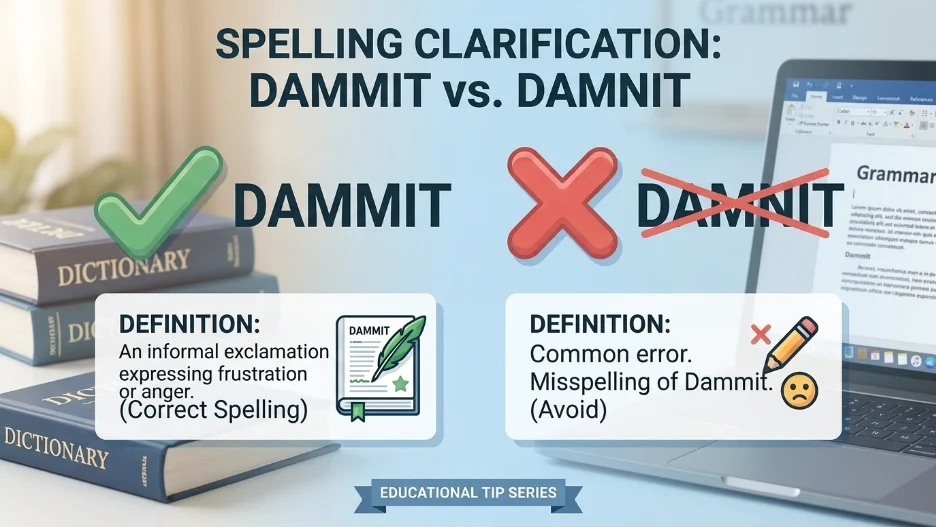
Quick Answer: Dammit is the more common and generally preferred spelling of this informal exclamation used to express anger, frustration, or annoyance. Damnit is a less common variant, while dammit is the standard spelling in most dictionaries.
Dammit vs Damnit: What’s the Difference?
The difference between these two spellings is actually quite straightforward once you understand the rules. “Dammit” is the accepted, dictionary recognized spelling. It’s what you’ll find in Merriam Webster, the Oxford English Dictionary, and other authoritative sources. This version drops the “n” from “damn it” to create a single word that matches how people actually say it.
“Damnit,” on the other hand, is a common misspelling that many people use but is technically incorrect. It tries to combine “damn” and “it” by simply removing the space, but that’s not how the contraction works in standard English usage.
Here’s a quick comparison to help you understand at a glance:
| Spelling | Part of Speech | Correctness | Example |
| Dammit | Interjection (exclamation) | Correct | “Dammit, I missed the bus again!” |
| Damnit | Interjection (exclamation) | Incorrect | “Damnit, this traffic is terrible.” |
| Damn it | Interjection (two words) | Correct | “Damn it, I can’t believe this happened.” |
| Goddammit | Interjection | Correct (stronger) | “Goddammit, why won’t this work?” |
Mini recap: “Dammit” and “damn it” are both correct spellings, with “dammit” being the more casual, phonetic version. “Damnit” is the one spelling you should avoid at all costs. If you’re unsure, stick with the two word version “damn it” since it’s always acceptable.
Is Dammit vs Damnit a Grammar, Vocabulary, or Usage Issue?
This is primarily a spelling and usage issue rather than a strict grammar rule. “Dammit” and “damn it” are interchangeable in meaning, and both function as interjections that express frustration or anger. The difference isn’t about grammar rules or vocabulary definitions, it’s about which spelling has become standard through usage over time.
Formal vs informal usage: In formal writing, you should generally avoid using either version. These are informal exclamations that don’t belong in academic papers, business reports, or professional correspondence. If you absolutely must express frustration in formal writing, you’re better off using less colorful language like “unfortunately” or “regrettably.”
Academic vs casual usage: In academic contexts, “dammit” and “damn it” are considered inappropriate and too informal. Stick to formal language in essays, theses, and scholarly articles. In casual contexts like text messages, social media posts, and informal emails, both “dammit” and “damn it” are perfectly acceptable.
Interchangeable or not: Yes, “dammit” and “damn it” are completely interchangeable in meaning and usage. The only difference is that “dammit” is a single word while “damn it” is two words. Some people consider “damn it” slightly more formal than “dammit,” but both are informal overall.
Practical Usage Examples
When to Use Dammit
“Dammit” works best when you need a quick, punchy exclamation that feels natural and conversational. Here are some examples across different contexts:
Workplace example: During a stressful project, you might catch yourself saying, “Dammit, I forgot to save the presentation before the system crashed.” This shows frustration without being overly formal or overly offensive in a professional setting (though use it sparingly and only with colleagues you know well).
Academic example: In a classroom setting, a student might mutter under their breath, “Dammit, I studied the wrong chapter.” While not appropriate in formal academic writing, it’s fine in casual conversation among classmates.
Technology example: When dealing with a glitchy computer, you might say, “Dammit, this software keeps freezing on me.” This expresses your irritation with a technical issue in a way that feels natural and human.
Usage recap: Use “dammit” when you want to sound casual, conversational, and authentically frustrated. It’s the go to choice for text messages, social media, and informal writing.
When to Use Damn It
“Damn it” as two words provides a slightly more deliberate, emphatic feel. It can sometimes carry slightly more weight than the contracted version.
Workplace example: After a major project setback, you might say, “Damn it, we spent three months on this proposal.” The two word version here adds emphasis and seriousness to the situation.
Academic example: A frustrated student might say, “Damn it, I need to pass this class to graduate.” This usage shows high stakes and strong emotion.
Technology example: When your phone dies right before an important call, you might exclaim, “Damn it, my battery is at zero.” This feels slightly more formal than “dammit” while still expressing genuine frustration.
Usage recap: Use “damn it” when you want to emphasize your frustration more strongly or when you’re writing in contexts where “dammit” might feel too casual. Many style guides consider it the safer choice overall.
When You Should NOT Use Dammit or Damn It
There are several situations where using “dammit” or “damn it” is inappropriate or could cause problems:
- Professional emails to clients or executives: This informal language can make you look unprofessional and immature.
- Academic papers or formal essays: These publications require standard, formal language without expletives.
- Job applications or cover letters: Using exclamations like this creates a terrible impression.
- Public speeches or presentations: These phrases can alienate audience members who find them offensive.
- Writing for sensitive audiences: Children, religious groups, or conservative organizations may find this language inappropriate.
- Legal documents or official records: These require neutral, professional language without emotional exclamations.
- International communication: Non native speakers may not understand the nuance or may find it confusing.
- When you’re genuinely calm: Using these phrases when you’re not actually frustrated can make you sound melodramatic or insincere.
Common Mistakes and Decision Rules
To help you avoid common pitfalls with these spellings, here are some examples of correct and incorrect usage:
| Correct Sentence | Incorrect Sentence | Explanation |
| “Dammit, I spilled my coffee.” | “Damnit, I spilled my coffee.” | “Damnit” is not a standard spelling. |
| “Damn it, this computer is slow.” | “Damnit, this computer is slow.” | The two word version is correct. |
| “I can’t believe this happened, dammit.” | “I can’t believe this happened, damnit.” | “Dammit” is the accepted contraction. |
| “Oh, damn it, I forgot my keys.” | “Oh, damnit, I forgot my keys.” | Always use “damn it” or “dammit.” |
Decision Rule Box:
If you mean the exclamation of frustration and want a casual feel, use “dammit.”
If you mean the exclamation of frustration and want a slightly more emphatic or formal feel, use “damn it.”
If you’re ever unsure, choose “damn it” because it’s always correct.
Never use “damnit.”
Dammit and Damn It in Modern Technology and AI Tools
The confusion between “dammit” and “damnit” has interesting implications in the age of AI and autocorrect. Modern spell checkers and AI writing tools consistently flag “damnit” as incorrect and suggest “dammit” or “damn it” as alternatives. This means that if you’re using tools like Grammarly, ProWritingAid, or even basic word processors, you’ll likely be corrected when you type “damnit.”
AI writing assistants are trained on vast datasets of standard English usage, and they rarely encounter “damnit” in authoritative sources. This reinforces the idea that “damnit” is the black sheep of the spelling family. The consistency across these platforms should give you confidence that “dammit” and “damn it” are the right choices.
Interestingly, predictive text on smartphones might suggest “damnit” sometimes, simply because it’s a commonly typed misspelling. However, this is a case where the technology adapts to user errors rather than reflecting correct usage. Trust the dictionaries and style guides over your phone’s autocorrect.
Etymology and Expert Insights
The word “dammit” has an interesting history that sheds light on its proper spelling. According to the Oxford English Dictionary, “dammit” first appeared in the late 1700s, formed by shortening “goddammit”. This explains why the double M spelling has such long standing authority.
The etymology traces back to “damn,” which came from the Old French “damner,” meaning “to condemn,” and ultimately from the Latin “damnare,” with the same meaning. In religious contexts, damnation referred to condemning someone’s soul to eternal punishment. Over time, the word softened into a general expression of frustration.
As linguist and lexicographer Kory Stamper notes, “Language evolves through usage, but that doesn’t mean every variation is accepted. The spelling ‘dammit’ has been codified in dictionaries for over a century because it reflects both pronunciation and usage patterns.”
Case Study 1: The Workplace Email Blunder
A marketing manager at a mid sized tech company sent an email to her entire team, including the CEO, expressing frustration about a delayed project. She typed “Damnit, we need to get this fixed today.” The CEO, a stickler for details, noted the misspelling and questioned her attention to detail in other areas. While this seems minor, the incident affected her reputation and ultimately delayed a promotion she was up for. The lesson? Small spelling errors can have significant consequences.
Case Study 2: The Academic Paper Rejection
A graduate student submitted a paper to a prestigious linguistics journal. The paper was well researched and argued, but it contained the misspelling “damnit” in several places. The reviewers, who were professional linguists, noted the errors and questioned the student’s attention to detail and command of English usage. The paper was rejected and required significant revision before being accepted by a less selective journal. The student learned that even informal exclamations need to be spelled correctly in academic writing.
Error Prevention Checklist
Always use “dammit” or “damn it” when:
- You’re writing informally to friends or family
- You’re texting or posting on social media
- You need to express frustration in a casual context
- You want to sound natural and conversational
Never use “damnit” when:
- Writing professionally or in any formal context
- Applying for jobs or submitting academic work
- Communicating with clients, executives, or superiors
- Creating content for a professional audience
Best practice: When in doubt, use “damn it” two words. It’s always correct and will never be flagged by spell checkers or perceived as wrong.
Related Grammar Confusions You Should Master
To help you avoid similar common language pitfalls, here are related grammar and spelling issues worth understanding:
- “A lot” vs “alot”
- “Could have” vs “could of”
- “Your” vs “you’re”
- “Its” vs “it’s”
- “Then” vs “than”
- “Affect” vs “effect”
- “To” vs “too” vs “two”
- “There” vs “their” vs “they’re”
- “Lose” vs “loose”
- “Accept” vs “except”
Advanced FAQs
Is “dammit” a bad word?
Yes, “dammit” is a mild swear word used to express frustration or anger.
Which is correct, “dammit” or “damnit”?
“Dammit” and “damn it” are correct. “Damnit” is generally considered a misspelling.
Is “dammit” appropriate in formal writing?
No, it’s better to avoid “dammit” in formal, academic, or professional writing.
Why do people write “damnit”?
“Damnit” is a common misspelling created by combining “damn” and “it” into one word.
Is “damnit” a real word?
“Damnit” is not generally recognized as the standard spelling. Use “dammit” or “damn it” instead.
Conclusion
The debate between “dammit” and “damnit” comes down to a simple fact: one is correct and the other isn’t. “Dammit” and “damn it” are both accepted spellings for expressing frustration, while “damnit” is an error you should avoid. The next time you feel the urge to type out an exasperated exclamation, remember to drop the “n” and embrace the double M. Your writing will be more credible, your readers will take you more seriously, and you’ll avoid the embarrassment of being corrected.
.
.

Neil Gaiman is an American writer who contributes educational content to LingRoya.com. His work focuses on helping readers improve their English with clear, practical and easy to follow guidance.