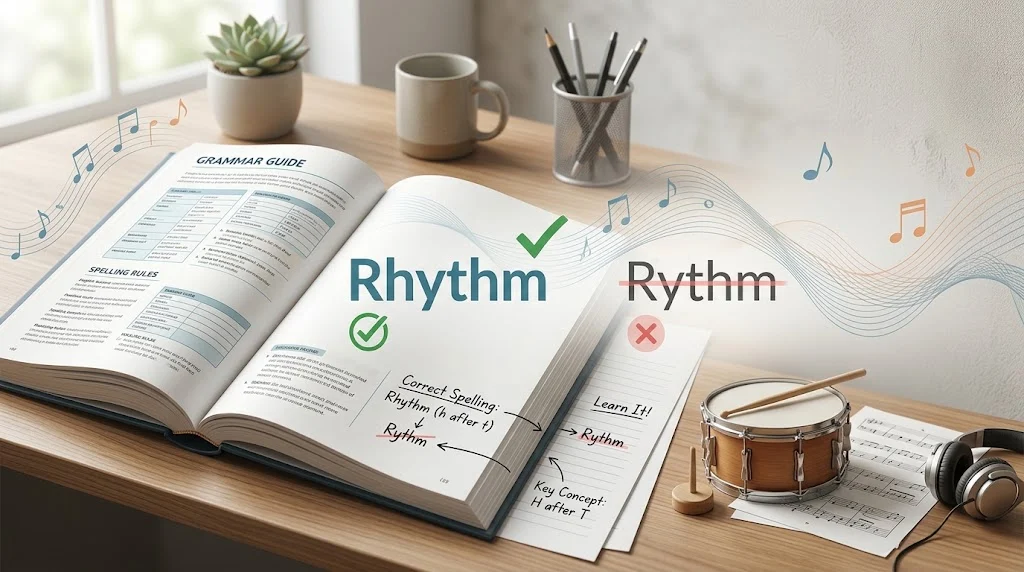
Quick Answer: Rhythm is the correct spelling, while rythm is a common misspelling. The word rhythm refers to a regular pattern of sounds, beats, movements, or events. Although rythm may look simpler and feel easier to spell, it is not accepted as the standard English spelling in formal, academic, workplace, or published writing.
If you have ever searched for rhythm or rythm, you are not alone. The confusion usually comes from the unusual spelling of rhythm, especially because the word contains no traditional vowel between its opening consonants and its final syllable. Rhythm is the correct English spelling for a regular pattern or repeated movement of sound, beats, or events, while rythm is an incorrect spelling.
This small spelling mistake can appear in school assignments, emails, articles, music discussions, and digital content. From a language perspective, knowing the correct form matters because spelling affects clarity, credibility, and search visibility. Understanding why rhythm is spelled this way also makes it easier to remember and use confidently.
Rhythm vs Rythm: What’s the Difference?
The difference is straightforward. Rhythm is the standard and correct English spelling. Rythm is a misspelling and should not be used in standard written English.
The word rhythm is primarily a noun. It describes a regular pattern of sounds, beats, movements, or events. It is especially common when discussing music, poetry, dance, speech, exercise, routines, and repeated natural processes.
| Word | Part of Speech | Meaning | Correct Usage |
| Rhythm | Noun | A regular pattern of sounds, beats, movements, or events | Correct |
| Rythm | Incorrect spelling | Intended to mean rhythm | Incorrect |
A musician may talk about the rhythm of a song.
A poet may carefully structure the rhythm of a poem.
A person may develop a healthy rhythm in their daily routine.
The spelling rythm does not represent a separate English word. It is simply an error that occurs when someone leaves out the first vowel sound pattern associated with the spelling.
Mini Recap
Rhythm is the correct spelling.
Rythm is a spelling mistake.
Use rhythm in formal and informal English.
The unusual spelling is mainly responsible for the confusion.
Is Rhythm vs Rythm a Grammar, Vocabulary, or Usage Issue?
The confusion between rhythm and rythm is primarily a spelling issue, rather than a grammar or vocabulary issue.
Both forms may appear when someone is trying to express the same idea, but only rhythm is recognized as the standard English word. There is no meaningful distinction in which one should be used formally and which one should be used casually.
This means you should not think of rythm as an informal alternative. It is simply an incorrect spelling.
In academic writing, professional communication, published articles, essays, reports, and formal correspondence, always use rhythm. In casual messaging, people may make spelling mistakes without serious consequences, but the correct form remains rhythm.
Why Is Rhythm So Difficult to Spell?
The main challenge is its unusual sequence of letters.
Many English words contain vowels that make pronunciation and spelling easier to predict. Rhythm is unusual because its spelling contains rhythm, with no conventional vowel appearing between the first consonant cluster and the final consonant sequence.
That makes the word easy to misspell as rythm, particularly for English learners.
A useful way to remember it is to associate rhythm with rhythmic and rhythmical. Once the spelling of the main word becomes familiar, its related forms become easier to recognize.
Using Rhythm Correctly in Everyday English
Rhythm appears in many areas of communication, not only music.
Workplace Example
A manager might say:
“Our team has developed a productive rhythm during the busiest part of the year.”
Here, rhythm describes a repeated and effective pattern of work.
Another example is:
“The new schedule helped everyone find a comfortable rhythm.”
The word suggests a regular pattern that develops over time.
Academic Example
In literature classes, students may analyze the rhythm of poetry.
For example:
“The rhythm of the poem contributes to its emotional effect.”
In this context, rhythm refers to the pattern created by stressed and unstressed syllables, sounds, and pauses.
Technology Example
Technology can also have a rhythm.
For example:
“The application follows a predictable rhythm as it processes incoming data.”
Here, the word refers to a repeated sequence or pattern rather than music.
Usage Recap
Use rhythm when describing a repeated pattern, beat, movement, or flow. It can apply to music, poetry, work, technology, conversation, exercise, nature, and everyday routines.
Why Rythm Is Incorrect
Rythm looks plausible because English spelling is often unpredictable. However, standard dictionaries do not treat rythm as the correct spelling of the word.
The error usually happens because writers remember the pronunciation but cannot recall the unusual letter sequence.
For example, someone may write:
“The song has a strong rythm.”
The intended meaning is clear, but the spelling is incorrect.
The corrected sentence is:
“The song has a strong rhythm.”
This distinction matters more in published writing because repeated spelling mistakes can make otherwise strong content appear careless.
When You Should NOT Use Rhythm or Rythm
There are several situations where writers commonly make mistakes with this word.
- Do not write rythm when discussing musical beats.
- Do not use rythm in academic essays or assignments.
- Do not use rythm in professional reports.
- Do not use rythm in articles, blog posts, or published content.
- Do not assume rythm is an accepted casual spelling.
- Do not create a spelling distinction between rhythm and rythm.
- Do not treat rythm as a British or American spelling variation.
- Do not replace rhythm with rythm simply because the shorter spelling appears easier.
The safest rule is simple: when you mean the English word describing a regular pattern of sound, movement, or events, spell it rhythm.
Common Mistakes and Decision Rules
| Correct Sentence | Incorrect Sentence | Explanation |
| The drummer maintained a steady rhythm. | The drummer maintained a steady rythm. | Rhythm is the correct spelling. |
| The poem has a beautiful rhythm. | The poem has a beautiful rythm. | The misspelled form should be avoided. |
| We are finding a new rhythm at work. | We are finding a new rythm at work. | Rhythm can describe a regular work pattern. |
| The dance follows the rhythm of the music. | The dance follows the rythm of the music. | The standard spelling is rhythm. |
| The natural rhythm of the waves was relaxing. | The natural rythm of the waves was relaxing. | The word describes a repeated natural pattern. |
Decision Rule Box
If you mean a regular pattern of sound, movement, activity, or events, use rhythm. Never use rythm as an alternative spelling.
Unlike some confusing English word pairs, there is no meaning based decision between these two forms. One is correct and the other is a misspelling.
Rhythm and Rythm in Modern Technology and AI Tools
Digital communication has made spelling errors easier to notice because written content is constantly published, searched, analyzed, and processed.
Search engines generally recognize that users may type common spelling mistakes, including rythm, when searching for information about rhythm. Modern language tools can also identify the incorrect form and suggest the standard spelling.
AI writing assistants, spell checkers, grammar applications, and word processing software commonly flag rythm as an error. However, writers should not depend entirely on automated correction. Understanding the correct spelling is still important because automated tools can sometimes overlook errors depending on context.
For SEO writers, spelling accuracy is especially important. A page that repeatedly uses rythm instead of rhythm can look less authoritative to readers, even when the overall information is accurate.
The Etymology of Rhythm
The history of rhythm helps explain why its spelling looks unusual.
The word ultimately comes from the Ancient Greek rhythmos, referring to measured movement or a regular pattern. It passed into Latin and later French before becoming part of English vocabulary.
The Greek origin also helps explain the distinctive rh beginning of the English spelling.
Over time, rhythm became strongly associated with music, poetry, movement, and patterns. Today, its meaning extends far beyond music and can describe almost any recognizable pattern of repeated activity.
An Expert View on Remembering Rhythm
“When an English word has an unusual spelling, learning its structure is often more reliable than trying to spell it from pronunciation alone.”
The important lesson is that rhythm should be remembered as a complete spelling pattern rather than reconstructed from how the word sounds.
A useful mental association is:
Rhythm → rhythmic → rhythmical
Seeing the related words repeatedly can reinforce the unusual letter sequence.
Two Practical Case Studies
Case Study One: Academic Writing
Imagine a student writing an essay about poetry. The student repeatedly uses rythm when discussing poetic structure.
The meaning remains understandable, but the spelling error can affect the overall impression of the paper. Correcting every instance to rhythm immediately improves the academic quality of the writing.
The result is simple: the argument stays the same, but the presentation becomes more accurate and professional.
Case Study Two: Website Content
Consider an educational website publishing an article about music. If the page repeatedly uses rythm, visitors may question the reliability of the content.
Replacing the incorrect spelling with rhythm creates a more polished reading experience and prevents readers from learning an incorrect spelling.
The concrete improvement is accuracy. The content becomes easier to trust, edit, share, and reuse.
Error Prevention Checklist
Always use rhythm when
You mean a regular pattern of sound.
You are discussing musical beats.
Analyzing poetry.
You are describing repeated movement.
You are describing a regular routine or pattern.
Writing for academic or professional readers.
Never use rythm when
You are writing a formal document.
Publishing educational content.
You are writing an essay.
Describing music or poetry.
You are creating SEO content.
Editing professional communication.
Trying to spell the standard English word for a repeated pattern.
Related Grammar Confusions You Should Master
Learning rhythm can also encourage you to review other commonly confused English forms.
- Their or there or they’re
- Your or you’re
- Its or it’s
- Advice or advise
- Affect or effect
- Breath or breathe
- Lose or loose
- Then or than
- Principal or principle
- Practice or practise
These pairs and spelling patterns can create similar problems because pronunciation, spelling, and grammatical function do not always align neatly in English.
Frequently Asked Questions
Is rhythm or rythm correct?
Rhythm is correct. Rythm is an incorrect spelling and should not be used in standard English.
How do you spell rhythm correctly?
The correct spelling is rhythm. Remember the unusual sequence of letters rather than spelling the word according to its pronunciation.
Why is rhythm spelled without a vowel?
The spelling comes through the historical development of the word from Greek and later languages. Its unusual structure has remained in modern English.
What does rhythm mean in English?
Rhythm means a regular pattern of sounds, beats, movements, or events. It is commonly used in music, poetry, dance, speech, routines, and natural processes.
Is rythm a word in English?
No. Rythm is generally a misspelling of the standard English word rhythm, not a separate standard vocabulary item.
Why do people spell rhythm as rythm?
People often misspell it because the pronunciation does not make the unusual letter sequence easy to remember. The absence of a conventional vowel also contributes to the confusion.
Is rhythm used only in music?
No. Rhythm can describe patterns in poetry, speech, work routines, exercise, nature, technology, and everyday activities.
How can I remember the spelling of rhythm?
Remember rhythm as a complete word and connect it with rhythmic. Repeated exposure to both forms makes the spelling easier to recall.
Is rhythm the same in British and American English?
Yes. Rhythm is the standard spelling in both British English and American English. Rythm is not a standard regional variation.
Conclusion
When deciding between rhythm and rythm, there is only one correct choice: rhythm. The word describes a regular pattern of sounds, movements, beats, or events and is widely used in music, poetry, speech, work, technology, and everyday life. The unusual spelling can make the word difficult to remember, but rythm should always be treated as a spelling error.
If you are writing an essay, article, report, email, or educational resource, choose rhythm every time. Once you become familiar with its letter pattern and related forms such as rhythmic, the spelling becomes much easier to recognize and reproduce accurately.

Margaret Atwood is an American writer who contributes to LingRoya.com creating clear and engaging content about the English language and everyday communication. She enjoys helping readers build confidence in their writing through simple, practical guidance.